Burrow Brand Guidelines
A modular sofa in boxes, from New York to Havenly.
Aa
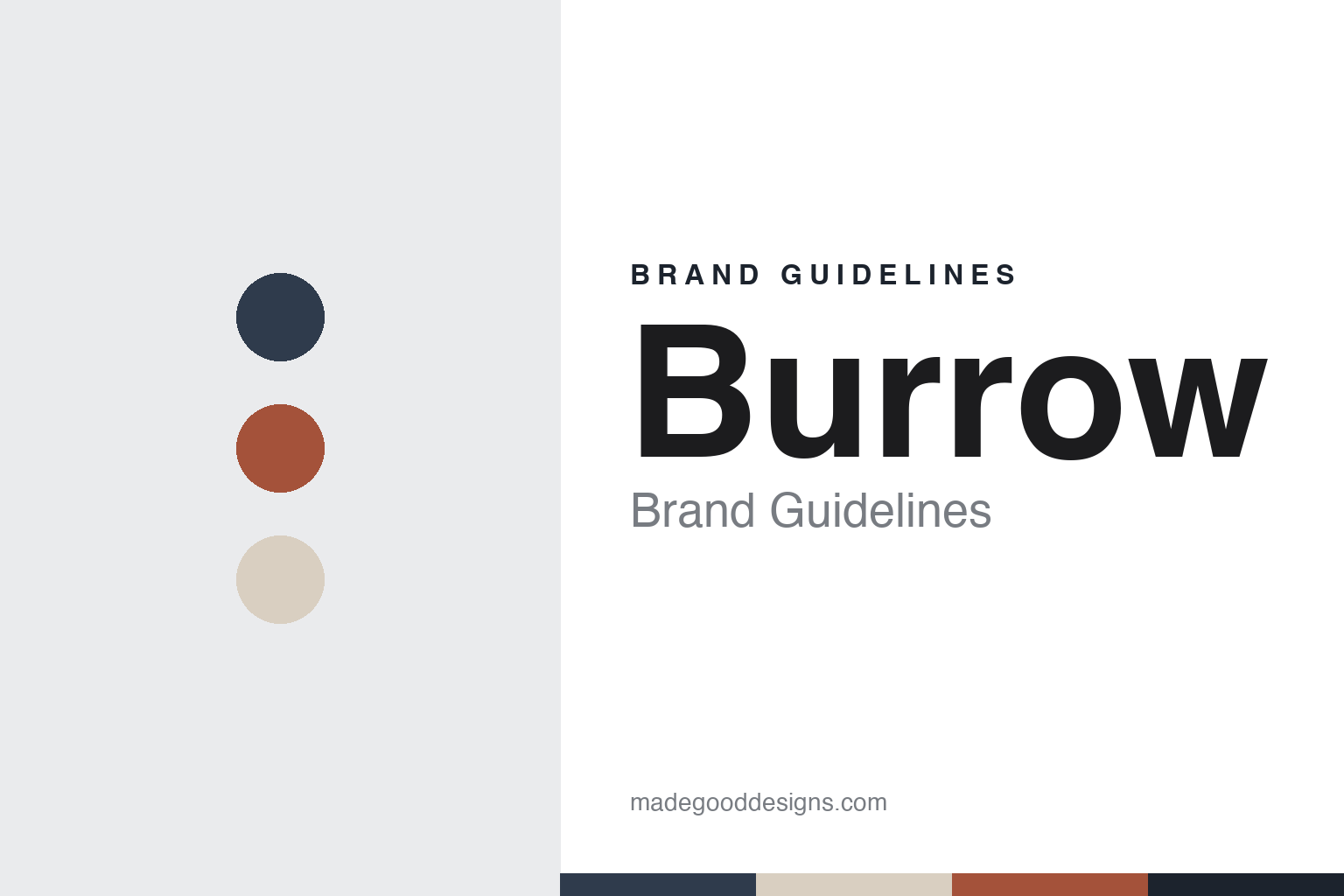
Two constants: a Burrow navy, oatmeal and brick palette and a Boxed serif register. Abstract homage — not a Burrow product or mark; no sofa, logo or box is reproduced.
A sofa that fits in a box
Two business-school founders and a modular couch.
Burrow is a New York furniture company built around one idea: a sofa that arrives in boxes small enough for a parcel carrier and goes together without tools. Its founders are Stephen Kuhl and Kabeer Chopra. Y Combinator, in a profile of the company published on its blog in August 2016, described them as two New Yorkers who started Burrow while at business school, after struggling to buy a sofa for their own apartment. A September 2017 report syndicated from Fast Company added that the pair met in an entrepreneurship class at the Wharton School, that Kuhl had been a consultant at Accenture and that Chopra had been an analytics manager at Michael Kors.
According to the New York property and design site 6sqft, writing in April 2017, the two came up with the idea in the autumn of 2015. Within about a year they had gone through Y Combinator, the Silicon Valley start-up accelerator, and taken pre-orders during a beta launch. Burrow itself dates its launch in the United States to 2017; Kuhl told Retail Insider in October 2022 that the company’s decisions since that launch had been driven by customer feedback, and Retail Dive also gave 2017 as the launch year when it reported on the company in 2024.
The 2016 Y Combinator profile set out the product in plain terms. The sofa was modular, so an owner could add a middle section to make a three-seater or take it out for a smaller room. The pieces travelled in compact boxes by ordinary parcel service rather than freight, and the frame hid a power outlet. The founders said they had hired industrial designers, furniture designers and a mechanical engineer to develop it. A United States patent titled “Modular sofa construction and methods for assembly”, assigned to Burrow, Inc., lists Kuhl and Chopra among its inventors.
Colour
From Mexico City to Mississippi, then to Havenly.
Where the sofas were made changed early. In the August 2016 Y Combinator profile the founders said that American furniture makers they approached had wanted to sell existing designs rather than retool for a modular sofa, and that Chinese suppliers would have meant shipping times of around six weeks. They settled on what they described as “a well-established manufacturer in Mexico City.” By the end of 2017, TechCrunch reported in March 2018, Burrow’s manufacturing had just moved from Mexico City to Mississippi, and the company marketed its sofas as made in America from that point. The same TechCrunch report said that New Enterprise Associates partner Tony Florence had joined Burrow’s board, and that Kuhl wanted Burrow to become “an entire home lifestyle brand.”
The range did widen. TechCrunch noted in 2018 that an ottoman, a chaise sectional and an option for wooden legs had joined the original one- to four-seat sofas. By October 2022, Retail Insider listed modular sofas, easy-to-assemble wall shelves, coffee tables and credenzas, and reported that Burrow, then headquartered in New York City, had begun selling to Canadian customers through a dedicated website, shipping from a warehouse in the Greater Toronto Area. At that date it had stores in New York, Boston, Atlanta and Los Angeles.
In October 2024 Burrow changed hands. Retail Dive reported on 16 October 2024 that Havenly Brands, the company that began as an online interior-design service and renamed itself from Havenly Inc. to reflect a group of brands, had acquired Burrow; the terms were not disclosed. Havenly’s other brands at the time included The Citizenry, St. Frank, The Inside and Interior Define. Havenly Brands has owned Burrow since 2024. Retail Dive reported that most of the Burrow team would move into Havenly, that Burrow’s leadership would stay for a transition period, and that its stores in New York, Chicago, Los Angeles and Boston would remain open. Kuhl, then chief executive, was to work on the product roadmap and marketing, and Chopra, then chief technology officer, on moving Burrow’s e-commerce platform onto Havenly’s systems.
Typography
Design and documentation.
The brands in this group all sell furniture direct to the people who buy it, mainly through their own websites, rather than leaving the sale to a department store or a showroom chain. Direct-to-consumer furniture brands in general sit at many different points in the trade: some design in one city and build in workshops far away, some ship sofas flat in boxes, some build each piece to order, and some later open stores of their own or change hands.
A furniture brand of this kind usually carries its identity less through a single product than through its website, its photography, its packaging and the way it explains how a piece is made and delivered. The company behind the name may have changed owners, moved its production or grown well beyond the place where it began, so the plain questions behind each name are worth asking: who started it, who owns it now, and where its furniture is actually made.
Each guide separates what independent sources record from what the company says about itself — its founding story, its owners over time, where its pieces are made and how its identity has changed — and marks plainly what rests only on the company’s own word.
Aa
A boxed serif for a flat-pack sofa brand. (Specimen set in DM Serif Display, a serif STAND-IN; NOT the Burrow logo.)
Burrow
Boxes, modules and colourways.
Much of Burrow’s identity is carried by the delivery itself. 6sqft described the 2017 launch sofa in detail: it shipped in two to five boxes depending on size and was put together with alignment pins, latches and levers. Buyers could choose between high and low arms, and the double-sided cushions had a smooth face and a tufted face. The upholstery came in five colours, which 6sqft listed as crushed gravel, charcoal, beige, navy blue and brick red, and an optional charging station added USB ports and power outlets to the frame. The site noted that Burrow had borrowed the flat-pack idea from IKEA and its delivery and return policies from direct-to-consumer mattress companies; Kuhl told the site that those mattress companies had “done a lot of the legwork” in educating customers.
TechCrunch reported in 2018 that assembly was meant to take around ten minutes with no tools. In 2022 Chopra described Burrow to Retail Insider as an American furniture brand that values function and form in equal measure. Beyond the website, the brand has been shown in its own stores, which by 2024 were in New York, Chicago, Los Angeles and Boston.
For a design guide, Burrow shows how a furniture start-up can make the box, the click-together joint and a short list of named colourways part of the brand. Compare Interior Define, its sister brand under Havenly, and West Elm, the Brooklyn-born furniture chain. For this guide we use a navy, an oatmeal and a brick with a serif, an unofficial interpretation; no product or logo is reproduced.
Explore & save
Keep Burrow’s identity on hand — save it to a board in the Made Good inspiration library.
Burrow identity set
Pin the Burrow navy, oatmeal and brick palette and the Boxed serif register to your own board.