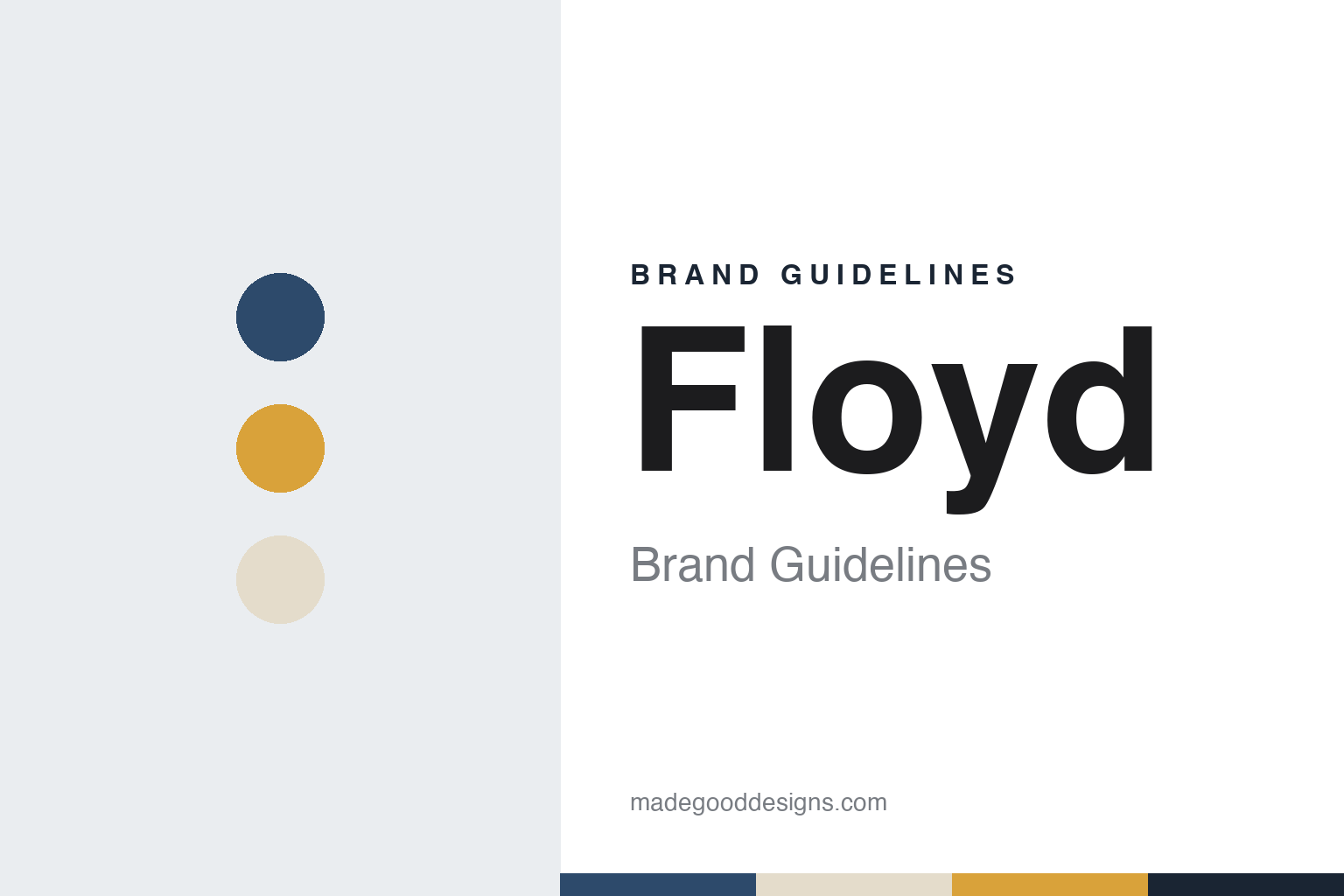
Floyd Brand Guidelines
The Floyd Leg, Detroit and a flat-pack home.
Aa
Two constants: a Floyd blue, birch and mustard palette and a Steel sans register. Abstract homage — not a Floyd product or mark; no leg, sofa or logo is reproduced.
One leg in Detroit
A clamp-on table leg and a Kickstarter.
Floyd began with a table leg. In February 2014 the University of Michigan’s Taubman College of Architecture and Urban Planning reported that one of its graduates, Kyle Hoff, who had completed a Master of Architecture there in 2013, had designed “a modular steel table leg that can be clamped onto any flat surface to form a table,” and was raising money on Kickstarter to put it into production with his business partner, Alex O’Dell. Hoff told the college that the idea came from moving between cities for work and study and repeatedly buying and throwing away furniture; he had wanted a work desk that was easy to pack up and move. The college reported that the two were based in Detroit and worked with local machine shops to make the legs.
The local news site Daily Detroit, profiling the company in November 2015, said Hoff came from Youngstown, Ohio, and O’Dell from Frankenmuth, Michigan, and that the two met in 2013 while working on the build-out of a Detroit co-working space, Practice Space. O’Dell, it said, first saw a prototype of the leg holding up a door that Hoff was using as a desk. The campaign ran in early 2014 and, in the paper’s words, “the Floyd Leg was born.” Sources differ on the founding year: Business of Home wrote in January 2025 that Floyd started in 2013 as a project between the two entrepreneurs, while Metropolis in 2018 and Design Milk in 2020 gave 2014.
Floyd’s own oral history of the product, published on its website, adds detail in the founders’ words. Hoff says he sketched the leg in about January 2013 in a Chicago apartment, and that the team considered the names “Bracket” and “Toto” before choosing Floyd, after his father, grandfather and great-grandfather, all named Floyd, who the company says worked in steel mills in Youngstown. The company also notes that the leg is shaped like an F when seen from the side.
Colour
From the leg to the sofa, and to Rize Home.
The leg became the start of a range. By November 2015, Daily Detroit listed a shelving system, the Floyd Utility Set, which lets buyers make a dining table or desk from a surface of their choice, and a new Floyd Bed Frame, then being launched through a second Kickstarter campaign. The company’s oral history explains how one led to another: the original leg had been sized as a desk leg, customers began using it for dining tables, and the resulting wobble was solved with ratchet straps used as cross-bracing in the Utility Set. Work on that tension system, the company says, led on to the bed. At the time the company had offices at Ponyride in Detroit, and Hoff told the paper that Detroit had “always been a part of our DNA.”
In 2018 Floyd moved into upholstery. Metropolis reported in August 2018 that the company had spent two years on an in-house design process for a sofa, beginning with a customer survey about how people used their sofas. The frame used the same powder-coated steel and birch plywood as Floyd’s other furniture, and the sofa came as a two-seater, three-seater or sectional. Hoff, then chief executive, described the aim as “a sofa that is beautiful, comfortable, and can move and grow with people over time.” By March 2020, Design Milk reported, Floyd had moved into a larger headquarters in Detroit’s Eastern Market district, with an R&D lab open to staff and customers, and its range included a dining table, platform bed, sofa, shelving and a bookshelf.
In January 2025 Floyd was sold. Business of Home reported on 10 January 2025 that the buyer was Rize Home, a Cleveland company that manufactures and imports beds and bedding and was founded as the Mantua Manufacturing Company. Under the deal Rize Home was to take over sourcing and back-end logistics, leaving Hoff and O’Dell to concentrate on product development, marketing and brand-building, and Floyd’s core team was to stay in Detroit. Rize Home has owned Floyd since 2025.
Typography
Design and documentation.
The brands in this group all sell furniture direct to the people who buy it, mainly through their own websites, rather than leaving the sale to a department store or a showroom chain. Direct-to-consumer furniture brands in general sit at many different points in the trade: some design in one city and build in workshops far away, some ship sofas flat in boxes, some build each piece to order, and some later open stores of their own or change hands.
A furniture brand of this kind usually carries its identity less through a single product than through its website, its photography, its packaging and the way it explains how a piece is made and delivered. The company behind the name may have changed owners, moved its production or grown well beyond the place where it began, so the plain questions behind each name are worth asking: who started it, who owns it now, and where its furniture is actually made.
Each guide separates what independent sources record from what the company says about itself — its founding story, its owners over time, where its pieces are made and how its identity has changed — and marks plainly what rests only on the company’s own word.
Aa
A sturdy sans for a steel-and-plywood brand. (Specimen set in Archivo, a sans-serif STAND-IN; NOT the Floyd logo.)
Floyd
Steel, birch and a Detroit story.
Floyd’s visual identity rests on materials more than on ornament. Its furniture pairs powder-coated steel with birch plywood, which Metropolis noted could be left bare on the 2018 sofa or upholstered in light blue, dark blue, mustard yellow or light grey. The company’s oral history recalls that the very first prototype legs, made by a manufacturer in Columbus, Ohio, came powder-coated in the only colour available, an industrial blue of the kind used on high-school lockers, and that early advice was to keep the range simple: two colours and two sizes. The same account says production legs were later painted and packed at a facility in Detroit.
The Detroit story runs through the brand. Hoff told Daily Detroit in 2015 that Floyd designed “within the processes of what manufacturers are already doing” by visiting their facilities, and Design Milk reported in 2020 that the team worked closely with its manufacturers using SolidWorks. The company described its aim to Design Milk as furniture “designed for the home and not to end up in a landfill in a couple of years,” and Hoff summed it up for Daily Detroit as “designing products that fit how people are truly living.” Its own oral history opens with the line “Floyd began with one leg.”
For a design guide, Floyd shows how a single, clearly drawn component can become a brand: a clamp-on leg named after a family of steelworkers, a city of manufacturers behind it, and a palette that comes from steel and plywood. Compare Burrow, the New York modular-sofa brand, and IKEA, the Swedish flat-pack furniture retailer. For this guide we use a blue, a birch and a mustard with a sans-serif, an unofficial interpretation; no product or logo is reproduced.
Explore & save
Keep Floyd’s identity on hand — save it to a board in the Made Good inspiration library.
Floyd identity set
Pin the Floyd blue, birch and mustard palette and the Steel sans register to your own board.