Penn Brand Guidelines
The Jeannette tennis-ball name, now part of Head.
Aa
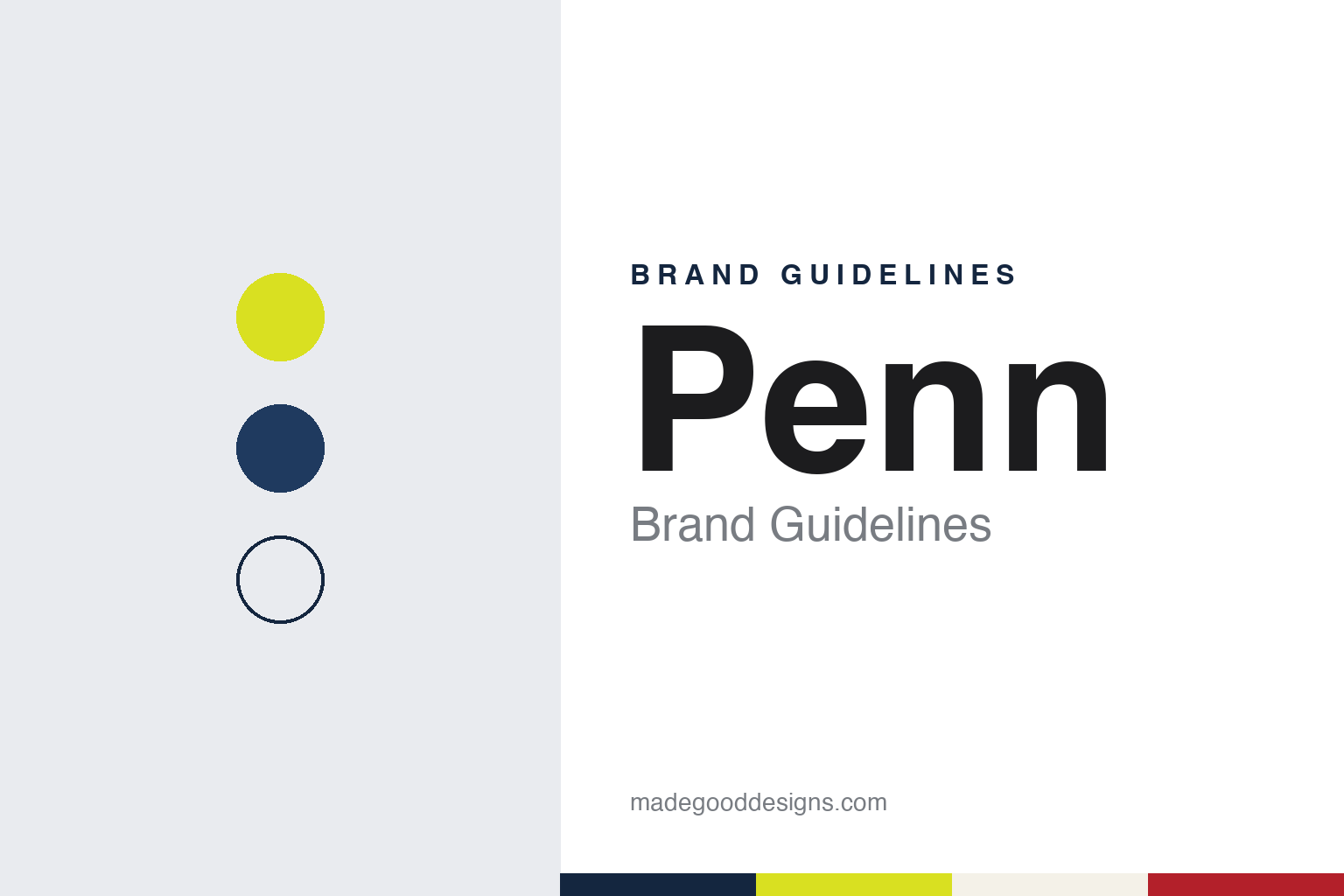
Two constants: a Penn navy, yellow and red palette and a condensed sans register. Abstract homage — not a Penn product or mark; no ball, can or logo is reproduced.
Pennsylvania Rubber
A rubber company in Jeannette and a short name.
Penn, in this guide, is the tennis- and racquetball-ball brand. Its name comes from the business that started it: the Pennsylvania Rubber Company of America, which English Wikipedia says was founded in 1910 in Jeannette, Pennsylvania, a town in Westmoreland County in the west of the state. The same article, citing the company’s own history, says Penn began making tennis balls in Jeannette in that year, and it gives the trading company today as Penn Racquet Sports, Inc., a subsidiary of Head N.V. Its infobox lists the company’s website as pennracquet.com and its products as sports equipment, accessories and sportswear. The article describes the business as a maker of tennis balls and racquetballs.
Wikipedia’s own photographs of the brand show a Penn Championship ball and a pair of balls printed with a Penn 3 mark, one new and one used.
Wikipedia, citing the company’s own timeline, says Penn introduced balls rated for different court surfaces and for play at high altitude in 1970; the company calls them “play-rated” balls. Wikipedia, again citing the company’s timeline, says Penn was named the official ball of the United States Professional Tennis Association in 1973, and lists the brand among the ball suppliers to the International Racquetball Tour and the United States Racquetball Association.
Penn has also been tied to tennis and racquetball organisations. Wikipedia, again citing the company, says Penn was chosen as the official ball of the United States Professional Tennis Association in 1973, and that Penn racquetballs are the official balls of the International Racquetball Tour and the U.S. Racquetball Association.
Colour
From GenCorp to Head.
Before Head, Penn belonged to a much broader manufacturer. On 17 May 1999 the trade newsletter Sporting Goods Intelligence reported that HTM had acquired Penn from GenCorp, which it described as a diversified manufacturer based in Fairlawn, Ohio, and which it said had been trying to sell the tennis-ball maker since the previous December. Wikipedia gives 1999 as the year Penn was acquired by Head N.V.
The acquisition placed Penn inside a group built around other sports. In January 2009 FashionUnited described Head N.V. as organised into four divisions — winter sports, racquet sports, diving and licensing — and listed its brands as Head, for racquets, skis, boots and other equipment; Penn, for tennis and racquetball balls; Tyrolia, for ski bindings; and Mares, for diving equipment. The same report placed the group’s headquarters in Austria. Penn therefore sits next to a racquet brand under the same owner, and the group sells tennis balls under both the Head and the Penn names.
Penn’s base in the United States moved west over time. Wikipedia gives the company’s headquarters today as Phoenix, Arizona, and Phoenix was where the group made its tennis balls in the 2000s. The FashionUnited report of January 2009 said Head’s tennis-ball factory in Phoenix would close on 5 March 2009. It said Head had begun making tennis balls at a new factory in China in January 2007, had been increasing production there since, and had decided to shut its US facility and make its worldwide volume in China.
That arrangement was still in place more than a decade later. In August 2021, in a report on a shortage of tennis balls in American shops — its reporter, Aaron Gordon, began with a trip to buy balls at two Target stores near him — Vice wrote that Head, which owns Penn, makes its tennis balls in China, and that Penn closed its Arizona factory in 2009. The same report quoted a customer-service representative for Head Penn Racquet Sports, who said the shortage was due to port delays.
Typography
Balls, cans and sticks.
A ball or stick brand is read at very close range and in motion, so its identity has to work at small sizes and on curved or narrow surfaces. On a ball, the name is usually printed or stamped onto the cover, often with a model name and a number that lets players tell one ball from another; on felt, leather or synthetic panels the mark has to survive wear, mud and repeated impact.
Packaging carries much of the rest. Balls sold in sets often come in pressurised cans or in tubes and boxes, and the label on that container — its colour, the name and the lettering — is often what a buyer sees first in a shop, long before the ball itself is handled.
Stick and racket equipment adds another surface. Heads, shafts and handles carry logos, model names and sometimes moulded lettering, and those marks are shaped to fit narrow frames and plastic parts.
Each guide that follows sets out what can be checked about a brand — who founded it, who owns it now and how its marks have appeared — and marks plainly what rests only on the company’s own word.
Aa
A condensed sans for a short name on a curved surface. (Specimen set in Oswald, a condensed sans STAND-IN; NOT the Penn logo.)
Penn
A short name printed on a moving ball.
For a ball brand, the name has to work on two very different surfaces. One is the ball itself: felt that is struck, scuffed and bounced, where the print must stay legible as the cover wears, and where a model name and a number sit beside the brand name. The other is the container, the can or tube that a buyer sees on the shelf and that carries the brand’s colours, its name and the description of the ball inside.
Penn’s ownership and its factories have changed more often than its name. The brand began with a rubber company in Jeannette, passed through GenCorp, was bought by Head in 1999, and has had its balls made in China since the Phoenix factory closed in 2009, according to FashionUnited and Vice. Through each of those changes the name on the ball stayed the same: the four letters of Penn.
Penn also lives beside its owner’s own name. Head sells racquets and tennis balls under the Head brand, according to FashionUnited, and keeps Penn as a separate name for tennis and racquetball balls; the customer-service line quoted by Vice in 2021 spoke for “Head Penn Racquet Sports.”
For a design guide, Penn shows how a short place-derived name can carry a brand through changes of owner and factory. Compare Wilson, another American name on tennis balls and racquets, which Vice reported in 2021 makes its tennis balls in Thailand rather than China, and Dunlop, a rubber name that became a racket brand. For this guide we use navy, an optic yellow and a red with a condensed sans, an unofficial interpretation; no product or logo is reproduced.
Explore & save
Keep Penn’s identity on hand — save it to a board in the Made Good inspiration library.
Penn identity set
Pin the Penn navy, yellow and red palette and the condensed sans register to your own board.