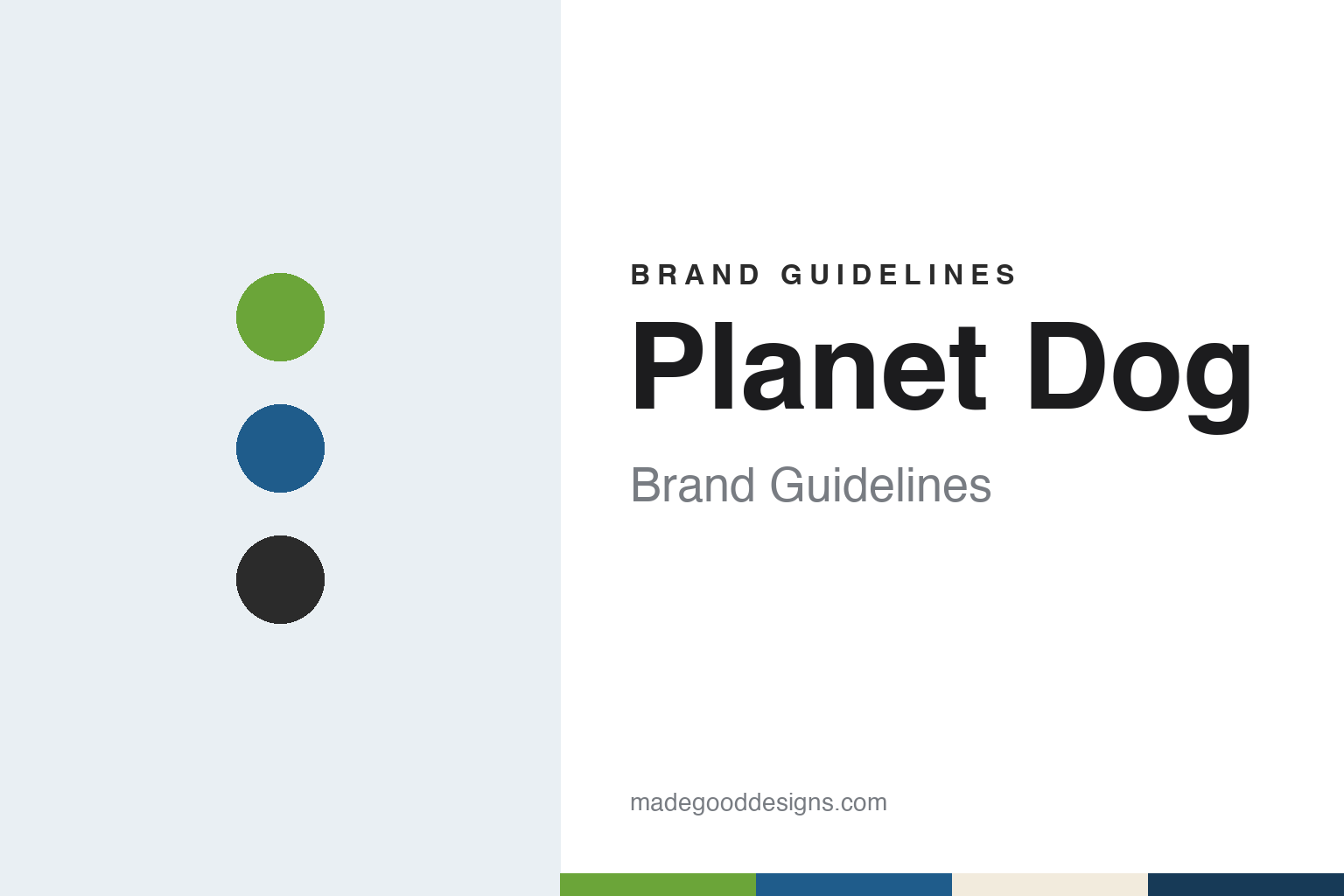
Planet Dog Brand Guidelines
The Maine toy maker behind the Orbee-Tuff ball.
Aa
Two constants: an Orbee green, ocean blue and deep navy palette and a rounded friendly sans register. Abstract homage — not a Planet Dog product or mark; no toy, pack or logo is reproduced.
A design house for dogs
A Portland, Maine company built around a ball and a mission.
Planet Dog is an American dog toy and accessory brand that grew up in Portland, Maine. Its own website, in a version captured by the Internet Archive on 1 January 2011, said the company had been operating “since incorporating in 1997” and described it as a socially responsible, values-based design house bringing people and dogs together. The same page gave a Portland, Maine address and set out a mission “to amuse, explore, support, innovate, create, educate, celebrate and philanthropate… all in the name of the dog.”
The founder is Alex Fisher. When the trade site Pet Insight reported the sale of the business in October 2018, it named Fisher as Planet Dog’s founder and chief creative officer and dated the company to 1997. The 2011 site said its aim was to develop products “made for dogs, by dog lovers,” and it called its internal mantra “think globally, act doggedly.” The site’s navigation listed Toys for Old Souls alongside Woodchuck, Slobber-Wick and Orbee-Tuff, and grouped other products under headings such as eco-friendly and Made in the U.S.A. The rest of the 2011 catalogue went well beyond toys: the site offered travel supplies, collars and leads, grooming supplies, treats and training products, items for the home, gifts for dog lovers and its own branded apparel, with toy sections split between adult dogs and puppies.
The 2011 about page called the Planet Dog Foundation the company’s flagship initiative and linked it from the main navigation, next to the mission statement, an adoption campaign and an adoption licence-plate initiative. The company said it “romps the romp” by providing financial resources to those in need, educating consumers about canine issues and creating recyclable products. The page also pointed visitors to a corporate timeline of milestones since 1997, and to a segment about the company that it said had been produced for CNN’s On the Rise with Aaron Brown.
Colour
One material, a recycled range, and a clear line on where things were made.
The product that came to define the name is the Orbee-Tuff ball. The Santa Barbara Independent, in a round-up of American-made goods published on 27 July 2012, described Orbee-Tuff as a patented thermoplastic elastomer and reported that the Orbee-Tuff Orbee Ball was manufactured in the company’s factories in Massachusetts and New York. The paper also reported that leftover material from that production went into a range called RecycleBALLs. On the company’s own 2011 website, Orbee-Tuff and the recycled toys each had a heading of their own in the shop navigation, so the material’s name appeared as a shopping category in its own right, next to the toy sections for adult dogs and puppies.
The same article drew a clear line through the catalogue. It said the Orbee-Tuff products, the treats, an all-natural grooming line and a product called the Shammy were made in the United States, and that only the company’s hemp products were sourced and produced in China. It also reported that a share of every purchase went to the Planet Dog Foundation, which supported canine service programmes, including the training, placement and support of dogs that help people in need.
When Outward Hound bought the brand, its chief woof officer, Kyle Hansen, praised Planet Dog’s Made in USA products, according to Pet Insight.
Typography
Design and documentation.
The seven brands in this group are all dog toy and accessory names: Planet Dog, Petstages, ZippyPaws, Petmate, Multipet, Coastal Pet and Lupine. Toy and accessory brands for dogs sit at many different points in the pet trade, from small workshops that still carry a founder’s story to names that now belong to larger pet-products groups, and a single brand can be sold everywhere from an independent pet shop to a national chain.
A pet brand’s identity is usually carried less by one toy or collar than by a name, a mascot and the promise printed on its packaging, because the company behind the name may have changed hands, moved its production or grown far beyond the town where it started. That makes the questions behind each name worth asking plainly: who started it, who owns it now, and where its toys, collars and leads are actually made.
Each guide separates what independent sources record from what the company says about itself — its founding story, its owners over time, where its products are made and how its packaging and marks have changed — and marks plainly what rests only on the company’s own word.
Aa
A rounded sans for a brand that wrote its own playful copy. (Specimen set in Nunito, a sans-serif STAND-IN; NOT the Planet Dog logo.)
Planet Dog
From an independent Maine brand to part of a Colorado group.
Ownership changed on 16 October 2018. Pet Insight reported that day that Outward Hound, the dog toy and gear company of Centennial, Colorado, had acquired Planet Dog. The report noted that Outward Hound had itself been acquired by the private equity firm J.W. Childs Associates in December 2017, and that Planet Dog was its third acquisition under that owner. The brand’s ranges were listed as the Orbee Ball, Orbee durable toys, plush toys and travel products. The same report placed Planet Dog in a run of purchases that year: Outward Hound had added the treat maker Wholesome Pride in July and the toy maker Charming Pet in August, and quoted Hansen under his title of chief woof officer.
Fisher was quoted on the handover. “We are excited to transition the Planet Dog brand and our socially responsible mission to the Outward Hound team,” he said, according to Pet Insight, which described that mission as focused on “community, environment and people.” Outward Hound has owned Planet Dog since 2018, and the name has stayed in use as a brand within the group. When Outward Hound announced on 9 July 2026, in a release distributed by PR Newswire, that funds affiliated with H.I.G. Capital had taken majority ownership of the company, Planet Dog was one of the seven brands it listed, alongside Outward Hound, Best Friends by Sheri, Catstages, Wholesome Pride Pet Treats, Nina Ottosson and Pupstages.
For a design guide, Planet Dog shows how a small Maine company could build a recognisable brand from one toy material, a playful tone of voice and a charitable arm placed at the centre of its website. Compare West Paw, the Montana dog-toy maker, and Outward Hound, the group that now owns the brand. For this guide we use Orbee green, ocean blue and deep navy with a rounded sans, an unofficial interpretation; no product or logo is reproduced.
Explore & save
Keep Planet Dog’s identity on hand — save it to a board in the Made Good inspiration library.
Planet Dog identity set
Pin the Planet Dog Orbee green, ocean blue and deep navy palette and the rounded friendly sans register to your own board.