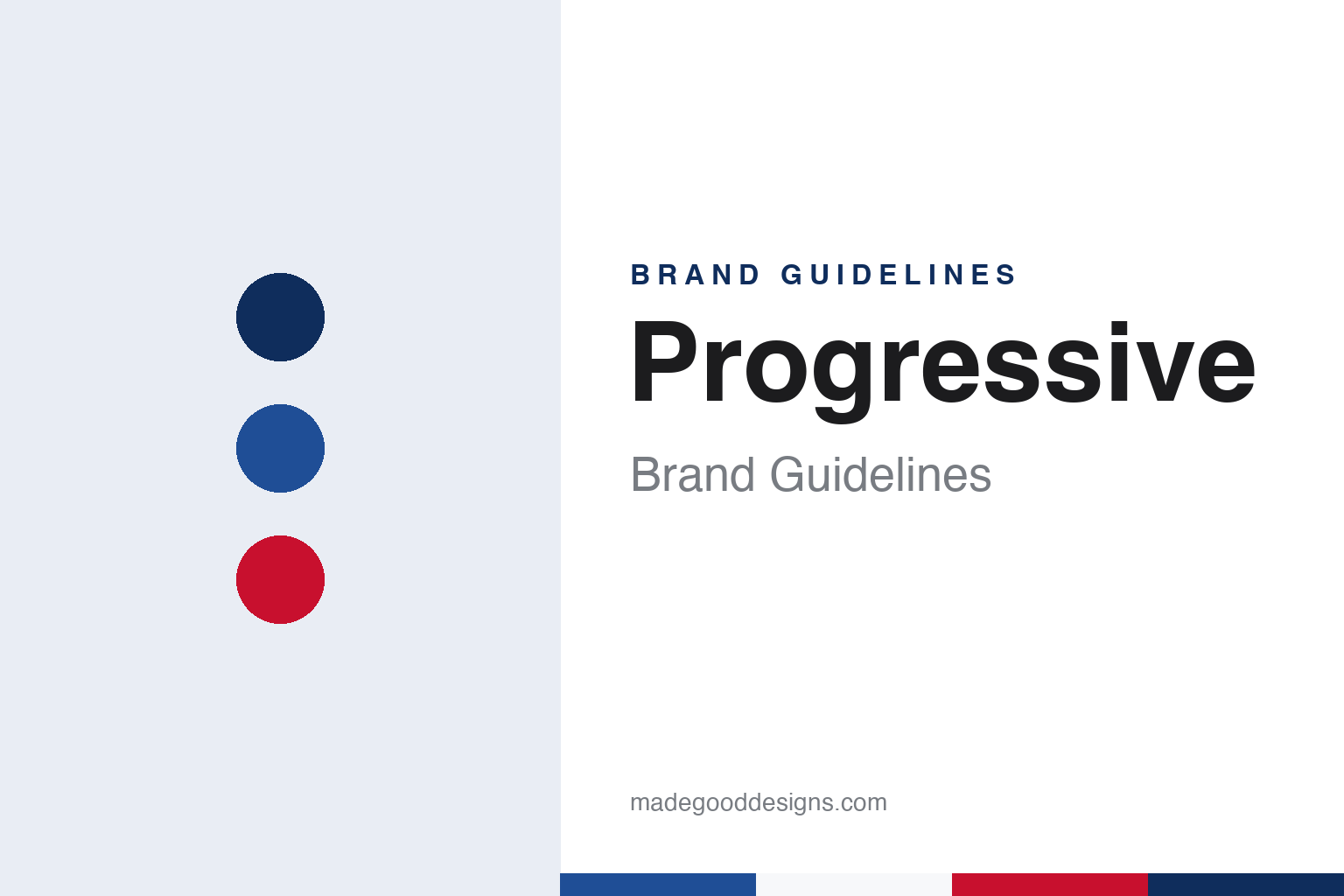
Progressive Brand Guidelines
The Cleveland car insurer of two attorneys and a cashier called Flo.
Aa
Two constants: a counter blue, lipstick red and apron white palette and a clean retail sans register. Abstract homage — not a Progressive product or mark; no character, logo or advertisement is reproduced.
Progressive Mutual
Two Cleveland attorneys and a company that kept to cars.
Progressive began in Cleveland in 1937. The Encyclopedia of Cleveland History, published by Case Western Reserve University, says the company started when two attorneys, Joseph M. Lewis and J. H. Green, formed the Progressive Mutual Insurance Co. The word “Progressive” has stayed in the company’s name through each change of corporate form since.
The founders kept their focus narrow from the start. The encyclopedia says that although they were licensed to write all types of automobile and casualty insurance, Lewis and Green limited themselves to auto insurance. The encyclopedia records the company writing auto insurance in Cleveland by 1940, three years after its founding.
The business grew in Cleveland after the Second World War. The encyclopedia records that by 1951 Progressive had established offices on Euclid Avenue in Cleveland and branches in Akron and Youngstown. In 1956, it says, the company organised Progressive Casualty Insurance, which wrote what the encyclopedia calls non-standard, high-risk automobile insurance.
The next generation of the Lewis family joined in the 1950s. The encyclopedia says Joseph Lewis’s son, Peter B. Lewis, joined the firm in 1955 after graduating from Princeton University, and became chief executive officer in 1965, the year The Progressive Corporation was founded as a holding company. Peter B. Lewis continued as the dominant figure in the firm, the encyclopedia says, and he was also known in Cleveland as a patron of the arts and of Case Western Reserve University, where he funded a business-school building designed by Frank O. Gehry.
Colour
A holding company, a public listing and a move to Mayfield Village.
The modern company took shape in the 1960s and 1970s. The Encyclopedia of Cleveland History says the Progressive Corp. was incorporated on 8 February 1965, bringing Progressive Casualty Insurance together with related insurance companies under one holding company. By 1970, the encyclopedia says, Progressive Casualty was writing its non-standard auto insurance in Ohio and other states.
Progressive became a publicly held company in 1971, the encyclopedia says, and in the following year built a new corporate headquarters in Mayfield Village. Its shares began trading on the New York Stock Exchange in 1987. The Progressive Corporation has been publicly held since 1971.
The company’s vehicles became part of its visibility in the 1990s. The encyclopedia describes the Immediate Response claims service, under which claims adjusters were sent directly to the scene of traffic accidents, and says the company built up a fleet of vehicles for the service, equipped with laptop computers and internet access by the mid-1990s. It adds that the brightly marked vehicles increased the company’s visibility as well as speeding up claims.
Leadership passed outside the founding family at the turn of the century. The encyclopedia says that in 2000 Peter B. Lewis stepped down as chief executive but remained chairman of the board, and that he was replaced by Glenn M. Renwick, formerly head of operations at the company. Through these changes the Progressive name stayed in use, from the mutual of 1937 to the listed holding company.
Typography
Design and documentation.
The brands in this group sell insurance: cover for cars, homes, health, income and lives. An insurer has no product to put on a shelf, so its identity has to live almost entirely in signs, sounds and paperwork — the name on an agent’s office window, a character in a television spot, a few notes of music that close an advertisement, and the letterhead on a policy that may sit in a drawer for years.
Mascots and spokespeople do much of the work in this category. A recurring character or a familiar voice gives a brand something to show where there is nothing to hold, and a short sung line can carry a name further than any logo. Agent-office signage repeats the mark street by street, often in a fixed colour and a set lockup, while policy documents, cards and claim forms carry the same mark into the home.
Each guide separates what independent sources record from what the company says about itself — who started the brand, who owns it now, and how its logos, characters and advertising have changed — and marks plainly what rests only on the company’s own word.
Aa
A clean retail sans — the register of a name badge and a shop counter. (Specimen set in Work Sans, a sans-serif STAND-IN; NOT the Progressive logo.)
Progressive
Flo, a white uniform and an imaginary store.
Progressive’s identity in advertising is a person rather than an animal or an object. Wikipedia says Flo, a fictional, upbeat store employee of Progressive, debuted in 2008 in television advertisements and has since appeared on radio, in print and in web banners. She was created by copywriter John Park and art director Steve Reepmeyer at the Boston agency Arnold Worldwide, Wikipedia says, citing the agency’s own case study and the visual-effects studio that worked on the spots.
The character is played by actress and comedian Stephanie Courtney. In a profile published by People on 2 September 2009, Courtney is described as a main-stage cast member of the Groundlings theatre company in Los Angeles, and she explains how much of the character is built by hair and make-up: about an hour for the teased and sprayed hair and another hour for the make-up, she said. The same profile notes that she grew up in Stony Point, New York, acting in school plays, and had played a switchboard operator on the television series Mad Men; she told the magazine a single Progressive spot could take more than a day to film. People described Flo’s retro style and bright red lipstick, and Courtney said she realised the character had caught on when people began sending her pictures of themselves dressed as Flo for Halloween.
Wikipedia describes Flo as a cashier, recognisable by her upbeat personality, white uniform, make-up and retro hairstyle. The cast around her has grown. Wikipedia says Progressive introduced an Australian counterpart, Kitty, played by Holly Austin, in 2011; that Jim Cashman joined as Jamie, Flo’s sidekick, in 2014; and that Natalie Palamides joined as another employee, Mara, in 2020. In November 2014, Wikipedia says, citing Advertising Age, Progressive aired spots that introduced members of Flo’s family, all of them played by Courtney.
The character has also appeared outside advertising. Wikipedia says Flo was added as a downloadable character in the video game ModNation Racers in late 2010, with her own Progressive kart, citing announcements on the PlayStation Blog in October and November that year.
For a design guide, Progressive shows how a single recurring character, a uniform and an imaginary shop can give a car insurer a face. Compare GEICO, with its gecko and cavemen, and Allstate. For this guide we use counter blue, lipstick red and apron white with a clean sans, an unofficial interpretation; no product or logo is reproduced.
Explore & save
Keep Progressive’s identity on hand — save it to a board in the Made Good inspiration library.
Progressive identity set
Pin the Progressive counter blue, lipstick red and apron white palette and the clean retail sans register to your own board.