Psyop Brand Guidelines
A studio built to persuade.
Aa
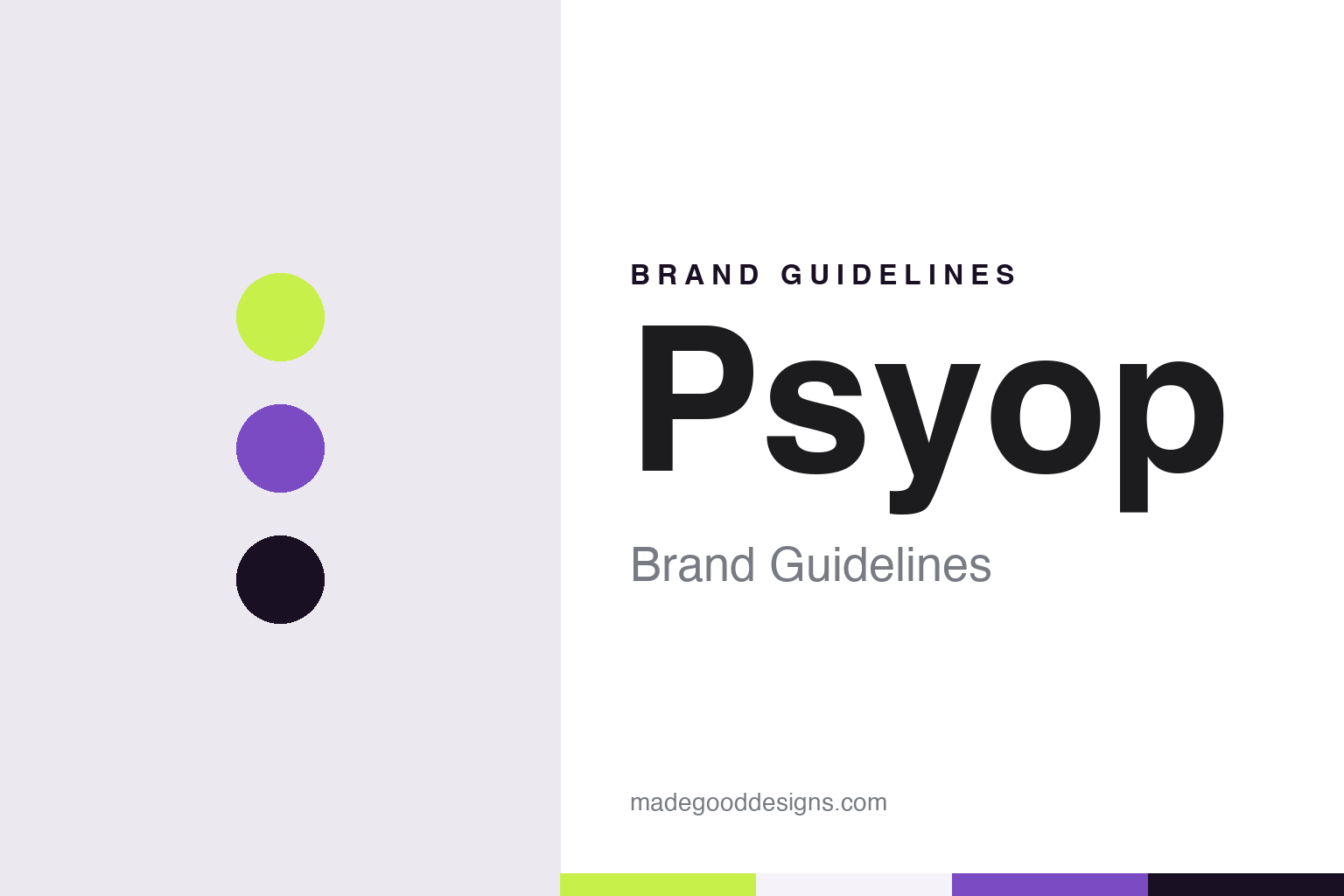
Two constants: an acid lime, ultraviolet and plum palette and an Expressive sans register. Abstract homage — not a Psyop asset or mark; no logo, icon or wordmark is reproduced.
Five founders in New York
Manhattan, 2000.
Psyop is a production studio that began in New York. Wikipedia says it was founded in 2000 in New York City by Marco Spier, Marie Hyon, Todd Mueller, Kylie Matulick and Eben Mears. The studio’s own profile, published by the Stuttgart animation network AMCRS in May 2022, says that in 2000 five creatives left MTV to start a new studio on the Lower East Side, and that it began in a bar with a Flame editing suite in the bathroom. Psyop says the aim was a place where art, story and technology would be pushed to the edge.
The founders have stayed visible in the studio’s public record. In an interview published by Motionographer on 25 July 2006, Kylie Matulick introduced herself as a creative director and co-founder of Psyop, and Todd Mueller described himself in the same terms. Motionographer reported on 15 April 2022 that the studio’s new German leadership team was being guided by co-founder Marco Spier. A Psyop announcement reproduced by the motion-design site Stash on 22 January 2025 quoted Marie Hyon as co-founder, welcoming two new managing directors.
The studio has always worked through directors as well as through the company name. In 2006, for example, Mueller and Matulick were credited as the pair directing a Coca-Cola commercial inside Psyop. The Stash release of January 2025 announced Jen Cadic as managing director for animation and Andrea Panda as managing director for live action and visual effects, and named the head of production and the VFX executive producer alongside them.
The name sets a tone of its own. Speaking to Motionographer in April 2022 about the new German studio, managing director Justin Stiebel said Psyop had always been known as more than a production company, as a team of artists who aim for the unexpected “in our mission to persuade”.
Colour
New York, Los Angeles and a studio in the cloud.
Psyop grew from one city into several. Wikipedia lists offices in New York City and Los Angeles, and the studio’s 2022 profile on AMCRS lists New York, Los Angeles, Stuttgart, Berlin and Mexico City. The same profile says Psyop opened an office in Stuttgart in 2021, when the longtime creative director and VFX supervisor Matthias Bäuerle moved back from New York.
The larger German launch followed in spring 2022. On 15 April 2022, Motionographer said the studio would set up its headquarters in Berlin, with smaller hubs across the country, under a leadership team of Justin Stiebel, Matthias Bauerle, Stefan Susemihl, Hans-Christoph Schultheiss and Jan Tiller. Spier was quoted saying the studio wanted a regionalised home for directors, creators and artists working under a collective approach that puts design and creativity first. Tiller said the operation was fully cloud based, so teams could work where they chose. The report added that Psyop would keep its existing representation relationships with RiffRaff in the UK and WIZZ in France.
That cloud set-up is now part of how the studio describes itself. Its AMCRS profile says Psyop’s cloud-based pipeline connects teams across the world, giving artists freedom to create and collaborate from anywhere.
Psyop has also used its name on projects of its own. Wikipedia says the studio opened Psyop Games, a video game publishing division, in 2013; released the animated series Grandma’s Cats Are Trying To Kill Her with DreamWorks Animation in 2015; launched a virtual-reality fortune-telling machine called Kismet in 2016; and made the short film Lost & Crowned with the game company Supercell, released on 12 September 2020. Wikipedia also says that a dating-sim spin-off called Hooked on You: A Dead by Daylight Dating Sim, made with Behaviour Interactive, was announced on 17 May 2022.
Typography
Idents, characters and the reel.
For an animation or motion-design studio, the identity rarely stops at a static logo. The mark usually has to move, and the opening ident that plays before a film, a commercial reel or a festival screening is often the first place an audience meets the name. A few seconds of motion has to carry the studio’s character: the pace of the cut, the way a letterform assembles or dissolves, the sound that lands with the final frame.
Characters can also become part of the brand. A recurring figure, a mascot or a shape that first appeared in a piece of work may migrate into the logo, the website header or the end card, so that the studio is recognised by something it made rather than by its wordmark alone.
The reel and the website are the other main brand surfaces. A showreel is edited like a manifesto, and a studio site is usually built around full-bleed moving image, with typography and colour kept quiet so the work sits in front. When reading these identities, look at how the logo behaves in motion, how the studio frames its own reel, and how consistently that system carries across offices, credits and social channels.
Aa
An expressive sans — after a short, punchy studio name. (Specimen set in Syne, a sans STAND-IN; NOT the Psyop logo or any Psyop typeface.)
Psyop
The Happiness Factory, 2006.
In 2006 Psyop made Happiness Factory, a commercial for Coca-Cola. Campaign Asia reported on 12 July 2006 that the spot was produced by Psyop under the directors Todd Mueller and Kylie Matulick. Motionographer described it later that month as Psyop’s work for Coke and the agency Wieden+Kennedy.
The directors described how the job came about in their Motionographer interview of 25 July 2006. Matulick said Psyop was already producing earlier Coke bottle spots for Wieden+Kennedy when the agency brought the studio a script about a bottle travelling through a vending-machine factory, being filled, capped and given “a huge amount of love”. Mueller said they had a weekend to pitch, and Matulick said that three days later they were on a plane to Amsterdam. Mueller said the competition was mostly live-action directors.
The studio changed the brief’s factory into something closer to a landscape. Matulick said the first idea was a natural, epic fantasy-scape with factory pieces hidden inside it, and Mueller described an ancient machine so sacred that geological formations had grown around it. Mueller said the team found the phrase “happiness factory” slightly contradictory, since factories are not usually happy, and so made the world “ridiculously happy” as its creative mantra. Matulick said Psyop worked closely with the Wieden+Kennedy creatives Rick Condos and Hunter Hindman, spending about two weeks on concepts before production.
For a design guide, Psyop shows how a studio can keep a short name while its founders, directors and offices change around it. Compare Coca-Cola, the client behind Happiness Factory, and The Mill, another production studio in this collection. For this guide we use acid lime, ultraviolet and plum with an expressive sans, an unofficial interpretation; no product or logo is reproduced.
Explore & save
Keep Psyop’s identity on hand — save it to a board in the Made Good inspiration library.
Psyop identity set
Pin the Psyop acid lime, ultraviolet and plum palette and the Expressive sans register to your own board.