PXG Brand Guidelines
Bob Parsons’ Scottsdale club maker, numbered in Marine Corps codes.
Aa
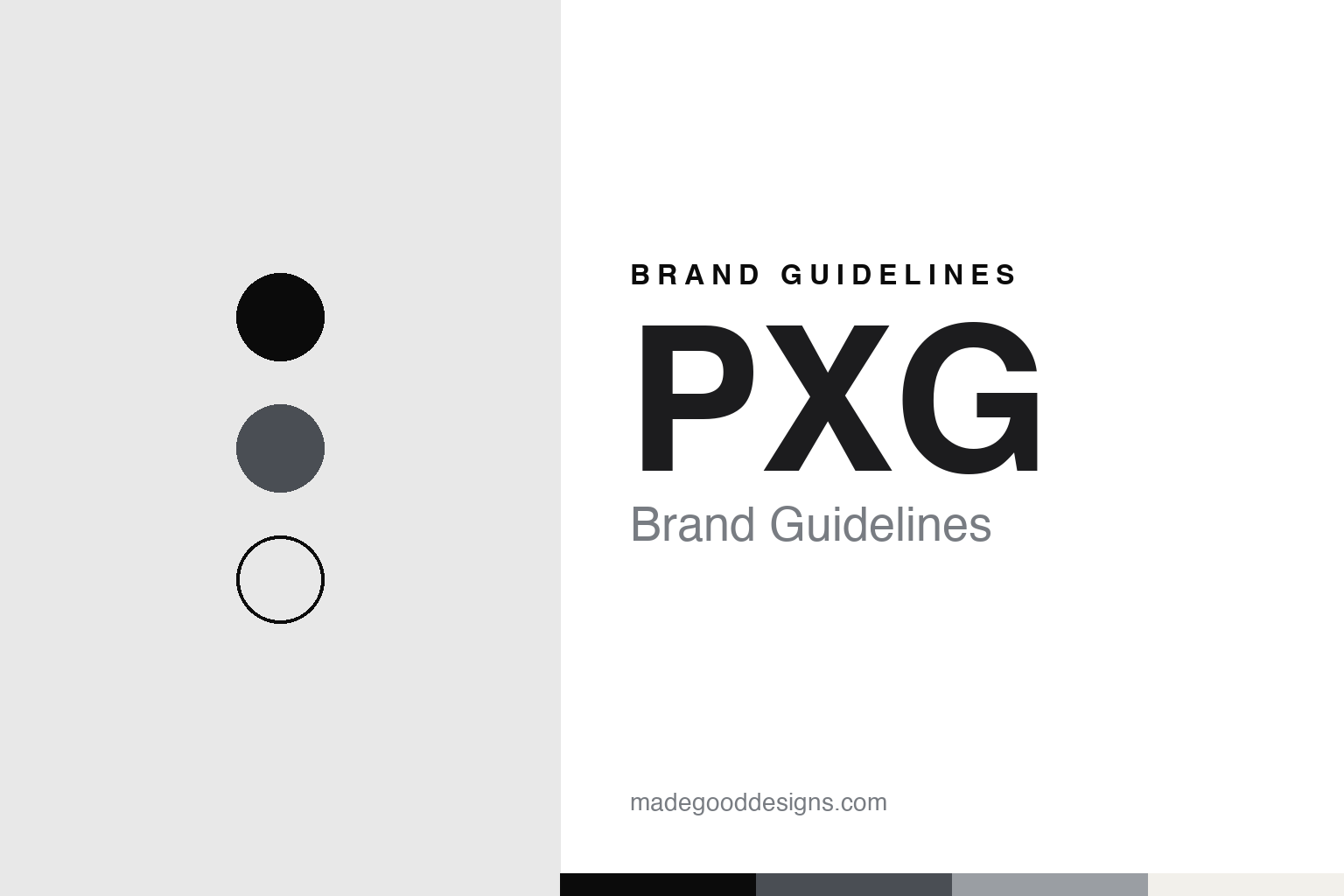
Two constants: a black, gunmetal and bone palette and a condensed sans register. Abstract homage — not a PXG product or mark; no club, logo or badge is reproduced.
Parsons Xtreme Golf
A GoDaddy founder, a former Tour pro and two Ping engineers.
PXG — Parsons Xtreme Golf — is the golf-club company of Bob Parsons, the founder of the web-hosting company GoDaddy. The company’s own biography of him says he founded PXG in 2013 “with the sole intent to design and develop the world’s finest golf clubs”; English Wikipedia’s article on the company gives 2014, and its article on Parsons dates the public launch to January 2015. The company is based in Scottsdale, Arizona, and its own website says it serves golfers in nearly 50 countries.
Parsons is a US Marine Corps veteran of the Vietnam War; PXG’s biography lists the Purple Heart, the Combat Action Ribbon and the Vietnamese Cross of Gallantry among his decorations. English Wikipedia says he founded GoDaddy in 1997, sold about 70 per cent of it to a private-equity consortium led by KKR and Silver Lake in July 2011, and stepped down as chief executive.
The club company grew from a friendship. GOLF.com reported in June 2016 that Parsons met Mike Nicolette, a former Tour professional then working at Ping, at the Whisper Rock club in Scottsdale, and that Nicolette, left Ping to help form PXG; the team also took on a materials scientist from Duke and a mechanical engineer from Ping. English Wikipedia names Brad Schweigert, formerly Ping’s director of engineering, as the company’s chief product officer. Parsons told GOLF.com he wanted a club that “looked like a blade, played like a cavity back.” By then golf was already his business in another way: in September 2013 he had bought a members-only course in Scottsdale and renamed it Scottsdale National Golf Club, English Wikipedia says, and GOLF.com placed his office there.
Colour
A hollow iron, Marine Corps numbers and a patent fight.
The answer was a hollow iron. GOLF.com reported in 2016 that the team found a thermoplastic elastomer that let them thin the faces of irons whose cavity is hidden inside the head, and Parsons called it their breakthrough. English Wikipedia says Schweigert and Nicolette designed the first version of what became the 0311 forged iron.
The numbers are part of the brand. PXG names its clubs 0211, 0311, 0317, 0341 and 0811, a convention English Wikipedia says is inspired by US military occupational codes as a tribute to the Marine Corps. GOLF.com noted the same “0311” on Parsons’ own motorcycle, alongside “Marine Corps” and “PXG.”
The clubs reached the tour early. In January 2015 Ryan Moore used prototype PXG irons and wedges at the Hyundai Tournament of Champions, English Wikipedia says; it cites ESPN reporting in January 2016 that Zach Johnson was among eight players moving to PXG, and in January 2017 that Lydia Ko had signed an endorsement deal with the company.
PXG defended the hollow-iron design in court. On 12 September 2017 it sued TaylorMade, alleging that its P790 irons infringed eight PXG patents on the hollow-body 0311 irons. A request to stop sales of the P790 was denied, and TaylorMade countersued over its own patents. After more than a year in the US District Court in Arizona the companies settled, cross-licensing patents on confidential terms, The Golf News Net reported on 1 February 2019. TaylorMade’s chief executive, David Abeles, called it “an acceptable and amicable resolution”; Parsons said PXG “will not hesitate to assert those patents in the future.”
Typography
Clubs, owners and documentation.
The seven brands in this group all make golf clubs: Cobra, Ben Hogan, Cleveland, PXG, Tour Edge, XXIO and Sub 70. A golf club brand has to work inside a narrow set of rules. The R&A and the United States Golf Association set what shapes and physical characteristics of clubs are allowed in competition, and the Rules of Golf limit a player to a maximum of 14 clubs in the bag, English Wikipedia notes — so every maker is designing variations on the same few objects: woods and drivers, irons and wedges, hybrids and putters.
Because the objects are so tightly defined, identity tends to live in the details: the shape of a head seen at address, the finish on a forged or cast iron, the name or number stamped on the sole, the colour of a headcover, and the way a brand sells and fits its clubs. Many modern iron heads are investment-cast from steel alloys, while forged irons remain popular with skilled players, English Wikipedia says, and heads, shafts and grips can be combined and fitted to a player in a great many ways.
The brands here differ in age, in ownership and in how they sell their clubs; two of them, Tour Edge in Batavia and Sub 70 in Sycamore, are Illinois companies, according to their own websites. Each guide separates what independent sources record from what the company says about itself — who founded it, who owns it now, where its clubs are designed, made and assembled, and how its marks have changed — and marks plainly what rests only on the company’s own word.
Aa
A condensed sans — tight, upright lettering in the spirit of stencilled codes. (Specimen set in Oswald, a sans STAND-IN; NOT the PXG logo.)
PXG
Fitted, founder-led and family-run.
PXG sells through fitting. A February 2024 release announcing PXG East Bay, near San Francisco, as its first bricks-and-mortar venture in California and part of a continuing expansion, described a 4,000-square-foot store with two TrackMan-equipped fitting bays, a putter-fitting studio and a practice putting green. The same release said the company holds that every new product should be “markedly better,” and the company’s clubs are “engineered to be custom fit and built to every golfer’s unique specification.” PXG’s slogan is “Nobody Makes Golf Clubs the Way We Do. Period.”
The brand also covers clothing. In 2018 Renee Parsons, Bob Parsons’ wife, established PXG’s apparel business, GOLF.com reported in January 2024, describing her as president and executive creative director of apparel and the range as “bold statement pieces and trendy yet timeless silhouettes.”
As of November 2025 the company was still led by its founder. A release dated that month named Bob Parsons as PXG’s founder, chief executive and chairman of the board, promoted Brad Schweigert to chief operating officer over product, operations, marketing and sales, and listed a board of Bob and Renee Parsons, Steve Gabbay, Schweigert and Jill Davis, the newly appointed chief information officer.
For a design guide, PXG shows how a founder’s biography — here, Marine Corps job codes — can become the naming system for a product range. Compare TaylorMade, its opponent in the P790 case, and Cobra Golf, another club maker in this series. For this guide we use black, gunmetal and bone white with a condensed sans, an unofficial interpretation; no product or logo is reproduced.
Explore & save
Keep PXG’s identity on hand — save it to a board in the Made Good inspiration library.
PXG identity set
Pin the PXG black, gunmetal and bone palette and the condensed sans register to your own board.