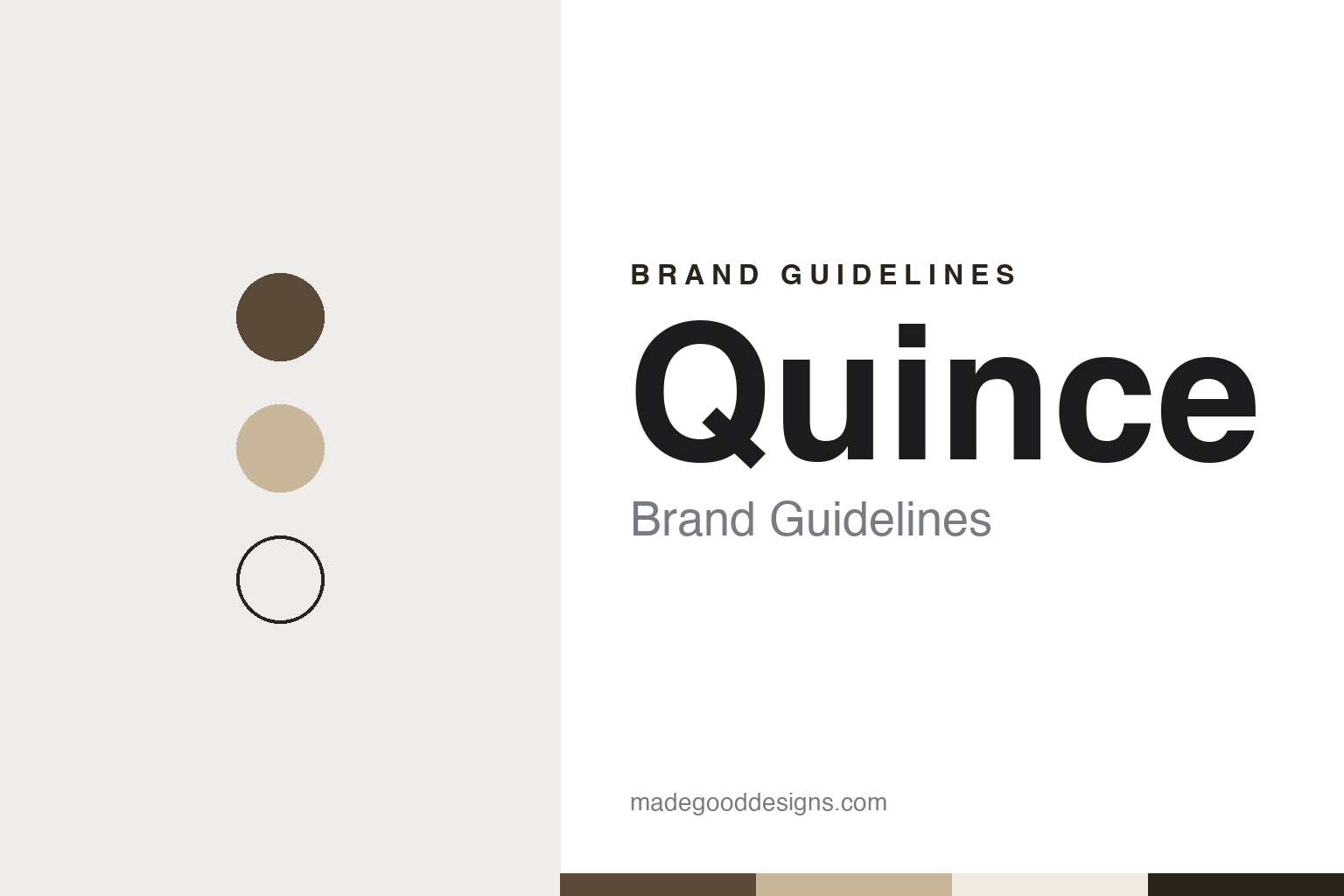
Quince Brand Guidelines
A linen sheet set, a cashmere sweater and a factory-to-door parcel.
Aa
Two constants: a walnut, flax and unbleached linen palette and a quiet catalogue serif register. Abstract homage — not a Quince product or mark; no sheet, colour or logo is reproduced.
From Last Brand to Quince
A beta under another name, then a public launch in the autumn of 2020.
Quince is an online retailer based in San Francisco. It sells clothing, accessories, jewellery and home goods, and bedding has been one of its core categories from the start. The company did not begin under its current name. TechCrunch reported on 12 October 2020 that Quince was launching out of beta after roughly a year of testing as Last Brand. The same report named Sid Gupta as co-founder and chief executive and listed Becky Mortimer and Sourabh Mahajan as co-founders. English Wikipedia also lists Zunu Mittal among the founders, and The Business of Fashion describes Mahajan as the company’s chief technology officer.
Accounts of the start date differ. Reports in Puck and The Cut, as cited by English Wikipedia, place the founding in 2019 under the name Last Brand and the rename in June 2020, while the same encyclopedia entry’s summary gives 2018. What is consistent across the coverage is the order of events: a period of testing under the first name, a rename, and a public launch in October 2020.
The origin story the company tells is a domestic one. Its About Us page says Quince “started when we brought our work home”: the team had built careers at high-end brands, it says, but buying luxury clothing, jewellery and home goods for themselves was a rare treat, so they built their own brand to make high-quality essentials at a price within reach. Business of Home, writing on 22 October 2025 and drawing on an interview Gupta gave to Forbes, added a more specific detail. Gupta and his wife noticed that the sheets and towels in hotels were better than the ones they had at home, and that observation is why the brand started in bedding.
At its public launch, TechCrunch reported, the range already ran from men’s and women’s clothing to accessories, jewellery and home goods. The seed backers named in that report were Founders Fund, 8VC and Basis Set Ventures. In 2026 Quince opened a Canadian website alongside its American one, according to a report carried by Yahoo Finance in January of that year.
Colour
Partner factories that ship directly to the customer, and what the company says about them.
The idea at the centre of the brand is a supply chain with fewer steps. TechCrunch described it in 2020 as a model the company calls M2C, for manufacturer to consumer: Quince goes directly to factories with designs for essentials, places orders that can be adjusted each week according to demand, and the factory then ships straight to the customer rather than to a warehouse or a store. English Wikipedia uses the same description, saying goods are produced by partner factories and shipped directly to buyers.
The company’s own pages set out how it chooses those factories. Its Our Factories page says Quince looks for specialist factories around the world and that its preference is for mid-sized, family-run operations that have employed the same workforce for many years, though it also works with larger operations that apply strict ethical standards. The page says the company partners only with factories that pay fair wages, and that many of them also take part in local social responsibility initiatives. Its About Us page says Quince only works with factories that meet or exceed global guidelines for workplace safety and wages. These are the company’s own statements.
Quince does not name individual factories or countries on those general pages. Its bedding is presented by fabric rather than by place. The Bedding 101 page groups the range into European linen, classic percale, Giza sateen, airy gauze, waffle, brushed cotton, silk, jersey and flannel, among others, with a short note on how each one feels. Linen sheet sets and duvet covers sit at the front of the bedding pages.
The home business has widened well beyond the bedroom. Business of Home reported in October 2025 that Quince had moved quickly into home over the previous eighteen months, building out from its bedding category into lighting, upholstery, case goods, rugs, tabletop and outdoor furniture. The same article said that in home the company sometimes works through importers, for rugs for example, and also sells other makers’ goods through a drop-ship marketplace, naming the French cutlery maker Jean Dubost and the North Carolina pottery brand East Fork. It described one curved-arm sofa as American-made.
Typography
Design and documentation.
Direct-to-consumer bedding brands sell sheets, duvets, pillows and towels mainly through their own websites rather than through department stores, and they usually build their identity there: in the name, the photography, the colour names given to each shade and the tone of the copy. Many are young companies, and some have since been sold, merged into larger groups, moved into physical stores or closed, so the brand a shopper sees today may sit with a different owner from the one that launched it.
Bedding is also a category where the place of making is easy to blur. A brand can be designed in one country while its fabric is woven, finished and sewn in others, and the wording on a website does not always say which step happened where. That makes the plain questions worth asking: who started the brand, who owns it now, and which mills or factories make its products.
Each guide separates what independent, dated sources record from what the company says about itself — its founding story, its owners over time and where its textiles are made — and marks plainly what rests only on the company’s own word.
Qu
A calm, bookish catalogue serif set against plenty of white space. (Specimen set in Libre Caslon Text, a serif STAND-IN; NOT the Quince logo.)
Quince
A plain wordmark, fabric-led product pages and an argument about price.
Much of the brand’s voice lives in explanation. The site footer links to a series of guides — Bedding 101, Cashmere 101, Silk 101, Leather 101, Cookware 101 and Luggage 101 — that teach customers about materials before selling them anything. Product names describe the fabric first, as in European Linen Sheet Set or Giza sateen sheets, so the bedding pages read more like a fabric guide than a set of named collections. The site’s header line describes the offer as high-quality essentials.
The other recurring element is the explanation of how prices are built. The About Us page sets out a diagram of a traditional supply chain, running from factory through sourcing agents, tariffs, warehouse, brand and store before reaching the customer, and contrasts it with a Quince chain that runs from factory to customer. The page lists the costs the company says it avoids, including sourcing agents, warehousing, wholesaling, distribution and storefront retail, and it includes a worked cost breakdown for a single product. The same page states the brand’s values as quality, sustainability and affordability, and says its designs follow a classic aesthetic meant to outlast trends.
That positioning has also drawn legal attention. Reuters reported on 24 November 2025 that Williams-Sonoma had sued Quince over its advertising of comparable products.
For a design guide, Quince shows how an online-only brand can build an identity out of plain naming, fabric education and an argument about the supply chain, rather than out of a heritage story. Compare Brooklinen, the Brooklyn sheet brand, and Parachute, the Los Angeles home brand. For this guide we use walnut, flax, unbleached linen and espresso with a serif, an unofficial interpretation; no product or logo is reproduced.
Explore & save
Keep Quince’s identity on hand — save it to a board in the Made Good inspiration library.
Quince identity set
Pin the Quince walnut, flax and unbleached linen palette and the quiet catalogue serif register to your own board.


