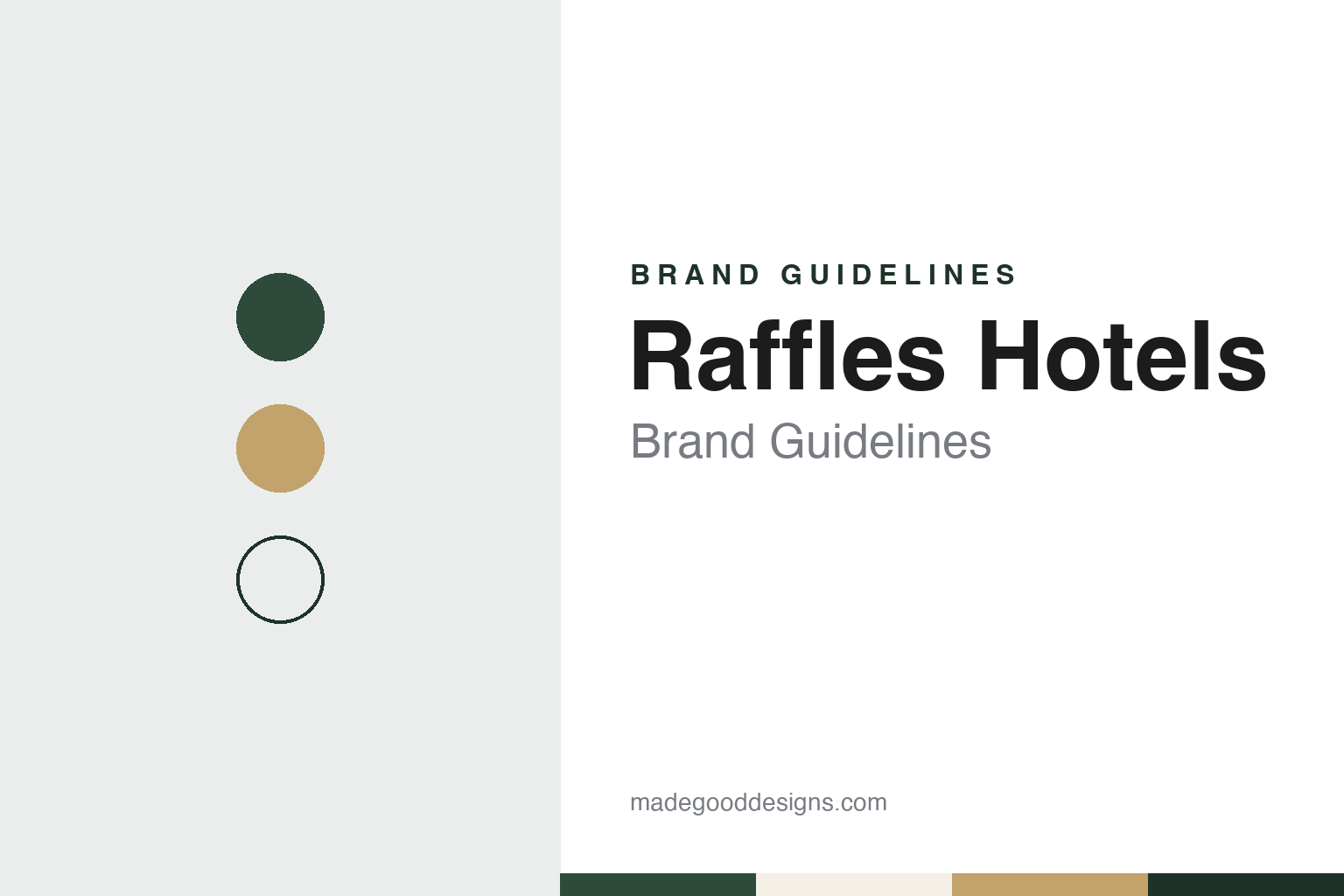
Raffles Hotels Brand Guidelines
A Beach Road hotel of 1887, a white facade and a name that became a hotel brand.
Aa
Two constants: a white, green and old-gold palette and a high-contrast serif register. Abstract homage — not a Raffles product or mark; no logo or building is reproduced.
A hotel on Beach Road
The Sarkies Brothers and 1887.
Raffles Hotels takes its name from one building in Singapore. Raffles Hotel stands on Beach Road, and English Wikipedia says it was established by the Armenian hoteliers known as the Sarkies Brothers. Singapore’s National Heritage Board, on its Roots heritage site, names the brothers as Martin, Tigran, Aviet and Arshak Sarkies. The hotel was named after Stamford Raffles, the British official associated with the founding of modern Singapore.
The site already had a history as a hotel. Wikipedia says a privately owned beach house built in the early 1830s became Emerson’s Hotel when Dr Charles Emerson leased it in 1878. After that lease expired, the Sarkies Brothers leased the property from its owner, Syed Mohamed Alsagoff, and the ten-room Raffles Hotel opened on 1 December 1887.
The hotel grew in stages over the next twelve years. Wikipedia says a pair of two-storey wings was completed in 1890 and the Palm Court Wing in 1894, after the brothers leased a neighbouring building on Beach Road. A new main building then replaced the original beach house. It was designed by the architect Regent Alfred John Bidwell of the firm Swan and Maclaren and completed in 1899. That white main building, with its verandahs and courtyards, is the image that the later Raffles hotels around the world refer back to.
The hotel also gave its name to a drink. The National Heritage Board credits the Singapore Sling to Ngiam Tong Boon, a bartender at the hotel, and the drink is still served in the Long Bar. The drink carries the city’s name and is tied to a single bar in the hotel.
Wikipedia says the Sarkies Brothers went bankrupt in 1931, and that in 1933 a public company, Raffles Hotel Ltd, took over the hotel. In 1987, a century after the opening, the Singapore government declared the building a National Monument.
Colour
Restorations, a chain and Accor.
The building has been restored twice in recent decades. Wikipedia says the hotel closed in 1989 for a renovation that lasted two years and reopened on 16 September 1991, restored to the look of its early-twentieth-century years, with all guest rooms converted into suites and the Long Bar moved from the lobby to a new shopping arcade. The online news site AsiaOne, reporting on 1 August 2019, also dated that restoration to 1989–1991.
The second restoration finished in 2019. AsiaOne reported on 1 August 2019 that the hotel had reopened its doors that day after a two-year revamp, which brought a fresh coat of paint, new white marble flooring inside and an upgraded air-conditioning system. It quoted the designer Edmond Bakos, speaking to The Straits Times, saying that the goal was to take the hotel to its next chapter rather than change it completely, and that if guests felt nothing had changed he would take it as a compliment. Coverage of the reopening in Portfolio magazine and TravelMole credited the restoration to the interior designer Alexandra Champalimaud working with the architecture and design firm Aedas.
AsiaOne listed the public rooms that returned. The former Jubilee Theatre became a ballroom; new restaurants included Yi, by the chef Jereme Leung, BBR by Alain Ducasse and La Dame de Pic, with Anne-Sophie Pic, which replaced the Raffles Grill. The Long Bar, with its floor strewn with peanut shells, came back along with the Tiffin Room, The Lobby, Writers Bar, Raffles Courtyard and Ah Teng’s Cafe. The names of these rooms, several of them decades old, form part of the brand as much as any logo.
The name has long reached beyond Singapore. Wikipedia says Colony Capital agreed in 2005 to buy Raffles Holdings, including the Raffles chain. The Raffles brand later sat within FRHI Hotels & Resorts, alongside Fairmont and Swissôtel. The travel site The Gate reported on 12 July 2016, quoting the company’s release, that after shareholder approval that day AccorHotels had completed its acquisition of FRHI and its three brands, a deal agreed in December 2015. The release named Chris Cahill as chief executive of a group of Accor brands that included Raffles. Raffles Hotels & Resorts has been part of Accor since 2016.
Typography
Design and documentation.
A hotel identity is carried less by a logo than by the many surfaces a guest touches. The first is usually the flagship building: its facade, its name lettering above the entrance and the canopy or porte-cochère where arrivals happen. In many hotel groups the founding property becomes the reference point that later openings quote in their signage, materials and colours.
Smaller objects do much of the daily work. Key cards, room folders, stationery, pens and do-not-disturb hangers repeat the mark at hand scale, and they are often the pieces guests take home. Because they are printed in volume, they also tend to fix a palette and a typeface more firmly than any brand manual.
Uniforms are another surface. Doormen, bell staff and front-desk teams wear colours and cuts that let a guest identify the hotel at a glance, and a uniform can stay unchanged for decades while the logo is redrawn around it.
Then come the less visible signals. A signature lobby scent, a house soundtrack, the livery of the cars that meet guests at the airport and the design of the bathroom amenities all extend the identity beyond print. For designers, the useful lesson is consistency across these touchpoints rather than any single element.
Aa
A high-contrast serif with a formal italic — the register of a hotel name painted across a white facade. (Specimen set in Playfair Display, a serif STAND-IN; NOT the Raffles logo.)
Raffles
A building, its rooms and a drink.
The first element of the Raffles identity is the Beach Road building. The Sarkies Brothers opened the hotel in 1887, and Bidwell’s main building of 1899 gave it the white front that later Raffles hotels quote. Both modern restorations, in 1989–1991 and 2017–2019, worked to keep that image rather than replace it, and the designer of the second one described success as guests feeling that nothing had changed.
The second element is a set of named rooms. The Long Bar, the Tiffin Room, the Writers Bar and the Palm Court give the hotel a vocabulary that travels with the name, and a cocktail, the Singapore Sling, links the bar to the city.
The third element is the move from one hotel to a brand. The Raffles name passed through Raffles Holdings, Colony Capital and FRHI before Accor completed its purchase of FRHI in July 2016, and it now sits within a large group while the Singapore hotel remains the reference point.
For a design guide, Raffles shows how a hotel brand can be built from one building, the names of its rooms and a drink. Compare the Accor Brand Guidelines, the group that has owned the brand since 2016, and the The Peninsula Hotels Brand Guidelines, another hotel brand that grew from a single building in Asia. For this guide we use palm green, old gold and white with a high-contrast serif, an unofficial interpretation; no product or logo is reproduced.
Explore & save
Keep Raffles Hotels’s identity on hand — save it to a board in the Made Good inspiration library.
The Raffles identity set
Pin the Raffles palm green, old gold and white palette and the high-contrast serif register to your own board.
