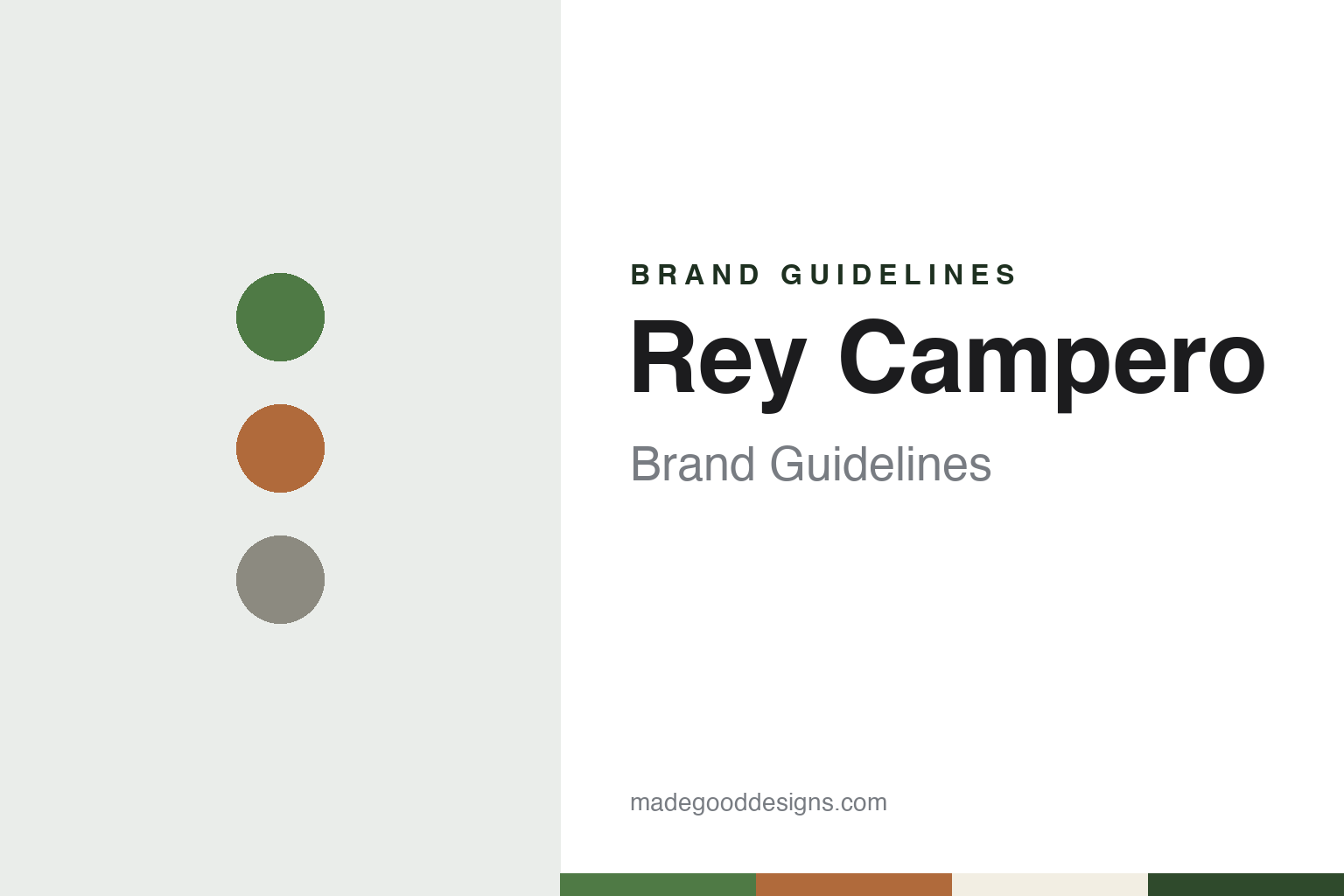
Rey Campero Brand Guidelines
The Sánchez family’s “King of the Countryside.”
Aa
Two constants: a Sierra green, copper and cantera cream palette and a sturdy grotesque sans register. Abstract homage — not a Rey Campero product or mark; no label, logo or bottle is reproduced.
Candelaria Yegolé
A village in the Sierra Sur and a family distillery.
Rey Campero — Spanish for “King of the Countryside” — is the mezcal of a family distillery in Candelaria Yegolé, a small village in the municipality of Zoquitlán, in the Sierra Sur, the southern mountains of the Mexican state of Oaxaca. Skurnik Wines & Spirits, the American wine and spirits company whose portfolio includes the brand, says the village lies along the Río Quiechapa, and that the family chose the name to reflect the bond between the landscape and the people who harvest its agaves.
The family presents the business as Destilería Sánchez. Its website says the family has made artisanal mezcal for four generations, since 1890, and gives the line in order. It calls Clara Manzano de Sánchez “our ancestor and founder,” the first generation; Nicolás Sánchez the second; Leopoldo Sánchez and his brother Ramiro the third; and names the uncles Vicente and Valentín as the ones who keep the craft alive today. Those dates and names are the family’s own account.
The brand itself is much younger. “Our brand was born in 2012 with an espadín,” the website says. Mezcalistas, the American mezcal publication, reported in September 2015 that the family had become a formal company in 2012.
Colour
Brothers, cousins and nephews.
Rey Campero has been presented through more than one family member. In September 2015 Mezcalistas described the brand as “a family of brothers, cousins, and nephews” and named Rómulo Sánchez Parada as its master distiller. It reported that he had learned to make mezcal from his father and worked in the palenque, as a mezcal distillery is called in Oaxaca, until about the age of 20; that he left for North Carolina when the mezcal economy collapsed; that he returned to Mexico in 2003 and settled in Oaxaca City; and that he went back to mezcal in 2012, when the family formalised the business. The mezcal review site Mezcal Reviews also describes him as the brand’s founder.
Other accounts put a different name first. Skurnik’s producer page says the family collective is “helmed by Vicente Sánchez Parada,” and the family’s own website names Vicente and Valentín, not Rómulo, as the generation in charge today.
The brand reached the United States in 2015. Mezcalistas reported that summer that William Scanlan’s new import company, Heavy Métl, had begun bringing in Rey Campero alongside Real Minero, and that almost all of Rey Campero’s agaves at the time were wild, with espadín the only cultivated one. The range named then included espadín, cuishe, madrecuishe, tobalá, mexicano, jabalí and tepextate, and the publication said arroqueño and sierra negra were expected to follow.
Typography
Design and documentation.
The seven brands in this group are all mezcal names: Bozal, Alipús, Real Minero, Rey Campero, Mezcal Vago, Madre and Dos Hombres. Mezcal is distilled from cooked agave, and much of it is made in small production houses that Wikipedia notes are called fábricas or palenques, often in villages in the hills of Oaxaca. The traditional method roasts the agave hearts in pit ovens and crushes them with a stone wheel turned by a horse, and Wikipedia says mezcal has been recognised internationally as an appellation of origin since 1994.
A mezcal brand’s identity is usually carried less by a single bottle than by a label, a name and the village it points to, because the company that sells the mezcal is not always the family that makes it, and one brand can draw on several producers. That makes the questions behind each name worth asking plainly: who started it, who owns it now, and which families and palenques actually make the mezcal.
Each guide separates what independent sources record from what the company says about itself — its founding story, its owners over time, where its mezcal is made and how its labels have changed — and marks plainly what rests only on the company’s own word.
Aa
A sturdy sans for a name about the countryside. (Specimen set in Archivo, a sans-serif STAND-IN; NOT the Rey Campero logo.)
Rey Campero
Wild agaves and copper stills.
The family describes its process step by step. It says it roasts mature agave hearts in a conical earth oven heated with wood, crushes them with a stone tahona made of cantera, ferments them with wild yeasts in vats of pine and sabino wood, and distils in copper stills; Skurnik adds that the agave is cooked underground for four to five days and rested for up to a week, that the crushed fibre ferments in the open air for up to twelve days depending on the season, and that the family uses three small copper pot stills. The family says its mezcals then rest for at least three months in glass jugs before bottling, a step it says softens the alcohol and brings out aroma and flavour.
Agave is where the brand puts its emphasis. The website says the family now works with more than ten varieties of wild agave and lists, among others, cuishe (Agave karwinskii), jabalí (Agave convallis), tepeztate (Agave marmorata) and mexicano (Agave rhodacantha), alongside the cultivated espadín (Agave angustifolia), which it says takes seven to ten years to mature, against fifteen to eighteen for jabalí and tepeztate. Mezcalistas lists Rey Campero ensambles — blends of several agaves — among them one of tepextate, cuishe and espadín. Skurnik says the family keeps nurseries in which espadín is grown alongside rarer types, some of which are allowed to flower and set seed. In a 2025 post on its website the family describes wild agaves as plants that grow without human help in dry, rocky and mountainous land, take on average between 10 and 20 years to mature, and help prevent soil erosion; it names seed saving and nursery propagation for later replanting as ways to protect them, and says the jabalí grows only in Oaxaca.
Rey Campero is not the family’s only label. The same website also sells a second mezcal brand, La Herencia de Sánchez, under the Destilería Sánchez name. The brand’s website is mezcalreycampero.com.
For a design guide, Rey Campero shows how a brand can lean on a place and a single phrase — the king of the countryside — while the family behind it tells its own history generation by generation. Compare Real Minero, the Santa Catarina Minas family brand that reached the United States through the same importer, and Montelobos, another Oaxacan mezcal with a landscape in its name. For this guide we use Sierra green, copper and cantera cream with a sans, an unofficial interpretation; no product or logo is reproduced.
Explore & save
Keep Rey Campero’s identity on hand — save it to a board in the Made Good inspiration library.
Rey Campero identity set
Pin the Rey Campero Sierra green, copper and cantera cream palette and the sturdy grotesque sans register to your own board.