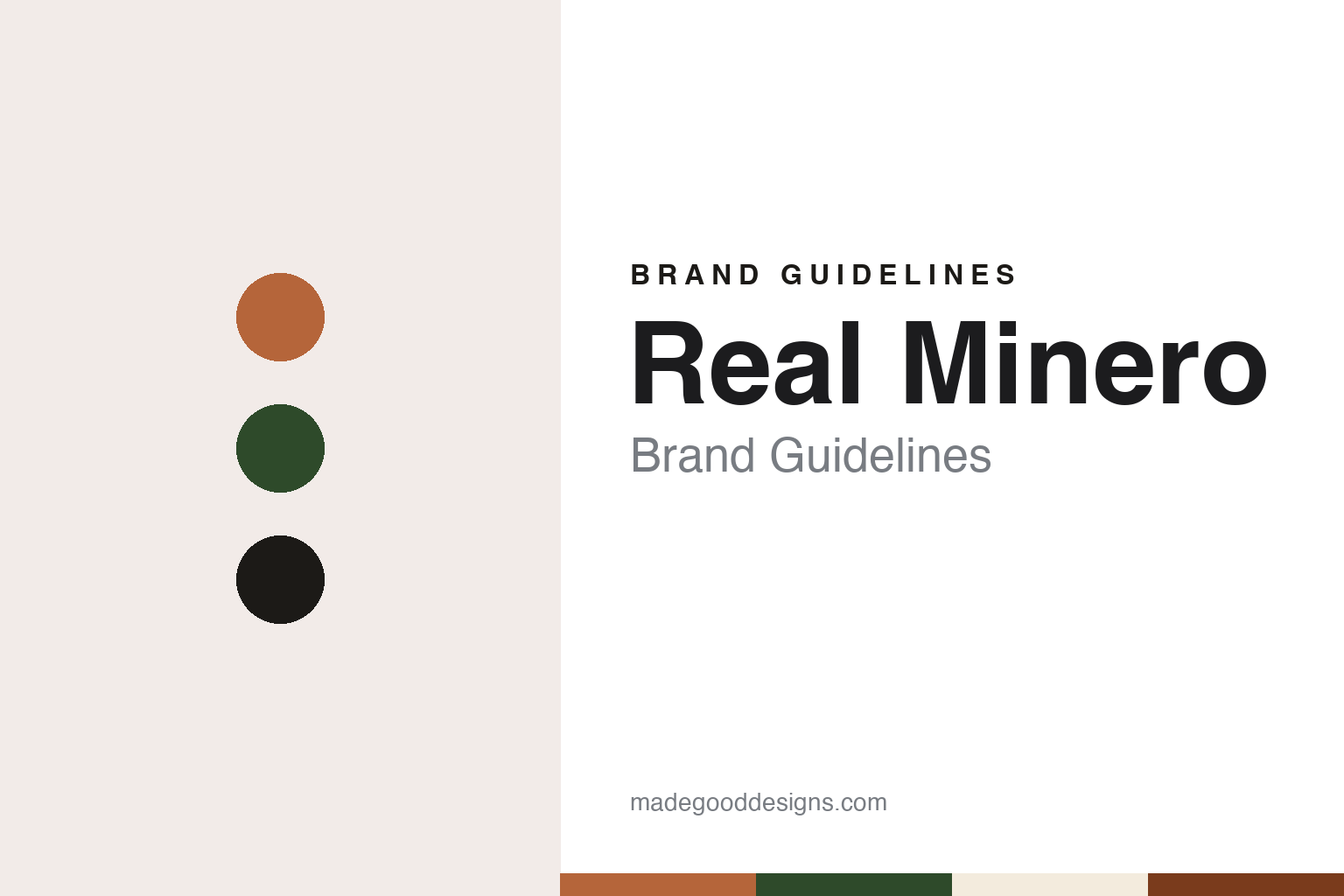
Real Minero Brand Guidelines
The Ángeles family’s clay-pot spirit from Santa Catarina Minas.
Aa
Two constants: a barro clay, label green and agave paper palette and a hand-signed serif register. Abstract homage — not a Real Minero product or mark; no label, logo or bottle is reproduced.
Santa Catarina Minas
A family, a palenque and a village name for its spirit.
Real Minero is the agave spirit of the Ángeles Carreño family of Santa Catarina Minas, in the Mexican state of Oaxaca. The family calls it a project spanning four generations. The name draws on a local word: the company says “minero” is what the spirits distilled in the village have long been called.
The family traces its craft to the late 19th century. Its own history names the great-grandfather Francisco Ángeles, known in the family as “Papá Chico,” as the first link, and says he and other distillers of the village went into the hills to make mezcal at a time when the work was illicit. His pupil was Lorenzo Ángeles Mendoza, the father of the present family. El Universal reported in October 2018 that Lorenzo Ángeles founded Real Minero, that he was its master distiller until 2016, and that he served as municipal president of Minas from 1973 to 1975.
The decisive year was 1978. The company says that Lorenzo and his cousin and compadre Nicolás Arellanes bought the family’s first palenque, as a mezcal distillery is called in Oaxaca, that year; El Universal reported that he bought land from his cousin in 1978, including the Tierra Blanca ranch where the family works. After a decade spent on other work, the company says, Lorenzo went back to making mezcal, and the family now works at the palenque it calls La Concepción.
Lorenzo Ángeles died in December 2016, according to both the company and El Universal. The company names his wife, Candelaria Carreño, and their daughters Graciela, Adriana and Miriam Ángeles Carreño; El Universal described Graciela as the one leading the family business in 2018.
Colour
From photocopied paper to a label signed by hand.
Real Minero has published an unusually detailed history of its own labels. In 1994, the company says, the family opened a small shop in Ocotlán and sold mezcal in plastic jugs and recycled bottles stoppered with corn cobs, under a photocopied scrap of paper glued on by hand that named only the shop, “Auténtico mezcal Minero,” and the type of spirit.
The first printed label came in 1999: a small screen-printed square of 6 by 4 centimetres, made by a friend who worked in a print shop, still without a brand name. The first Real Minero logo appeared in 2004, on a label with a green background for the square bottle that, the company says, almost every producer used at the time. In 2005 the label was redrawn in three colours — red, blue and black — one for each variety; by then the official mezcal standard, NOM-070, was in force, and the family replaced the word “minero” with the recognised category “mezcal joven.”
Special editions followed. For the palenque’s 30th anniversary in 2008 the company issued 120 bottles of a canastuda agave with a label wound around the bottle in a spiral; a 2012 collection, La casa de los 26 maestros mezcaleros, paid tribute to past distillers of the family palenque; and three editions marked its 40th anniversary in 2018.
The label still in use dates from 2010. The company says the first sketch was made in Oaxaca by the studio Morpho, with final adjustments by Nils Dallman, and that in its first version each label was filled in by hand and signed by Lorenzo Ángeles, the brand’s first master distiller. Printing later moved from screen printing to digital, and until 2019 each label was made of five pieces glued on by hand.
Typography
Design and documentation.
The seven brands in this group are all mezcal names: Bozal, Alipús, Real Minero, Rey Campero, Mezcal Vago, Madre and Dos Hombres. Mezcal is distilled from cooked agave, and much of it is made in small production houses that Wikipedia notes are called fábricas or palenques, often in villages in the hills of Oaxaca. The traditional method roasts the agave hearts in pit ovens and crushes them with a stone wheel turned by a horse, and Wikipedia says mezcal has been recognised internationally as an appellation of origin since 1994.
A mezcal brand’s identity is usually carried less by a single bottle than by a label, a name and the village it points to, because the company that sells the mezcal is not always the family that makes it, and one brand can draw on several producers. That makes the questions behind each name worth asking plainly: who started it, who owns it now, and which families and palenques actually make the mezcal.
Each guide separates what independent sources record from what the company says about itself — its founding story, its owners over time, where its mezcal is made and how its labels have changed — and marks plainly what rests only on the company’s own word.
Aa
A warm serif for a label once signed by hand. (Specimen set in Fraunces, a serif STAND-IN; NOT the Real Minero logo.)
Real Minero
“Porque solo lo auténtico perdura.”
The brand left Mexico through small importers. The company says it first exported in 2010, to Germany, through the importer Axel Huhn, and to the United States in 2015, through William Scanlan III of Heavy Métl, the year its label first appeared in another language. Mezcalistas reported in September 2015 that Heavy Métl had begun importing that summer with Real Minero and Rey Campero. The company names Agave by Montiel as its European partner since 2022.
Its labels kept changing with circumstances. After Lorenzo’s death, the company says, filling in labels by hand became less practical, so from 2017 it moved to adhesive paper with fewer pieces and a cork engraved with the logo; from 2019 all label data has been printed. In 2022, the company says, it stopped using the word “mezcal” on its bottles because of the rules of NOM-070, and the American wine and spirits company Skurnik, whose portfolio includes the brand, lists its bottlings as “destilado de agave.” In 2025 the company announced that Edgar Ángeles Carreño had left after eight years as production manager, and that lots from the second half of 2025 carry the words “Equipo Real Minero” instead of a named master distiller.
The method is the brand’s other constant. The company says it distils in clay pots, crushes cooked agave by hand with a wooden mallet in a trough, and roasts it in a conical earth oven. It also describes a botanical garden holding seventeen agave species, a seed bank, and a library project in the village. Its motto is “Porque solo lo auténtico perdura” — because only the authentic endures.
For a design guide, Real Minero shows how a label can carry a family’s history, from a photocopied shop sign to a signed, hand-filled card. Compare Rey Campero, the Sierra Sur family brand that reached the United States with the same importer, and Del Maguey, the Oaxacan single-village mezcal brand. For this guide we use barro clay, label green and agave paper with a serif, an unofficial interpretation; no product or logo is reproduced.
Explore & save
Keep Real Minero’s identity on hand — save it to a board in the Made Good inspiration library.
Real Minero identity set
Pin the Real Minero barro clay, label green and agave paper palette and the hand-signed serif register to your own board.