Rosários 4 Brand Guidelines
The Mira de Aire dye-house that became a Portuguese yarn spinner.
Aa
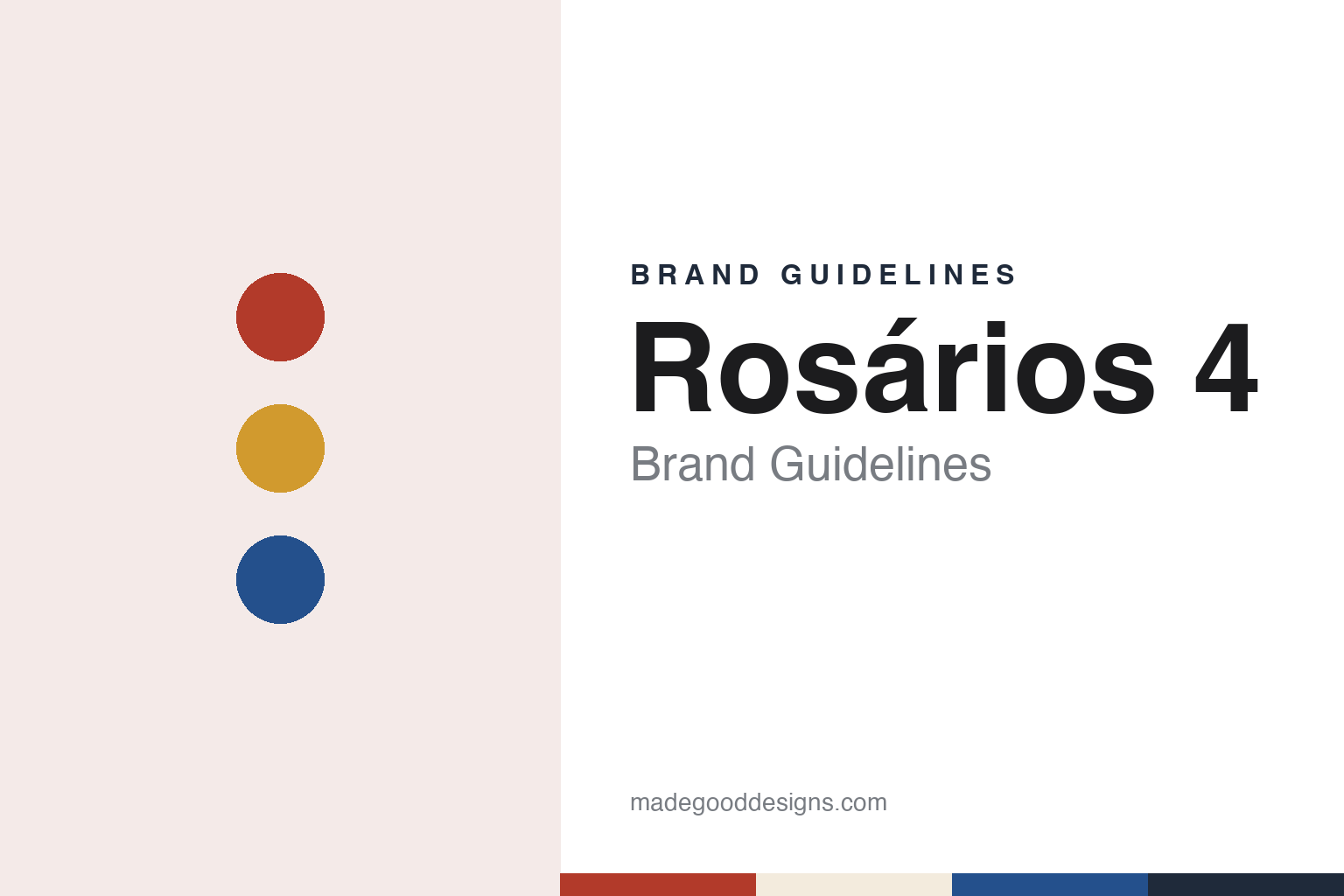
Two constants: an Arraiolos red, ochre and tile blue palette and a rounded geometric sans register. Abstract homage — not a Rosários 4 product or mark; no yarn band, pattern or logo is reproduced.
Tinturaria
A dye-house in the Serra de Aire.
Rosários 4 is a yarn maker in Mira de Aire, a small town in the municipality of Porto de Mós, in Portugal’s Leiria district, best known for its caves and set on the edge of the Serras de Aire e Candeeiros Natural Park. The company describes itself as a specialist in the production and dyeing of yarns for knitting, crochet and embroidery. Its trading company is called Tinturaria Rosários 4, Lda — tinturaria is Portuguese for dye-works.
That name reflects how it began. According to the company’s own history, the business started in the late 1970s as a dye-house run by Manuel Delfim do Rosário, whom it calls its founder and dyer, at the top of the town, facing the slopes of the serra. A Portuguese company-information service, eInforma, gave the company’s age as 47 years in 2026, which points to about 1979. The company says the textile industry was then one of the most important in the region, and that both the founder and his wife, Conceição, had worked in a textile factory.
The company traces the family’s link to wool back further still. It says that in the 1930s Manuel Delfim’s maternal grandparents and uncles carded and spun wool for caps and blankets, and that his mother was a weaver who made blankets on wooden looms — blankets it calls traditional pieces of the region to this day. Its history page is headed “a story that began two generations before the company was founded.”
At first, the company says, it dyed wool and synthetic yarns for the many knitwear factories then working in the area. Spinning was soon added to dyeing, and in the 1980s it began making yarn for hand-knitting. Its first knitting yarn, it says, was Catita, an acrylic that has now been in the range for more than 30 years. The eInforma summary lists the company under the Portuguese activity code for the preparation and spinning of textile fibres.
Colour
Arraiolos wool and natural fibres.
The product the company calls one of its most emblematic is Arraiolos wool. Arraiolos rugs are embroidered wool carpets from the town of Arraiolos in the Alentejo, worked in a diagonal cross-stitch known as ponto de Arraiolos; English Wikipedia, citing a 2007 Universidade NOVA de Lisboa thesis, says they date back to at least the 16th century. Rosários 4 says it began producing 100% wool Arraiolos yarn in 1995, with a colour card of more than 400 shades, and added tapestry yarn and embroidery thread at about the same time. It still sells canvases, needles and pattern magazines for the craft, including a series on contemporary Arraiolos design.
The company says its 100% wool yarns carry the Pure New Wool seal — the guarantee associated with the Woolmark certification mark, which the International Wool Secretariat launched in 1964 — and that it has been certified to the ISO 9001 quality standard since 2000.
Its knitting yarns are split between a Classic Collection and an Ecofriendly Collection, which the company says is a registered mark and which takes in yarns of wool, cotton, linen, silk, bamboo, corn fibre, milk protein, sugar cane and cork. It has also made a collection coloured with plant- and animal-based dyes. In January 2026 it promoted Folclore, a worsted-weight yarn that it says is made from Portuguese wool and produced entirely, “from spinning to dyeing,” in Mira de Aire; a thinner companion yarn, Romaria, shares the same wool and colours.
The company says it launches new collections twice a year and has shown them at the Handarbeit + Hobby trade fair in Cologne since 2003; at the 2017 edition it launched a kit for dyeing yarn at home, and it sells undyed yarn for the purpose. Its range also takes in crochet cotton, a children’s collection and supplies for tufting.
Typography
Spinners and their places.
The seven brands in this group all sell yarn for hand knitting and crochet, and they come from six countries on two continents: Filcolana from Denmark, Kelbourne Woolens and Harrisville Designs from the United States, Rosários 4 from Portugal, La Bien Aimée from France, Koigu from Canada and Atelier Zitron from Germany. Most knitters meet them first as a name on a ball band or a skein tag in a yarn shop, rather than as a company.
Behind those labels the yarn trade takes several shapes. Some brands own the mill that spins their fibre; others design a yarn and its colours and have it spun, dyed or finished by partners; still others dye undyed yarn by hand in small batches. A label’s country is not always the country where every step happened, and “made in” can mean spinning, dyeing or only the final winding.
Each guide sets out what independent sources record about the brand — who founded it, who owns it and where its yarn is made — and separates that from what the company says about itself, marking plainly what rests only on the company’s own word.
Aa
A rounded geometric sans — warm and plain. (Specimen set in Outfit, a sans STAND-IN; NOT the Rosários 4 logo.)
Rosários 4
A producer that sells its own colours.
From the turn of the millennium, the company says, it began looking abroad, and it now sells in Europe, Asia, Australia and the Americas. It argues that being a producer, rather than a brand that buys in finished yarn, lets it develop products to suit individual customers. Its website is published in Portuguese, English and Spanish and, alongside the yarns, carries a large library of free patterns, numbered in sequence, and video tutorials on stitches and techniques.
The company also sets out its environmental procedures. It says it pre-treats its liquid effluent in its own industrial wastewater plant, monitors its gaseous emissions and separates waste for recycling, and that its preference for natural fibres follows from the same policy. These are the company’s own statements.
We found no record of an acquisition or outside owner in the sources we checked; the business still trades under the Tinturaria Rosários 4 name from Mira de Aire.
For a design guide, Rosários 4 shows how a regional dye-house can turn a national craft — Arraiolos embroidery and its hundreds of wool shades — into a brand with its own colour range. Compare Bergère de France, a French spinning mill that sells yarn under its own name, and Katia, a family yarn brand from neighbouring Spain. For this guide we use Arraiolos red, ochre, tile blue and undyed cream with a sans, an unofficial interpretation; no product or logo is reproduced.
Explore & save
Keep Rosários 4’s identity on hand — save it to a board in the Made Good inspiration library.
Rosários 4 identity set
Pin the Rosários 4 Arraiolos red, ochre and tile blue palette and the rounded geometric sans register to your own board.