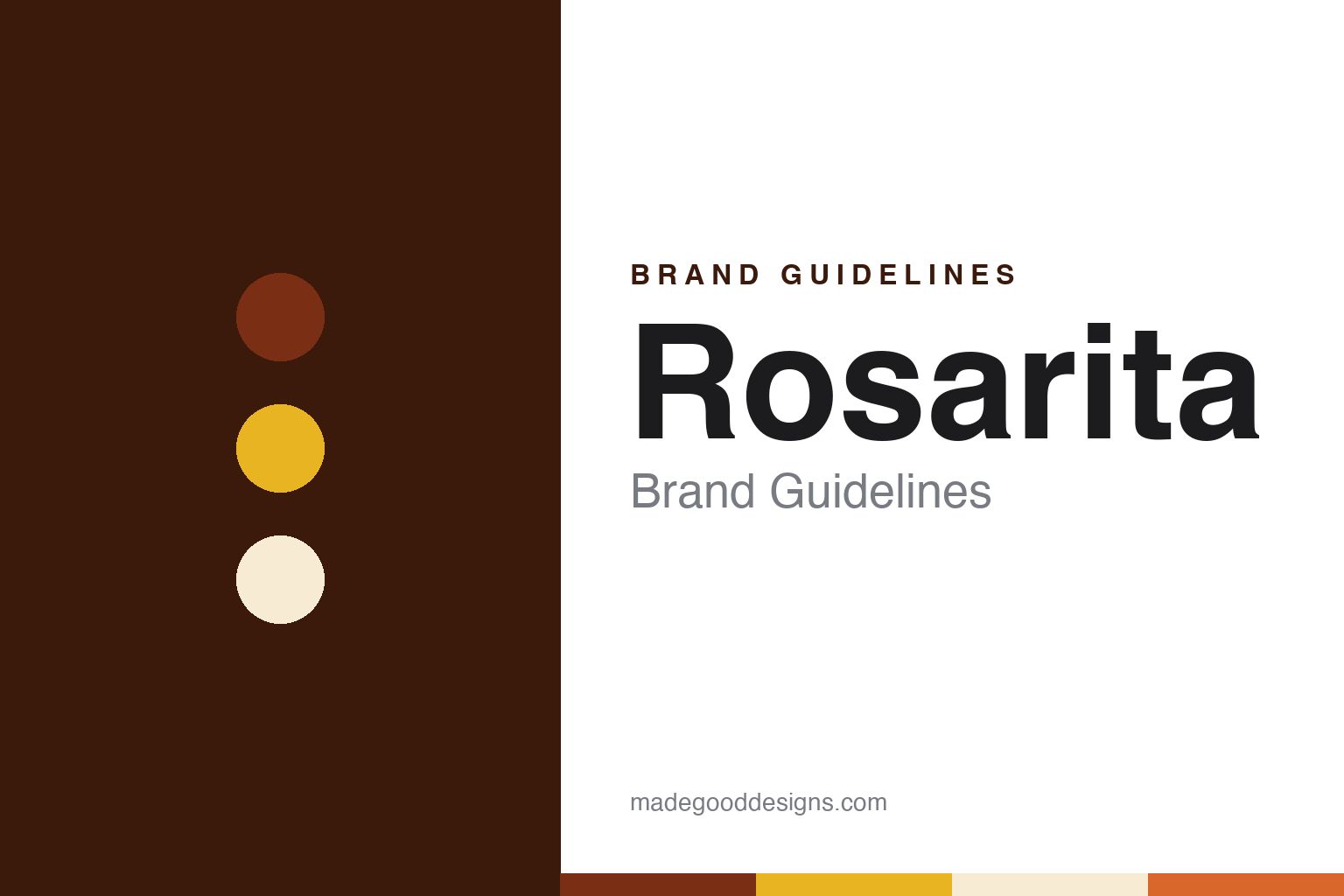
Rosarita Brand Guidelines
A tamale stand at a fiesta, a name taken from a wife and a señorita drawn by a son.
Aa
Two constants: a bean brown, sombrero yellow and tortilla cream palette and a retro script register. Abstract homage — not a Rosarita product or mark; no can, label or logo is reproduced.
Tamales at the fiesta
A sign painter, a cook from Mesa and a festival stand near a Yaqui village.
Rosarita is an American brand of refried beans, whole beans and enchilada sauce, sold today by Conagra Brands. Its name comes from a real woman in Mesa, Arizona. The fullest published account of its origins is a personal essay by Susan Guerrero, a granddaughter of the founders, titled “The Real Rosarita” and published by Saveur on 4 February 2008. She wrote that in 1914, in Mesa, Rosaura Castro, the daughter of a teamster, married Pedro W. Guerrero, a clerk in a clothing store, and that the company later co-founded by the couple took its name, Rosarita, from a diminutive form of hers.
The idea, in the family’s telling, came from a festival. Guerrero wrote that during Easter week of 1922 her grandfather, by then a sign painter, went to the annual fiesta at Guadalupe, a Yaqui village southwest of Mesa, and noticed crowds of largely Anglo customers queuing at rough food stands. He began to wonder, she wrote, what would happen if tamales were sold in a clean, attractive setting. A year later, according to the essay, Pedro and Rosaura and a few friends set up their own stand at the Guadalupe fiesta, dressed in their best clothes and starched white aprons, with every tamale wrapped in a white paper napkin. The tamales sold out.
The company’s own history places the same discovery in 1923. An “About Us” page on the brand’s website, archived in July 2023 under a Conagra Brands copyright line, says Pedro Guerrero of Arizona dreamed of bringing Mexican food to a wide public and found that tamales were popular when he sold them at a festival in 1923. In Saveur, Susan Guerrero described her grandfather as the one who drove the plan, writing that the creation of the brand was his dream rather than her grandmother’s, while Rosaura was the cook whose tamales, tortillas and chile sauces inspired it. She wrote that Rosaura later worked as a consultant to the company, contributing recipes and test-freezing food.
The business took decades to arrive. The essay says Pedro registered the company’s original name, Rosita, in 1925, and bought tamale wrappers for a company that did not yet exist. He needed capital and partners. Writing for Mediaite on 21 March 2013, the chef Amanda Cohen retold the story in her series on women cooks and gave the same date for the registration of the Rosita name, noting that the couple spent the following years planning and saving before they could try the idea again on a commercial scale.
Colour
Partners in Mesa, a trademark change, Beatrice Foods and Conagra.
The partners arrived in the 1940s. Susan Guerrero wrote in Saveur that Pedro eventually found Ann Petrie, a Mesa restaurant owner, and R. G. Scarborough, a young accountant, and that in 1945 the partners hired a local woman to make tamales from Rosaura’s recipe in one of Petrie’s kitchens. Mediaite likewise dated the partnership to 1945 and named Petrie. The brand’s own website says Guerrero founded Rosita Mexican Food Products in the 1940s.
According to the Saveur essay, the business grew quickly, soon moving into a large, modern factory, and began making prepared tortillas, sauces, beans and frozen foods. The foods sold initially in local grocery stores and then across the American West, she wrote. Mediaite said that after building a following in the Southwest the brand went national.
The name changed in the late 1950s. Saveur said that in the late 1950s, after a trademark dispute, the name was changed slightly from Rosita to Rosarita. The brand’s website says the name was changed to Rosarita as the company expanded from selling fresh tamales to selling canned beans.
The family sold the business in 1961. Susan Guerrero wrote that in 1961 Beatrice Foods, then a large processed-food group, approached her grandparents and that they sold Rosarita. Mediaite said in 2013 that Beatrice Foods bought the couple out in 1961. Both articles said the brand was owned by ConAgra at the time they were written, Saveur in 2008 and Mediaite in 2013.
Conagra still owns it. Eat This, Not That! reported on 15 March 2022 that Conagra Brands had confirmed a recall of cans of Rosarita Organic Refried Beans sold at Costco, issued in cooperation with the US Food and Drug Administration. The brand’s website, archived in July 2023, carried a Conagra Brands copyright line and described the current range as sauces, refried beans and whole beans. The website says Rosarita refried beans are still made with the Guerrero family recipe, a claim the company makes about its own product.
Typography
Design and documentation.
The names in this group sit on supermarket shelves as salsa jars, tortilla packs, bean cans and frozen-burrito boxes. Packaging of this kind has to work at a glance: a shopper scanning a long aisle of similar jars or a freezer door of similar boxes reads colour, a name and a picture of the food before reading any small print, so a label’s job is to make one product easy to find again on the next visit.
Each format has its own constraints. A jar label wraps around glass and leaves room for the colour of the salsa to show through; a tortilla pack is soft and folds, so the name has to survive creases; a can label is printed flat and read on a curve; and a frozen box has to stay legible behind frosted glass. Heat levels, flavours and sizes are usually signalled with colour bands or small badges rather than new designs.
Each guide separates what independent, dated sources record about a brand — who started it, who owns it now and where its food is made — from what the company says about itself, and marks plainly what rests only on the company’s own word.
Aa
A rounded, connected retro script — the hand-lettered register of a mid-century grocery label. (Specimen set in Lobster, a script STAND-IN; NOT the Rosarita logo.)
A señorita in a yellow sombrero
A family drawing that outlived the family’s ownership.
The Rosarita mark began as a family drawing. Susan Guerrero wrote in Saveur in 2008 that when her grandfather registered the Rosita name in 1925 he had her uncle Adolfo, one of the couple’s sons, draw a picture of a young Mexican woman to serve as a logo. She described the figure as a señorita in a yellow sombrero and wrote that, at the time of her essay, the figure still appeared on the label. The brand’s own website agrees on the origin, saying that one of Guerrero’s sons designed the picture of the Mexican woman for the logo.
The name has a similar family source. In the Saveur account Rosarita is a pet form of Rosaura, the cook whose tamales, tortillas and chile sauces the essay credits as the inspiration for the business.
The family story also shaped how the company describes its food. The brand’s website, under the heading “Rosarita Beans Are Authentic,” presents the beans in terms of a family tradition, says the refried beans are made with the Guerrero family recipe, and describes the texture as creamy with pieces of whole bean. Those are the company’s own words about its product. Saveur, for its part, recalled the factory her grandfather took the family to visit in later years, where men in rubber boots stirred large vats of refried beans and a photograph of the founders still hung on the wall.
For a design guide, Rosarita shows how a single hand-drawn figure, made inside a founding family, can stay with a brand after the family that drew it has sold the business. Compare it with Van Camp’s, another canned-bean brand in the Conagra portfolio, and Old El Paso, a border-cannery label for the same Mexican-food shelf. For this guide we use bean brown, sombrero yellow, tortilla cream and lantana orange with a retro script, an unofficial interpretation; no product or logo is reproduced.
Explore & save
Keep Rosarita’s identity on hand — save it to a board in the Made Good inspiration library.
Rosarita identity set
Pin the Rosarita bean brown, sombrero yellow and tortilla cream palette and the retro script register to your own board.