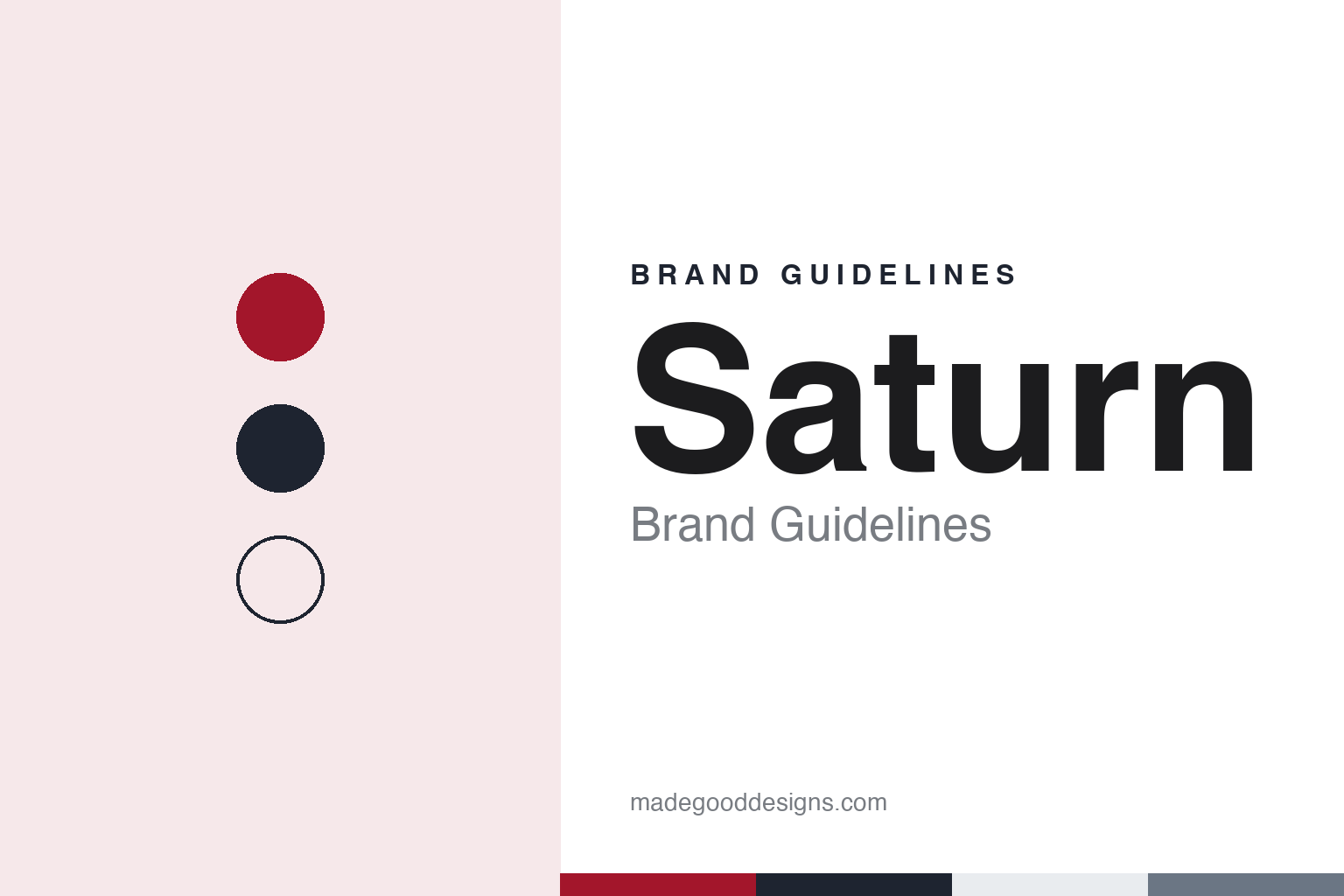
Saturn Brand Guidelines
GM’s separate car company, from Spring Hill to wind-down.
Aa
Two constants: a red, navy and silver palette and a clean geometric sans register. Abstract homage — not a Saturn or General Motors product or mark; no badge, logo or nameplate is reproduced.
A separate company
A General Motors subsidiary with its own plant, cars and retailers.
Saturn was set up by General Motors as a subsidiary, the Saturn Corporation, on 7 January 1985, according to English Wikipedia. The idea was that the brand would stand apart from the rest of GM: it had its own small cars, its own network of retailers, its own approach to pricing, its own workforce and its own manufacturing plant at Spring Hill, Tennessee. English Wikipedia says the project, code-named Saturn, had been under discussion inside GM since June 1982 and was made public by the GM chairman Roger B. Smith and the president F. James McDonald in November 1983.
The cars came several years after the company. English Wikipedia says the first Saturn, a red 1991 model-year SL2 sedan, was built on 30 July 1990, and that the first Saturn retailer opened in Memphis, Tennessee. The early range was a family of small sedans, coupes and, from 1993, wagons, which English Wikipedia groups as the S-Series. Later Saturns included the Vue sport utility vehicle, from the 2002 model year, and the Sky roadster, from the 2006 model year.
Saturn’s separate standing inside GM did not last for the whole of its life. English Wikipedia describes a gradual folding of the brand back into the corporation, with more of its models drawn from other GM divisions and, late in its run, from GM’s German arm Opel. It also says that in 2004 GM and the United Auto Workers dissolved the separate labour contract that had covered the Spring Hill plant, allowing Saturn operations to be integrated with the rest of GM. By the brand’s final years Saturn models were also built at other GM plants: when the brand closed, Reuters reported, GM halted work on the Outlook in Michigan, the Vue in Mexico and the Aura in Kansas.
Colour
A different kind of company, said the advertising.
Saturn’s identity rested less on a badge than on a promise about how the company would behave. English Wikipedia says the brand was launched as “a different kind of car company,” and lists the advertising lines it used in turn: “A Different Kind of Car Company” from 1990 to 1994; “A Different Kind of Company. A Different Kind of Car.” from 1994 to 2002; “It’s Different in a Saturn” from 2002 to 2004; “People First” from 2004 to 2006; “Like Always. Like Never Before.” from 2006 to 2007; “Rethink American” in 2007; and simply “Rethink” from 2008 until the end.
The retailers were part of that promise. English Wikipedia says Saturn became known for a “no-haggle” way of selling. In June 2009, when GM was preparing to sell the brand, CNNMoney reported that Saturn retailers were independently owned businesses, like almost all car dealerships in the United States, and that they sold only Saturn vehicles — which made them dependent on the brand’s survival.
The product itself carried part of the story. English Wikipedia says the original Saturns used dent-resistant plastic body panels on a steel spaceframe, and that GM presented the panels as a way to revise the cars’ styling easily; the S-Series was restyled several times over its run. English Wikipedia also says GM had at first planned to sell the Saturn car under one of its existing brands — Chevrolet, Pontiac, Oldsmobile, Buick, Cadillac or GMC — before deciding in 1985 to make Saturn a brand of its own.
Saturn also tried to travel. English Wikipedia says exports to Taiwan began in June 1992 and that Saturns were later sold in Japan through agreements with Japanese companies, and it notes that the brand was sold in Canada until GM closed the Canadian Saturn retailers at the end of 2009.
Typography
Retired names, kept badges.
A car brand lives in a handful of physical objects long before it reaches a screen. The badge on the grille and the tailgate, the script on a front wing, the hood ornament where one exists, and the emblem moulded into a steering-wheel hub are all small pieces of metal or plastic that have to read at a glance and survive weather, washing and years of handling. Each one is a design brief in miniature: a mark that works in chrome, in paint and in relief, at the size of a coin and at the size of a showroom sign.
Dealer signage carries the same mark at architectural scale. Pole signs, fascia lettering, service-bay headers and the colours of a showroom interior turn a badge into a place, and they are usually specified by the carmaker so that one dealership looks like the next. When a manufacturer retires a marque, that whole system has to be undone in stages: signs come down or are re-skinned for a sister brand, parts and service support continue for cars already on the road, and the badges themselves pass into the hands of owners, clubs and collectors. A retired marque often keeps a second life in that afterlife, carried by the people who still drive and restore the cars.
Aa
A clean geometric sans for a brand that sold a way of doing business. (Specimen set in Inter Tight, a sans STAND-IN; NOT the Saturn logo.)
The end of Saturn
A sale that did not happen.
The brand’s end came during GM’s restructuring of 2009. On 5 June 2009, CNNMoney reported that GM, then in bankruptcy, had announced it would sell its Saturn unit to Penske Automotive Group, the dealership company controlled by Roger Penske. Under the plan, Penske would act as a distributor of Saturn cars and parts to the existing retailers, in an arrangement CNNMoney compared with the way Penske distributed Daimler’s Smart car in the United States. GM would keep building the Aura sedan and the Vue and Outlook for two years, while the Sky and the Astra would be dropped.
The deal depended on finding another carmaker to supply future Saturns. On 30 September 2009, GM said it would close Saturn and wind down its retail network after the Penske deal collapsed, Reuters reported the next day; Penske had been negotiating with Renault to supply vehicles once the production agreement with GM ran out, and Renault said in a statement that “the conditions for an agreement have not been found.” GM said it would wind Saturn down by October 2010, under an agreement already approved by its retailers. English Wikipedia dates the end of Saturn production to 7 October 2009 and the end of the remaining franchises to 31 October 2010.
GM kept looking after existing owners through its other brands. English Wikipedia says that in early 2010 GM offered Saturn owners incentives to move to a new Chevrolet, Buick, Cadillac or GMC vehicle, and that in Canada Saturn service, parts and warranty work moved to other GM retailers. Saturn is a retired brand, and GM no longer sells new Saturn vehicles.
For a design guide, Saturn shows a brand built around a way of selling rather than a single object — a slogan, a separate showroom and a separate plant. Compare Chevrolet, one of the GM brands to which Saturn owners were offered incentives in 2010, and Pontiac, retired by GM in the same restructuring. For this guide we use a deep red, navy and silver with a sans, an unofficial interpretation; no product or logo is reproduced.
Explore & save
Keep Saturn’s identity on hand — save it to a board in the Made Good inspiration library.
Saturn identity set
Pin the Saturn red, navy and silver palette and the clean geometric sans register to your own board.