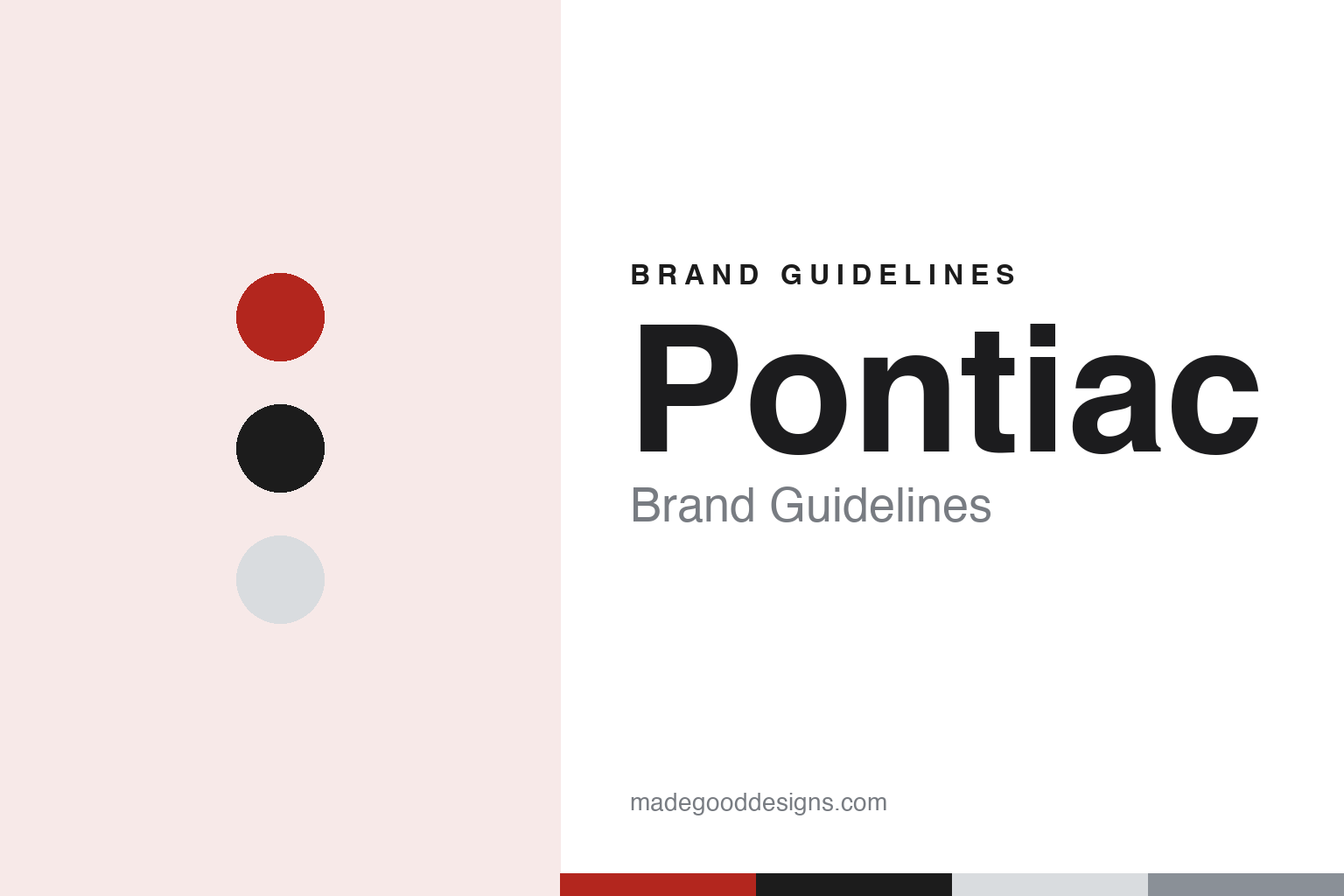
Pontiac Brand Guidelines
From Oakland’s companion to the red arrowhead.
Aa
Two constants: an arrowhead red, black and steel palette and a condensed display sans register. Abstract homage — not a Pontiac or General Motors product or mark; no badge, logo or nameplate is reproduced.
Oakland’s companion
A new GM make, named for a chief and a city.
Pontiac began in 1926 as a new make from General Motors, introduced as a lower-priced companion to GM’s Oakland cars, according to English Wikipedia and a 2010 history of the brand in The Truth About Cars. Oakland itself had been founded in 1907 in Pontiac, Michigan, by the carriage maker Edward Murphy, and had joined GM soon after William C. Durant set up the group; English Wikipedia says the first Pontiac was built in the same city.
The name came from a person before it came from a place. English Wikipedia says the make was named after Pontiac, the Odawa leader who led an uprising against British rule around Detroit from 1763, and who had already given his name to the city where the cars were made. The Truth About Cars describes the first Pontiac as an inexpensive six-cylinder car sold alongside the more expensive Oakland. The companion soon outgrew its parent: English Wikipedia says Pontiac had supplanted Oakland entirely by 1933, and the formal name became the Pontiac Motor Division of General Motors.
Pontiac was sold in the United States, Canada and Mexico. In Canada, English Wikipedia says, Pontiacs were built by GM of Canada from 1926, at plants in Oshawa, Ontario, and Regina, Saskatchewan, and Canadian buyers later had their own model names, such as Laurentian and Parisienne. In the early 1930s, The Truth About Cars reports, Pontiac’s manufacturing was combined with Chevrolet’s from 1932, and for the rest of its life the brand worked to set its cars apart from their Chevrolet relations. In GM’s line-up, English Wikipedia says, Pontiac sat above Chevrolet and below Oldsmobile, Buick and Cadillac.
Colour
Headdress, Silver Streaks and the Dart.
Pontiac’s visual identity can be traced on the cars themselves. English Wikipedia says a Native American headdress served as the brand’s logo until 1956, and was replaced for 1957 by a red arrowhead design that stayed for the rest of the brand’s life; the arrowhead is also known as “the Dart.” The older head was kept in one small place — the high-beam indicator lamp on the dashboard — until 1970. The same article describes the 1959 models as carrying an “Arrowhead” emblem with a star at its centre, running up the bonnet from between the split grille.
Before the arrowhead, the signature was chrome. The 1935 Pontiacs carried a bold ribbed band called the Silver Streak, The Truth About Cars says, echoing the fluted streamlined trains of the time. English Wikipedia describes the Silver Streaks as one or more narrow strips of stainless steel running from the grille along the centre of the bonnet, later extended to the boot lid and the tops of the fins, doubled to two strips for 1955 and 1956, and dropped in the same year as the headdress emblem.
The front end then became the trademark. English Wikipedia says the split grille, introduced in 1959 to go with the brand’s new “Wide Track” stance, was dropped for 1960, came back for 1961 and remained the marque’s signature from then on, along with a pointed “arrowhead” nose in the 1960s and 1970s. The renewal was led by Semon “Bunkie” Knudsen, who became general manager in 1956, according to English Wikipedia; one of his first steps was removing the Silver Streaks. The Truth About Cars says the Wide Track idea became an enduring marketing line, and credits the brand’s illustrated advertisements of the period to the team of Fitzpatrick and Kaufman.
The advertising followed the cars. English Wikipedia says that from the 1959 models Pontiac’s marketing concentrated on the way of life that owning the car promised rather than on the car itself, and that the brand leaned on its “Wide Track” design in doing so. Model names carried the older imagery for decades: the Chieftain, introduced with the 1949 models, the Star Chief from 1954, and the Canadian Strato-Chief.
Typography
Retired names, kept badges.
A car brand lives in a handful of physical objects long before it reaches a screen. The badge on the grille and the tailgate, the script on a front wing, the hood ornament where one exists, and the emblem moulded into a steering-wheel hub are all small pieces of metal or plastic that have to read at a glance and survive weather, washing and years of handling. Each one is a design brief in miniature: a mark that works in chrome, in paint and in relief, at the size of a coin and at the size of a showroom sign.
Dealer signage carries the same mark at architectural scale. Pole signs, fascia lettering, service-bay headers and the colours of a showroom interior turn a badge into a place, and they are usually specified by the carmaker so that one dealership looks like the next. When a manufacturer retires a marque, that whole system has to be undone in stages: signs come down or are re-skinned for a sister brand, parts and service support continue for cars already on the road, and the badges themselves pass into the hands of owners, clubs and collectors. A retired marque often keeps a second life in that afterlife, carried by the people who still drive and restore the cars.
Aa
A condensed display sans for a brand built on chrome strips and a pointed badge. (Specimen set in Oswald, a condensed sans STAND-IN; NOT the Pontiac logo.)
Retiring the Dart
A brand closed during GM’s restructuring.
Pontiac ended as part of GM’s restructuring in 2009. On 27 April 2009, Dow Jones Newswires reported, in a story carried by The Wall Street Journal’s online edition, that GM said it would eliminate its Pontiac brand by the end of the following year as part of a stepped-up restructuring plan. English Wikipedia quotes GM’s chief executive at the time, Fritz Henderson, calling the closure an “extremely personal decision,” and says a Michigan Pontiac dealer, Jim Waldron, said in May 2009 that he was interested in buying the brand and its logos; GM had already decided to retire it.
The last cars followed within months. English Wikipedia says the brand was withdrawn in Mexico after the 2009 model year, where its place was taken by a new name, Matiz, with a badge similar to Pontiac’s. In the United States, the last Pontiac — a white 2010 model-year G6 sedan built at GM’s Orion Township plant in Michigan — was shipped on 4 January 2010, and GM’s franchise agreements with Pontiac dealers expired on 31 October 2010, according to English Wikipedia, which adds that the car was acquired in March 2023 by the Pontiac Transportation Museum in Pontiac, Michigan. Pontiac is a retired brand, and GM no longer sells new Pontiac vehicles.
For a design guide, Pontiac shows how a badge can change completely — from a headdress to an arrowhead — while a car’s front end keeps the brand recognisable. Compare Chevrolet, the GM brand whose manufacturing Pontiac shared from 1932, and Oldsmobile, another GM brand that was retired. For this guide we use an arrowhead red, black and steel grey with a condensed sans, an unofficial interpretation; no product or logo is reproduced.
Explore & save
Keep Pontiac’s identity on hand — save it to a board in the Made Good inspiration library.
Pontiac identity set
Pin the Pontiac arrowhead red, black and steel palette and the condensed display sans register to your own board.