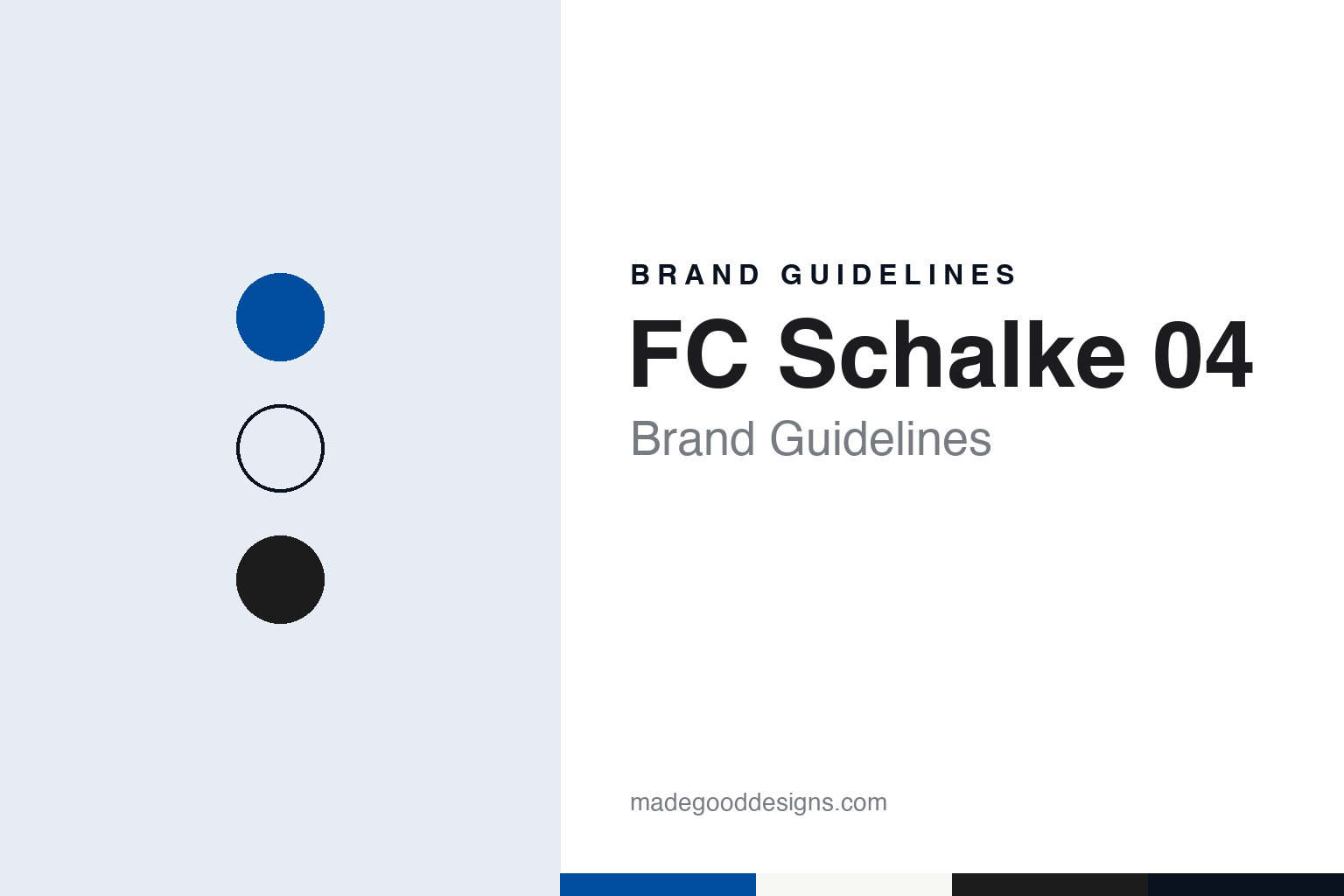
FC Schalke 04 Brand Guidelines
Royal blue and white, a pithead greeting and a hammer hidden in a letter.
Aa
Two constants: a Königsblau, pit white and coal palette and a condensed pithead sans register. Abstract homage — not an FC Schalke 04 product or mark; no crest, shirt or logo is reproduced.
Westfalia Schalke
A street-corner club in a mining district.
FC Schalke 04 takes its name from a district and a year. English Wikipedia says the club, officially Fußballclub Gelsenkirchen-Schalke 04 e.V., comes from the Schalke district of Gelsenkirchen in North Rhine-Westphalia, and that the “04” derives from its formation in 1904. It is often abbreviated to S04. Alongside football, the club runs athletics, basketball, handball, table tennis, winter sports and eSports sections.
The founding story is partly legend. German Wikipedia says that, according to tradition, a group of young people met on 4 May 1904 in the Hauergasse in Schalke; they were pupils and apprentices at the Zeche Consolidation colliery and at the kitchen-appliance maker Küppersbusch. They set up a loose club called Westfalia Schalke. The same source notes that no documents survive from the founding years, and that a few oral accounts printed in newspapers for club anniversaries grew over the century into a founding myth.
The early club had to work its way into organised football. English Wikipedia says Westfalia could not gain admittance to the Western German Football Association and played in one of the unofficial “wild” associations. In 1912 it merged with the gymnastics club Schalker Turnverein 1877 to gain entry to the official league, separated again in 1915, and rejoined in 1919 as Turn- und Sportverein Schalke 1877.
The modern name arrived in two steps. German Wikipedia says that at a meeting on 5 January 1924 the footballers split from the gymnasts and chose the name Fußballklub Schalke 04. English Wikipedia adds that in 1928, when the club opened a new stadium, it acknowledged the support of the city by renaming itself FC Gelsenkirchen-Schalke 04, the full name it still carries. The club remains a registered members’ association based in Gelsenkirchen.
The Ruhr daily WAZ reported on 2 May 2026 that Schalke had beaten Fortuna Düsseldorf 1–0 at home to return to the Bundesliga, under the headline “Der Fußball trägt Königsblau”, football wears royal blue, which uses the club’s own nickname as a shorthand for the club.
Colour
From red and yellow to royal blue, and a G drawn as a hammer.
The colours changed with the name. German Wikipedia says Westfalia Schalke’s colours were originally red and yellow, and English Wikipedia gives the same founding colours. When the footballers broke away in 1924 they adopted the blue and white kit that German Wikipedia records as the colours chosen at the January 1924 meeting.
Two nicknames came out of that period. English Wikipedia says that around 1923 the club picked up the name Die Knappen, from an old German word for miners, a reference to the coal miners of Gelsenkirchen. The blue and white kit gave the second name, Die Königsblauen, “the royal blues”. Both are still in everyday use in German coverage of the club, as the WAZ headline of May 2026 shows.
The club song carries the same industrial imagery. German Wikipedia says Hans J. König wrote the club song Blau und Weiß, wie lieb’ ich dich, “blue and white, how I love you”, and that its line about a thousand fires in the night refers to the flares from burning mine gas that lit the sky over the city after dark. Gelsenkirchen long carried the nickname “city of a thousand fires”.
The crest is built on the city as well as the club. German Wikipedia says the club badge has shown a stylised G enclosing the lettering S04 since 1945, the G standing for Gelsenkirchen. In 1958 the letter was redrawn so that its shape forms a stylised miner’s hammer, a reminder of the founding years. For a period, the outer edge of the logo was made of three concentric circles meant to visualise the Schalker Kreisel, the spinning-top passing style the team developed before the war.
The hammer is drawn into the G rather than added beside it, so the mining reference sits inside the initial of the city name.
Typography
Design and documentation.
South American club identities often grew out of a small, fixed set of visual devices that later designers inherit rather than invent. Colours tend to come first: a pair of shades chosen in a club’s early years becomes the base layer for crests, shirts, stadium seating and printed matter, and later redesigns usually work within that pair instead of replacing it. Shirt patterns carry much of the recognition. A diagonal sash cuts across a plain shirt from shoulder to hip and reads clearly at a distance; horizontal hoops wrap the body in alternating bands; vertical stripes divide it into columns. Each pattern behaves differently when reduced to a badge, a scarf or a social-media avatar, so club graphics often simplify the shirt into a few flat shapes. Stadiums add a second vocabulary. Many grounds are known by affectionate nicknames rather than their official names, and those nicknames appear on signage, merchandise and broadcast graphics. Animal mascots form a third layer, often adopted from supporters’ chants or newspaper cartoons before clubs formalised them. For a designer, the useful lesson is how a few durable elements — two colours, one pattern, a nickname and a creature — can carry an identity across generations of kits and media.
Aa
A condensed pithead sans — the register of a colliery sign and a stadium gate. (Specimen set in Saira Condensed, a sans-serif STAND-IN; NOT the FC Schalke 04 logo.)
FC Schalke 04
A pit greeting, three grounds and a miner as mascot.
The club’s grounds trace its move from colliery to motorway. German Wikipedia says the Glückauf-Kampfbahn, officially Kampfbahn Glückauf, was built on land of the former Zeche Consolidation and opened in 1928; it is named after the miners’ greeting Glückauf. English Wikipedia says it is still used by the club for ceremonial purposes, such as introducing new players and head coaches.
The club then moved twice. English Wikipedia says Schalke moved in 1973 to the Parkstadion, built for the 1974 World Cup, and German Wikipedia says the club played there until 2001, after which the Parkstadion was partly demolished in 2004. In August 2001 the team moved into the Arena AufSchalke, which German Wikipedia says has been called the Veltins-Arena since 2005 under a sponsorship agreement with the Veltins brewery.
The miner theme carries into match-day ritual. German Wikipedia says the miners’ song Steigerlied, in a version by the Ruhr singer Erwin Weiss, is sung before the teams come out, and that the club anthem Königsblauer S04, “royal blue S04”, is played after the final whistle. The official mascot is a young miner, a Knappe, named Erwin, who wears the number 04 for the founding year. German Wikipedia says Erwin was already known to fans from a column in the stadium magazine before he took up the mascot role in 1995, and that his predecessor was a plush mole called Wühli.
Sponsors have changed around the crest. English Wikipedia says the Chinese electronics maker Hisense has been a headline sponsor since 2022 and that the shirt sponsor since 2026 is the Beumer Group. Across those changes the shirt has stayed royal blue with white.
For a design guide, FC Schalke 04 shows how a club can fold its town, its founding year and its industry into one compact mark, and let a colour become its name. Compare it with Borussia Dortmund, its Ruhr neighbour in the Revierderby, and Bundesliga, the league it returned to in 2026. For this guide we use Königsblau, pit white and coal with a sans, an unofficial interpretation; no product or logo is reproduced.
Explore & save
Keep FC Schalke 04’s identity on hand — save it to a board in the Made Good inspiration library.
FC Schalke 04 identity set
Pin the FC Schalke 04 Königsblau, pit white and coal palette and the condensed pithead sans register to your own board.