Shoney’s Brand Guidelines
The Charleston drive-in that left Big Boy.
Aa
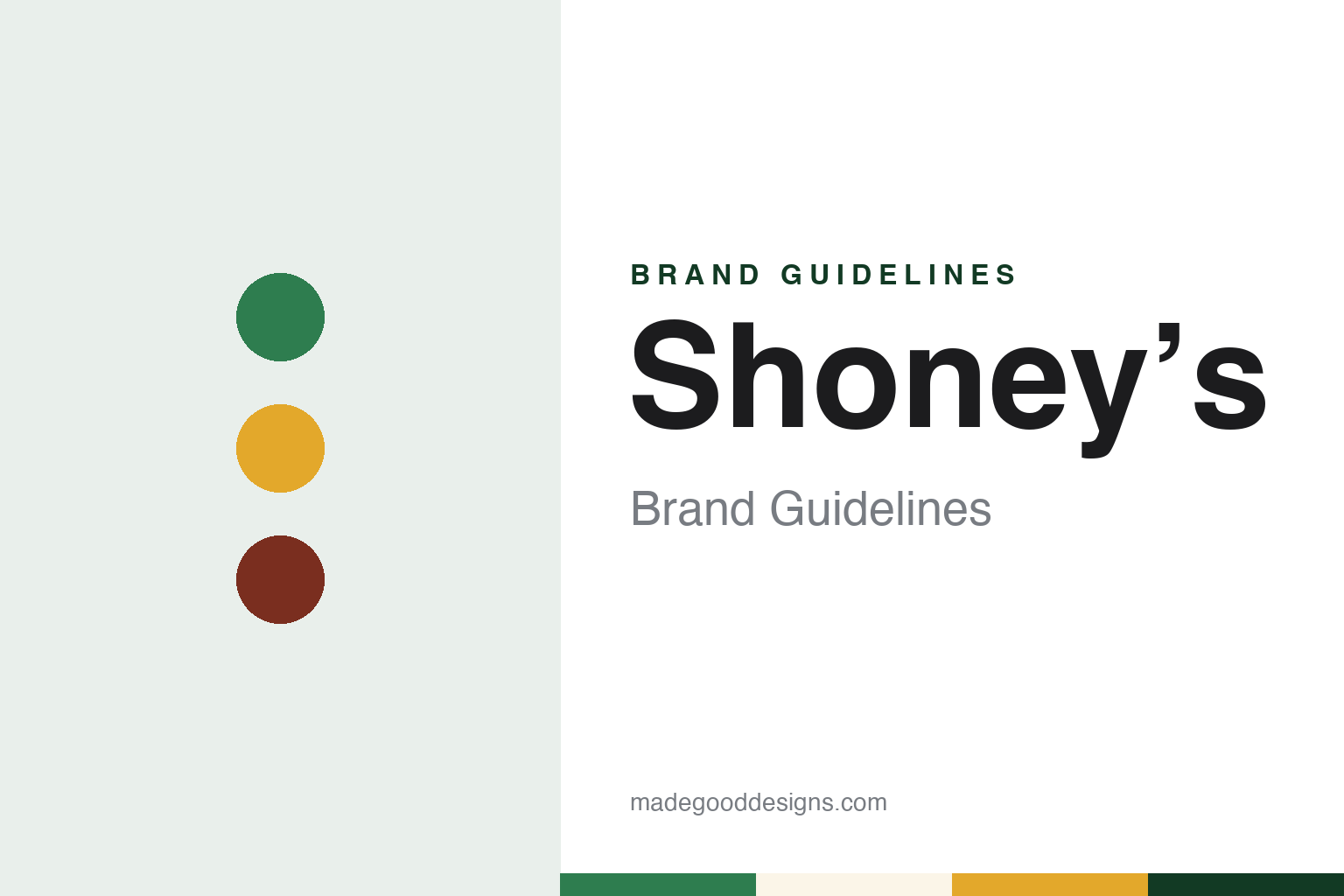
Two constants: a drive-in green, mustard gold and brick palette and a family slab serif register. Abstract homage — not a Shoney’s product or mark; no bear, sign or logo is reproduced.
Parkette
A drive-in, a franchise and a naming contest.
Shoney’s traces its start to 1947, when Alex Schoenbaum opened the Parkette Drive-In in Charleston, West Virginia, next to his father’s bowling alley, English Wikipedia says. FSR magazine, in March 2014, likewise described the Nashville company as tracing its roots to the 1947 opening of a Charleston drive-in, and the company’s own history dates its opening location to the same year.
The Parkette joined Big Boy early. Wikipedia says Schoenbaum met the Big Boy founder Bob Wian in 1951 and became a franchisee on 7 February 1952, calling his locations Parkette Big Boy Shoppes; its article on Frisch’s adds that his friend Dave Frisch, of Frisch’s Big Boy, introduced him to Wian. Wikipedia also credits Schoenbaum with persuading Wian to set up a formal franchising system. In May 1954 a public “Name the Parkette Big Boy Contest” was announced, and in June 1954 Schoenbaum’s drive-ins were renamed Shoney’s.
Schoenbaum grew the chain through subfranchising across the south-eastern United States, outside Florida, where the Big Boy rights belonged to Frisch’s. Wikipedia says early subfranchisees traded under their own names — Lendy’s in Roanoke, Virginia, Elby’s in northern West Virginia and Becker’s in Rochester, New York, among them — and that later subfranchises all used the Shoney’s name. One subfranchisee, Ray Danner, opened a Shoney’s Big Boy with a business partner in Madison, a Nashville suburb, in 1959. His company went public in 1969 as Danner Foods and launched the seafood restaurants that became Captain D’s, Wikipedia says.
In 1971, according to Wikipedia, Danner Foods bought the Shoney’s trademark and assets from Schoenbaum. Danner became president and chief executive, the headquarters and commissary moved from Charleston to Nashville, the companies took the name Shoney’s Big Boy Enterprises, and Schoenbaum became chairman of the board. Wikipedia says that as a director of a public company he closed his personally owned Shoney’s No. 1, the original Parkette drive-in, by 1975.
Colour
Leaving Big Boy, a bear mascot and new owners.
The Big Boy link then loosened. Wikipedia says stockholders approved renaming the company Shoney’s, Inc. in 1976, and that the company said the change reflected its range of food-service brands. It records that Big Boy grew less prominent at Shoney’s after that, and that in April 1984, following a federal court ruling in Shoney’s favour in a dispute with Frisch’s, Shoney’s bought out its franchise agreement from Marriott, then owner of the Big Boy trademark, and withdrew from the Big Boy system. The company’s own timeline puts the end of the affiliation in 1977 and says it swapped the Big Boy mascot for its own Shoney bear.
Wikipedia traces the bear through print. It says Shoney’s began publishing its own children’s comic in 1976, contracted to Paragon Products, and that after 75 issues the title became Shoney’s Fun and Adventure Magazine, introducing a Shoney’s bear mascot, Uncle Ed, in place of Big Boy so that it could serve Shoney’s restaurants outside the Big Boy system.
Shoney’s also lent its name to lodging. Wikipedia says the company founded Shoney’s Inn in 1975, sold the motels in 1991 while continuing to collect royalties on the name, and that the remaining Shoney’s Inns were rebranded as GuestHouse between 2002 and 2006.
Ownership changed in the following decades. In 1993 a federal court approved the settlement of a class action, joined by the NAACP Legal Defense Fund, that alleged racial discrimination in employment at Shoney’s company-owned restaurants, Wikipedia records, citing The Washington Post. The company filed for Chapter 11 bankruptcy protection in 2000 and was acquired by Lone Star Funds in 2002, Wikipedia says, citing The New York Times. On 1 January 2007, it says, Lone Star announced the sale of the chain to David Davoudpour, founder of the Atlanta-based Royal Capital Corporation. The company names Davoudpour as its chairman and chief executive, and its website is published by Shoney’s North America, LLC; Wikipedia and FSR both place the headquarters in Nashville.
Typography
Design and documentation.
The restaurant names in this group grew up along American highways and suburban roads, where a chain had to be recognised from a moving car long before anyone read a menu. In that setting a brand’s identity is carried as much by buildings as by printed matter: a tall pole sign that can be seen from the road, a roof shape repeated from one site to the next, a colour that marks the building at a distance, and a name lettered large enough to read at speed.
Inside, the same identity continues in smaller pieces — the menu board and printed menu, placemats, cups and wrappers, staff uniforms and, for many chains, a character or mascot meant to make the name friendly and easy to remember. Because restaurant chains are often sold, merged, franchised or licensed, those pieces can outlast the company that first commissioned them, and a sign or roof can stay in place long after ownership has changed.
Each guide separates what independent sources record from what the company says about itself — who started the chain, who has owned and franchised it since, and how its name, signs and buildings have changed — and marks plainly what rests only on the company’s own word.
Aa
A family slab serif — the register of a roadside sign and a laminated menu. (Specimen set in Bitter, a slab-serif STAND-IN; NOT the Shoney’s logo.)
Shoney’s
A borrowed mascot, then one of its own.
Shoney’s visual history falls into two eras. Under Big Boy it used the franchisor’s character: Wikipedia says that before 1954 the Parkette used both the East Coast and West Coast versions of the Big Boy, though never together, and that from 1956 the West Coast design was used by all franchisees other than Frisch’s and its subfranchisees. After leaving Big Boy, the company says, it adopted the Shoney bear as its own mascot. The name itself followed a public naming contest, which Wikipedia dates to May 1954.
The menu carries names from the Big Boy years. Wikipedia says Shoney’s contributed the Slim Jim sandwich and the hot fudge cake to the Big Boy system, and it lists the All American Burger, the Slim Jim, hot fudge cake and strawberry pie among Shoney’s signature items, adding that the chain became known for its breakfast bar from the 1980s.
Recent design work has focused on the restaurants themselves. FSR reported in March 2014 that a prototype inside the Sugarloaf Mills outlet mall in Lawrenceville, Georgia, opened that January under the company’s own billing as a “family casual-dining concept,” with liquor service and a takeout counter called Shoney’s On the Go. Wikipedia says the chain began modernising locations with a contemporary look in 2017.
For a design guide, Shoney’s shows how a franchisee can build its own name inside a licensed system and then replace the borrowed mascot with one of its own. Compare it with Big Boy, the system it grew up in, and Friendly’s, another American family-restaurant name. For this guide we use drive-in green, mustard gold and brick with a serif, an unofficial interpretation; no product or logo is reproduced.
Explore & save
Keep Shoney’s’s identity on hand — save it to a board in the Made Good inspiration library.
Shoney’s identity set
Pin the Shoney’s drive-in green, mustard gold and brick palette and the family slab serif register to your own board.