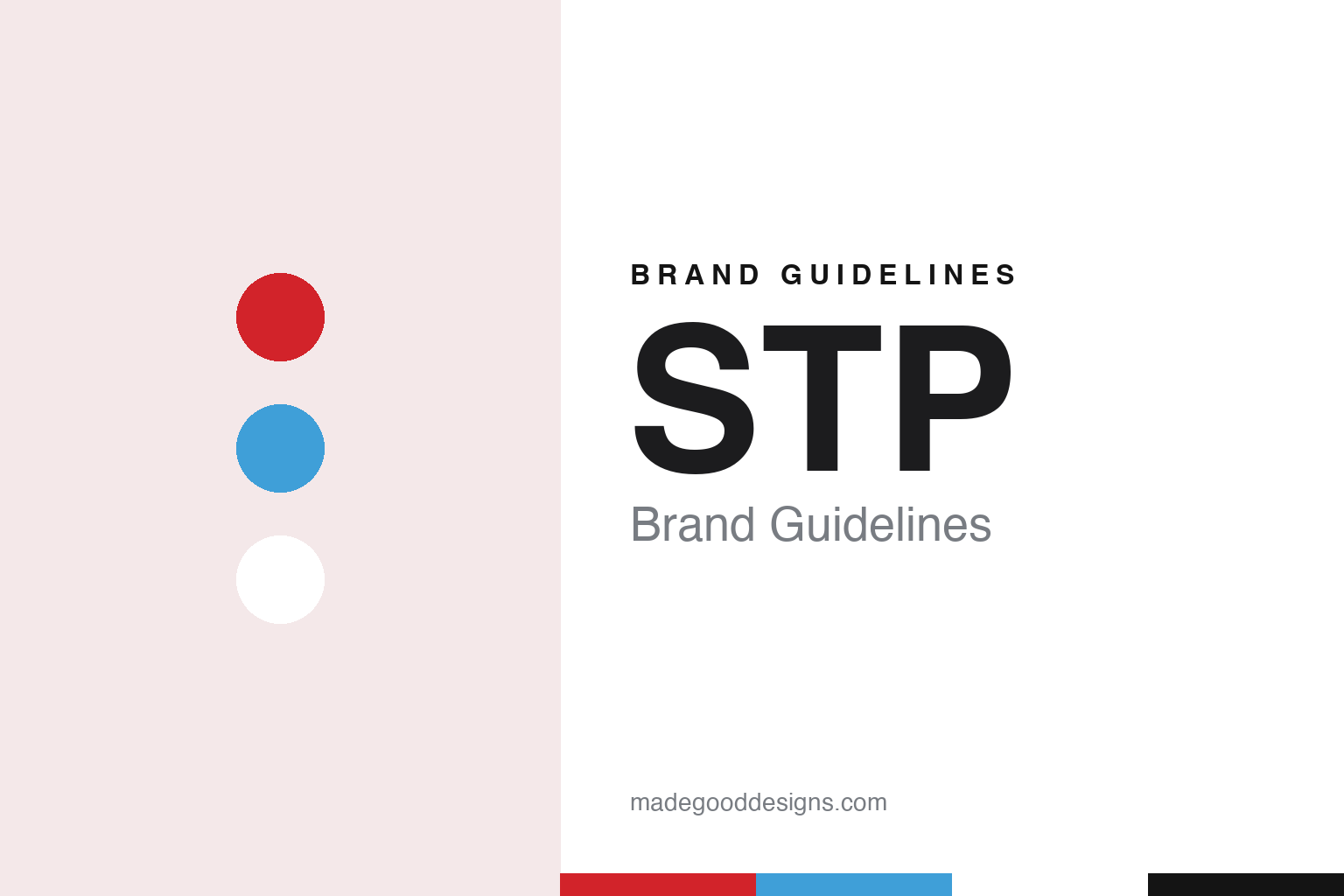
STP Brand Guidelines
Three letters in a red oval that went racing for decades.
Aa
Two constants: a red, blue and white palette and an italic grotesque register. Abstract homage — not an STP product or mark; no can, oval logo or race car is reproduced.
Scientifically Treated Petroleum
An oil treatment from St. Joseph, Missouri.
STP began in St. Joseph, Missouri. English Wikipedia says the company behind it, Chemical Compounds, was founded there in 1953 by Charles Dwight (Doc) Liggett, Jim Hill and Robert De Hart, and that its sole product, STP Oil Treatment, was introduced in 1954. The brand’s own history page dates the introduction to October 1954, and says the founders packaged the oil treatment in a backyard garage at night and sold it from the trunks of their cars on business and pleasure trips.
The three letters came from a phrase. English Wikipedia says the name was derived from “Scientifically Treated Petroleum.” After the Studebaker-Packard Corporation bought the company in 1961, the article says, Studebaker briefly tied the letters into its own advertising as “Studebaker Tested Products.” The company’s history page says early growth came from word of mouth and from the brand’s link to auto racing, and dates the arrival of a second product, STP Gas Treatment, to 1960–1961.
The figure who became the public face of the brand was Andy Granatelli. English Wikipedia says the Studebaker-Packard chief executive Sherwood Egbert believed STP could one day outgrow its parent and recruited Granatelli as chief executive of STP to raise the product’s image; the company’s history page dates his appointment to 1963 and says he grew the brand’s marketing through auto and boat racing. Wikipedia describes Granatelli turning up at races in a white suit carrying the red oval STP logo, and handing out all-weather STP stickers.
Studebaker itself left the car business in 1966. English Wikipedia says the company then put its effort into its other divisions, including the petroleum business that held STP, and that STP was spun off as a publicly traded company in 1969. The history page adds that its shares went on the American Stock Exchange under the symbol “STP.”
Colour
Indianapolis, the No. 43 and Day-Glo red.
Racing became the brand’s advertising stage. English Wikipedia says Granatelli entered two Novi specials in the 1964 Indianapolis 500, driven by Jim Hurtubise and Bobby Unser, and that an hour-long black-and-white film, Way of a Champion, was made about the 1964 and 1965 races and centred on the Novis. STP’s history page says that in the late 1960s the company sponsored its own Indy car team featuring Mario Andretti, who won the 1969 Indianapolis 500. In 1970, Wikipedia says, Granatelli set up an STP Formula One team for Andretti, running a March Engineering chassis.
The partnership that fixed the brand’s colours in the public mind began in 1972. An article on STP’s website by the motorsport writer Mike Harris tells how Granatelli approached Richard Petty about putting the company’s logo on the No. 43 car. The two agreed terms, the article says, until Granatelli told Petty the car would be Day-Glo Red, the STP colour, and Petty answered that it had to be Petty Blue. The next morning they settled on a two-tone car in both colours. STP’s Legacy Motor Club page says the relationship began with a victory at Riverside International Raceway on 23 January 1972.
English Wikipedia says STP sponsored Petty through the end of his driving career in 1992, then the No. 43 of Petty Enterprises with Bobby Hamilton and John Andretti, until shortly after the Clorox acquisition. The company’s history page says Hamilton returned the No. 43 to victory lane at Phoenix in 1996. The brand came back to stock-car racing in the 2010s: Wikipedia says that in February 2013 STP announced a multi-year deal for the STP Gas Booster 500 at Martinsville Speedway, beginning on 7 April 2013, and that it became title sponsor of the World of Outlaws Sprint Car Series for 2013.
STP’s Legacy Motor Club page says the relationship with the Petty family continues. Its history page says that in 2018 Richard Petty Motorsports hired Darrell “Bubba” Wallace Jr. to drive the STP No. 43, and that on 4 September 2022 Erik Jones won the Southern 500 at Darlington Raceway in the car. In 2023, the company says, STP was primary sponsor of Jones’s entry for the NASCAR All-Star Race at North Wilkesboro Speedway.
Typography
Car care and its owners.
The brands in this group sell antifreeze, engine additives, waxes and polishes, and they meet buyers on the same shelf of a car-parts store or a supermarket aisle. Products of this kind are usually chosen in a few seconds, standing in front of rows of jugs, bottles, tins and tubs, so the pack does much of the work that a showroom or a salesperson would do for other goods.
A car-care brand’s identity is carried less by a single product than by its containers: the shape and colour of a plastic jug, the label wrapped around a small additive bottle, the lid of a round wax tin or the cap of a polish bottle. Names on those packs may also outlast the companies that created them, passing from founders to larger groups and from one market to another.
Each guide separates what independent sources record from what the company says about itself — its founding story, its owners over time, where its products are made and how its packaging and advertising have changed — and marks plainly what rests only on the company’s own word.
Aa
An italic grotesque for a racing-sticker brand. (Specimen set in Archivo Italic, a sans STAND-IN; NOT the STP oval logo.)
Owners
From Studebaker to Energizer.
STP changed hands often after it went public. English Wikipedia says it was acquired by Esmark in 1976, which was bought by Beatrice Foods in 1984, and that Beatrice sold STP to Union Carbide the following year; the article cites a Los Angeles Times report of 10 April 1985 on Union Carbide’s plan. In 1986, it says, Union Carbide’s auto products, including STP’s stablemates Prestone and Simoniz, went through a leveraged buyout, and the resulting company, First Brands, was bought by Clorox in 1998. In the autumn of 2006, Wikipedia says, STP fuel additives began to be used in Marathon gasolines.
In 2010, according to the same article, Clorox sold STP and Armor All to the private equity firm Avista Capital Partners, which named the business Armored AutoGroup; in April 2015 Armored AutoGroup was acquired by Spectrum Brands. On 28 January 2019, Energizer Holdings announced the closing of its acquisition of Spectrum Brands’ global auto care business, which brought STP together with Armor All and A/C Pro. Energizer has owned STP since 2019, and the brand’s website now credits the trademark to Energizer Auto. In December 1995 STP settled Federal Trade Commission charges over advertising for an engine treatment, English Wikipedia says, citing the agency.
The range has grown well beyond the oil treatment. STP’s website sorts its products into Engine & Fuel Systems, Functional Fluids, Maintenance & Other and Licensed Products, alongside an STP Pro Series; the company’s history page dates a Complete Fuel System Cleaner to 1996 and the Ultra 5-in-1 Fuel System Cleaner to 2014, the brand’s 60th anniversary year, when it also hosted the STP 500 at Martinsville. A country selector points to editions for markets across the Americas, Europe and Asia.
For a design guide, STP shows how three letters, an oval and a racing livery can stand for a product sold in a can, and how a sponsorship colour argument can become a brand asset. Compare Armor All, its stablemate at Clorox, Avista, Spectrum and Energizer, and Prestone, which shared Union Carbide and First Brands with it. For this guide we use oval red, No. 43 blue and white with an italic sans, an unofficial interpretation; no product or logo is reproduced.
Explore & save
Keep STP’s identity on hand — save it to a board in the Made Good inspiration library.
STP identity set
Pin the STP oval red, No. 43 blue and white palette and the italic grotesque register to your own board.