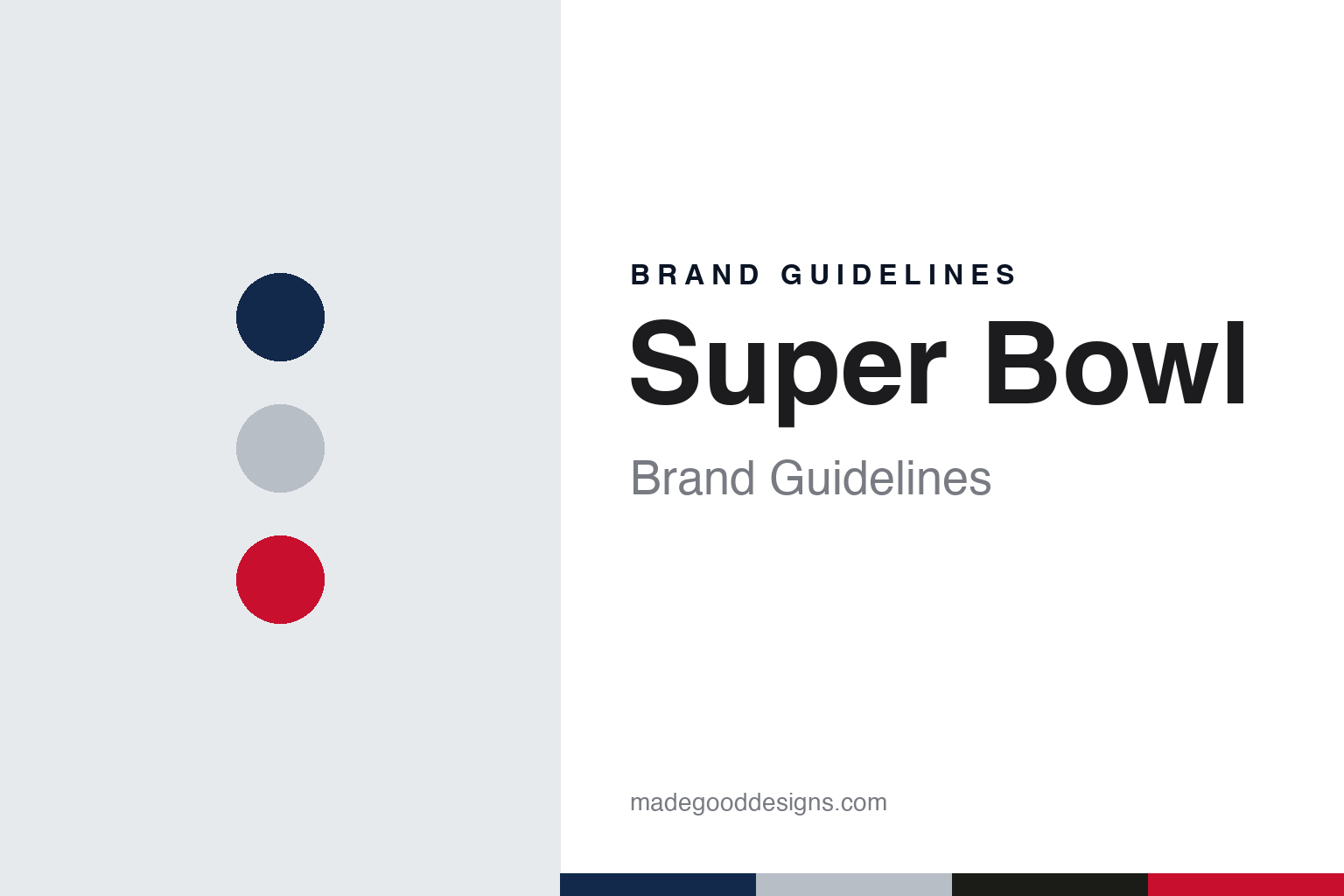
Super Bowl Brand Guidelines
A name borrowed from a child’s bouncing ball, numbered like a monument.
Aa
Two constants: a navy, silver and red palette and a condensed sans register for numerals. Abstract homage — not the Super Bowl logo, the Lombardi Trophy or any NFL mark; no logo is reproduced.
Kansas City
A placeholder name that the press would not let go.
The game was born from a merger. English Wikipedia says the championship was established as part of the 1966 agreement between the National Football League and the rival American Football League, which set up a game between the two leagues’ champions. The owners’ chosen title was formal and long: the AFL–NFL World Championship Game. Sports Illustrated, reviewing the game’s logos in January 2025, notes that the early designs did not say “Super Bowl” at all but carried a long title naming a “World Championship Game” between the AFL and the NFL.
The shorter name came from Lamar Hunt, owner of the AFL’s Kansas City Chiefs. Wikipedia says Hunt used the term “Super Bowl” for the championship game during the merger meetings in the mid-1960s, and that he later said the name was probably in his head because his children had been playing with a Super Ball, the high-bouncing toy. A vintage example of the ball is on display at the Pro Football Hall of Fame in Canton, Ohio. In a letter to NFL commissioner Pete Rozelle dated 25 July 1966, Hunt wrote that he had “kiddingly called it the ‘Super Bowl,’ which obviously can be improved upon.”
It was not improved upon. Wikipedia says the Kansas City Star quoted Hunt using the phrase that July, and the press picked it up at once. The league itself was lukewarm: in May 1967 it said that not many people liked the name, calling it a bad play on words, and Rozelle asked for suggestions such as “Merger Bowl,” “Summit Bowl” and “The Game.” None displaced it. Both Wikipedia and Sports Illustrated say “Super Bowl” became the official name from the third game, in 1969.
The numbering followed two years later. Wikipedia says Roman numerals have identified each game since Super Bowl V, played in January 1971, and that the numerals were applied retroactively to the four games before it. That choice tied each edition to a season rather than a calendar year, because the game is played in the year after the season it concludes. The only break came at Super Bowl 50, played on 7 February 2016, which used Arabic numerals for marketing reasons; the following year the league went back to Roman numerals with Super Bowl LI.
The trophy acquired its name at the same point. Wikipedia says the winners’ trophy was named after Vince Lombardi, the former Green Bay Packers coach, in 1970, and that it was presented under that name from Super Bowl V, in Miami. Four decades later the same trophy would become the centre of the game’s logo.
Colour
Red, white and blue, then a peach, a flower and a lighthouse.
For its opening decade the game barely had a logo. Todd Radom, a designer and sports branding consultant, told ESPN in February 2025 that the early Super Bowls did not have formalised logos because there was little need for them: not much merchandise was sold with the marks, and they were not shown on the field. Sports Illustrated describes the early designs as straightforward, simply “Super Bowl” followed by the Roman numerals, with the typeface and colours changing each year.
Colour followed the flag for a long time. ESPN says red, white and blue dominated the logos from 1967 until the early 1990s, with exceptions such as Super Bowls IV, VI, XV and XVI, whose bold gold lettering stood apart. Host-city elements arrived gradually. ESPN points to Super Bowl XXI in 1987, played at the Rose Bowl in Pasadena, whose logo included the venue’s signature flower.
The local turn was commercial as well as decorative. Chris Creamer, founder of SportsLogos.net, told ESPN that the NFL saw an opportunity to sell far more Super Bowl merchandise in the early 1990s, and that by Super Bowl XXVIII in 1994 the league was leaning into designs that would appeal to local fans, who were the people likely to attend. That game, played at the Georgia Dome in Atlanta, used a peach, Georgia’s state fruit. Creamer singled out the Mardi Gras influences of Super Bowl XXXI in New Orleans in 1997 and the San Diego lighthouse in the logo for Super Bowl XXXVII in 2003. Radom, who designed the logo for Super Bowl XXXVIII in Houston in 2004, told ESPN that the logos of that era were deeply rooted in the location of each game and looked like the moment in which they were played. The habit lasted into 2005, when Jacksonville placed one of its bridges behind the lettering.
The marks also moved onto the players. ESPN’s Uni Watch column, published in February 2016, traced the history of the Super Bowl jersey patch: logo patches appeared on game jerseys from Super Bowl XXV, played in January 1991, and became a standard part of the uniform later in that decade. Some teams have worn the patch on the right side of the chest rather than the left, because a team logo or a memorial patch already occupied the usual spot.
Radom also described a quieter change behind the scenes. He told ESPN that after the creative burst of the 1990s, an emphasis on focus groups formalised the design process, while computers let designers experiment with more colours and outlines.
Typography
Numerals, a trophy and a stadium.
A sporting event is an unusual kind of brand. It has no product on a shelf and often no single owner of the kind a company has; instead it is held together by a name, a date on the calendar and a set of objects and rituals that recur each time it is staged.
Trophies frequently become the mark itself. A cup, a figure or a plate is drawn, simplified and printed on tickets, broadcasts and merchandise, so that the object handed to the winner also works as the event’s signature. Host venues do similar work: a clubhouse, a finish line, a grandstand or a stretch of road is photographed so often that its outline turns into shorthand for the whole occasion.
Traditions add another layer. A jacket, a garland, a particular flower, a colour worn on the day or a song sung before the start can be as recognisable as any wordmark, and organisers tend to protect them carefully. Finally, sponsor naming sits alongside all of this. Presenting partners, official suppliers and naming rights put commercial marks next to the event’s own, and the way an organiser balances or limits them is itself a design decision worth studying.
XLV
A tall condensed sans — the register of a stadium scoreboard and a ticket stub. (Specimen set in Oswald, a sans-serif STAND-IN; NOT the Super Bowl logo lettering or any NFL typeface.)
Super Bowl
One template, then the host cities came back.
In 2011 the league stopped redesigning from scratch. ESPN’s Uni Watch column said in February 2016 that the era of distinct Super Bowl logos ended with a standardised template built around the Vince Lombardi Trophy, to be used for every game that followed, and that the league moved at the same time from embroidered cloth jersey patches to a plastic, heat-sealed product. ESPN reported in February 2025 that from Super Bowl XLV, played in 2011, the trophy became a prominent part of the logo, that a depiction of the host venue was included behind it, and that silver was the only colour until gold was added for Super Bowl 50 in 2016.
Designers were not all persuaded. Radom told ESPN that the early years of the standard logo were all monochromatic, and that the trophy, while recognisable, is a limiting shape to work with when it has to be combined with Roman numerals. ESPN says silver remained the main hue from Super Bowl LI through Super Bowl LIV, now paired with two accent colours that changed each year.
The league reopened the door in 2022. ESPN says the shades of the numerals for Super Bowl LVI referred to the host city with palm trees for Los Angeles, and Super Bowl LVII in 2023 used a desert-like illustration for Arizona. The Super Bowl LVIII logo for Las Vegas in 2024 carried outlines of casinos and the “Welcome to Las Vegas” sign in a purple and reddish gradient with gold outlines. For Super Bowl LIX in New Orleans in 2025, ESPN reported, the artist Tahj Williams made an intricately beaded patch in red and green using the methods of the city’s Black Masking Indian tradition. Radom estimated that each logo is finished roughly eighteen months to two years before its game.
The name itself is guarded closely. Wikipedia says the NFL owns “Super Bowl” as a registered trademark and actively discourages unauthorised commercial use of it and of “Super Bowl Sunday,” which is why unsanctioned advertisers talk about “the Big Game.” In 2004 the league sent cease-and-desist letters to Las Vegas casinos hosting Super Bowl parties, and many renamed them “Big Game” parties. In 2006 it applied to trademark “The Big Game” as well, then withdrew the application in 2007 after opposition from Stanford University and the University of California, Berkeley, whose annual football meeting has carried that name since 1892.
For a design guide, the Super Bowl shows how a numbering system and a trophy silhouette can carry an event identity while the artwork around them changes with each host city. Compare the NFL, whose shield sits above the whole league, and the Masters Tournament, another American sporting event that guards its name and its imagery closely. For this guide we use shield navy, trophy silver and numeral red with a condensed sans, an unofficial interpretation; no product or logo is reproduced.
Explore & save
Keep Super Bowl’s identity on hand — save it to a board in the Made Good inspiration library.
Super Bowl identity set
Pin the Super Bowl-inspired navy, silver and red palette and the condensed sans register to your own board.