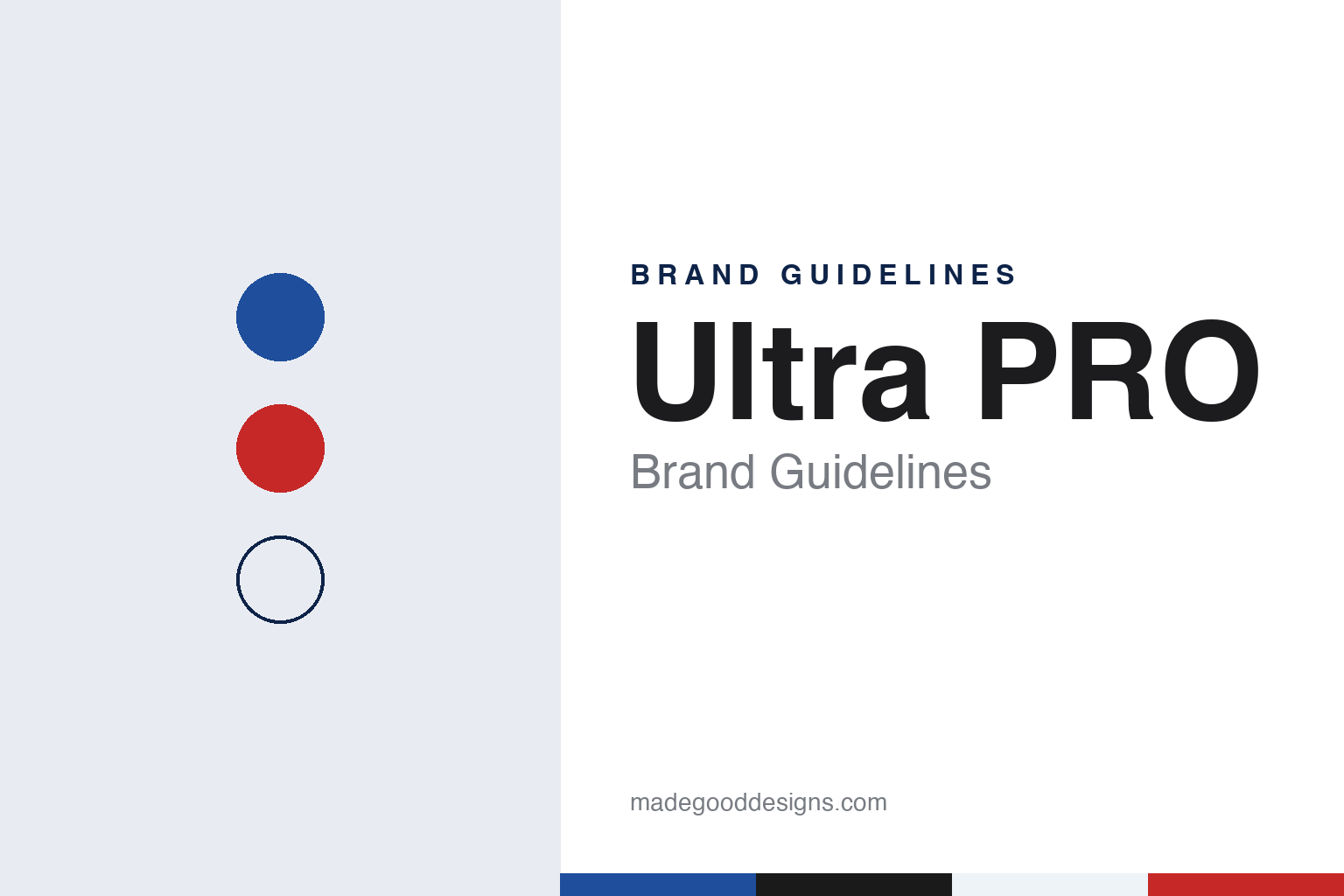
Ultra PRO Brand Guidelines
The Commerce, California card-protection maker that began as Rembrandt.
Aa
Two constants: a collector blue, archive black and clear-sleeve palette and a condensed collector sans register. Abstract homage — not an Ultra PRO product or mark; no sleeve, package or logo is reproduced.
From photo pages to card pages
A photo-album business that followed collectors.
Ultra PRO is the card-protection and collectibles-storage company of Commerce, California, in the Los Angeles area, whose products include card sleeves, rigid card holders, binders, deck boxes and playmats. The company says it has been “designing and manufacturing” products since 1952. Its story, as told by the company, starts with photography rather than games. In a 2011 interview on the trading-card maker Upper Deck’s blog, Lynne LaPlaca, then general manager of Ultra PRO’s collectibles division, said: “We were founded as Rembrandt initially.” She credited the company president, Robbie Shipp, with introducing PVC-free pocketed pages to the photo industry, and said that in 1988, when the only pages available to card collectors were PVC, the company began supplying card collectors with the same PVC-free pages, including a nine-pocket page that it handed out at trade shows.
A company profile published by the Chicago Toy & Game Group in September 2020 gives the same arc in broader strokes: beginnings in photo albums and photo pages; storage for sports cards and memorabilia in the 1970s and 1980s as card collecting grew; and, in 1995, card protection for the collectible card games that had then appeared. The company’s European store describes Ultra PRO International LLC as making accessories for sports and gaming collectibles and photo and scrapbooking albums and pages.
On its websites the company writes its name as Ultra PRO, with the second word in capitals; the 2007 trade coverage of its sale wrote it both as Ultra Pro and as Ultra*Pro.
Colour
Licences, sleeves and named product lines.
Much of Ultra PRO’s visible design work sits on other people’s worlds. In August 2006 ICv2 reported that the company had acquired the rights from Wizards of the Coast to produce card protection featuring the Magic: The Gathering brand, starting with tournament sleeves that October and following with deck protectors, deck boxes and portfolios. The same report noted that it already made card protection with the Pokémon brand, supplies carrying the work of fantasy illustrators, and products under a new NBA licence.
Today Ultra PRO’s US website sells accessories organised by licence — Pokémon, Magic: The Gathering, Dungeons & Dragons and Warhammer 40,000 among them — alongside its own named lines. Several of those names are trademarks the company prints in capitals with a registered sign: TOPLOADER sleeves for rigid card storage, ONE-TOUCH magnetic holders, DECK PROTECTOR sleeves and PRO-BINDER albums.
The company’s site also describes divisions beyond storage. Its Entertainment division publishes family board games and electronic toys; its TableTopics division sells conversation-starter card sets; and its SP Images division distributes collectible trading cards and memorabilia to retailers in the United States. Alongside the Commerce headquarters, the site lists satellite facilities in Ohio, Massachusetts, Minnesota and Belgium, while the European store says the company supplies customers mainly from its California warehouse, with a secondary warehouse in Rotterdam.
Typography
Design and documentation.
The seven brands in this group are all board game publishers and accessory makers: Stronghold Games, Ultra PRO, Indie Boards & Cards, Kolossal Games, Board&Dice, Hachette Boardgames and Lucky Duck Games. Names in this trade sit at many different points, from small studios still run by the people who started them to labels that now belong to much larger toy, book or games groups, and a single game can pass through a designer, a publisher, a crowdfunding page and a distributor before it reaches a table.
A board game publisher’s identity is usually carried less by one box than by a logo on many boxes, a name and the kind of game it promises, because the company behind the name may have changed hands, licensed its games abroad or had them manufactured far from where they were designed. That makes the questions behind each name worth asking plainly: who started it, who owns it now, and where its games are actually made.
Each guide separates what independent sources record from what the company says about itself — its founding story, its owners over time, where its games are made and how its look has changed — and marks plainly what rests only on the company’s own word.
Aa
A condensed sans — the register of capitalised product names on a hang-tag. (Specimen set in Barlow Condensed, a sans STAND-IN; NOT the Ultra PRO logo.)
Ultra PRO
Private equity, acquisitions and a games division.
Ownership has changed at least once in the documented record. On 1 June 2007 the Los Angeles investment firm Marlin Equity Partners announced that it had acquired Ultra Pro, then described as a maker of storage products for sports and gaming collectibles, photographs and multimedia, and owner of the 7gypsies scrapbooking brand; Adam Lerner joined as chief executive. Marlin’s principal George Kase said the firm expected it to be the first of several acquisitions as it built Ultra Pro into “a global, diversified consumer products company.” In January 2008 Marlin announced that its portfolio company Ultra Pro had added the scrapbooking brand Chatterbox, with both brands to be based in Commerce. Today the company describes itself as “privately-held, family-owned,” with head offices near Los Angeles.
The move into games came by acquisition. In August 2015, ICv2 reported, Ultra PRO International LLC acquired Jolly Roger Games, the Illinois publisher founded by Jim Dietz in 1996, and kept it as a separate unit under Dietz; Jolly Roger’s titles then included the Lovecraft-inspired card game Cthulhu’s Vault, designed by Richard Launius with Dietz, and the two-player Cuban missile crisis game 13 Days. In January 2016 the company hired Sean Lashgari to lead a new Entertainment division. In September 2016 it signed an agreement to buy Playroom Entertainment, the publisher of Killer Bunnies and Geek Out!, with founder Dan Rowen joining to manage the line; ICv2 counted it as the fourth deal in thirteen months, after Jolly Roger, Ruby Mine, the maker of TableTopics, and licensing rights to Stone Blade Games’ titles, including Ascension. The Playroom deal, ICv2 reported, would bring long-delayed releases such as Sitting Ducks Deluxe and a new all-ages social game, Pass the Pandas — a title the company’s US site still lists among its games.
For a design guide, Ultra PRO shows how an accessories brand can work in the background of other brands’ art, with licensed artwork on the outside and its own capitalised product names on the line. Compare Stronghold Games, a hobby publisher whose games go into those sleeves, and Kolossal Games. For this guide we use collector blue, archive black and a clear-sleeve tint with a condensed sans, an unofficial interpretation; no product or logo is reproduced.
Explore & save
Keep Ultra PRO’s identity on hand — save it to a board in the Made Good inspiration library.
Ultra PRO identity set
Pin the Ultra PRO collector blue, archive black and clear-sleeve palette and the condensed collector sans register to your own board.