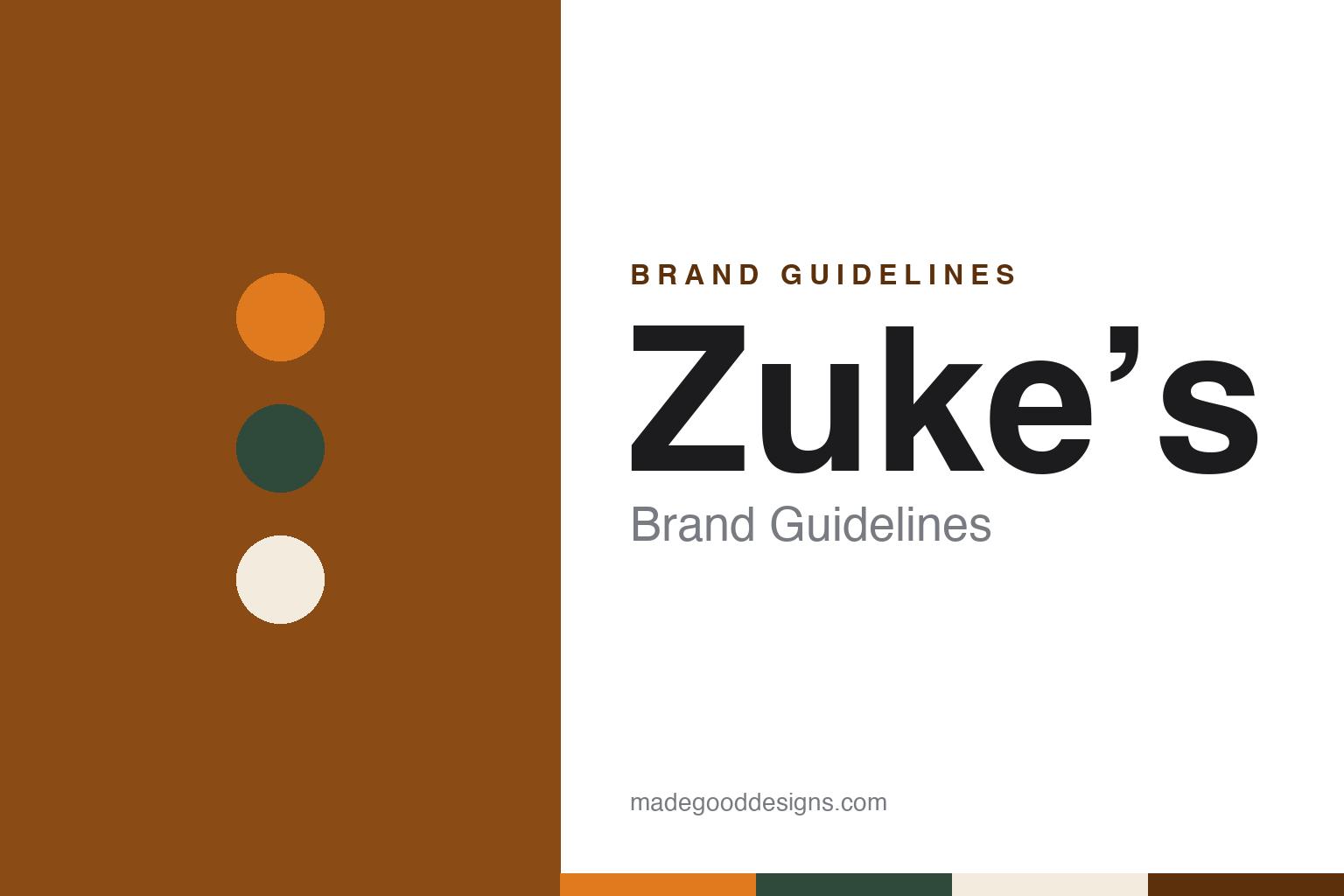
Zuke’s Brand Guidelines
The Durango dog treat owned by Nestlé Purina since 2014.
Aa
Two constants: a trail orange, forest and sandstone palette and an outdoor slab serif register. Abstract homage — not a Zuke’s product or mark; no treat, pack or logo is reproduced.
Patrick and Zuke
A hike, a shared energy bar and a garage in Durango.
Zuke’s is named after a dog. Its founder, Patrick Meiering, named the company after his chocolate Labrador, Zuke, Private Equity Wire reported in January 2014, and the company tells the same story. On its website Zuke’s says that in 1995 Meiering was on a hike with Zuke and shared his energy bar with the dog so that they could finish the trek; in a video on the same site, Meiering says the first Zuke’s treat was made in his garage after that hike.
The local press tells a similar version. In November 2010 the Durango Herald profiled Meiering as the company’s founder, chief executive and, in his own title, “Head Bone Maker.” The paper reported that the business had started with natural energy bars for dogs, an idea that came after Zuke was worn out on a mountain hike, and that it had grown from Meiering’s garage some fifteen years earlier.
The name itself came later than the product. Speaking at a Durango investor showcase in 2017, Meiering said, according to the Durango Herald, that his first product was an energy bone for dogs sold as the Power Bone, and that a threatened lawsuit from the company behind PowerBar prompted him to name the business after his dog instead. In that account he started the company in his apartment rather than his garage; the Herald’s 2017 report also dated the sale to Nestlé Purina to 2013, while the trade reports of the deal appeared in January 2014.
Zuke’s was a Durango, Colorado company. The company says it was founded there, and in 2018 the Durango Herald described it as founded in Durango in 1995 and long seen locally as a business success story. By 2010, the Herald reported, it had more than ten product lines and sold through independent pet stores, natural grocers and outdoor retailers in the United States, Canada and Asia; by 2018, the paper later reported, its products were stocked by chains including Petco, PetSmart and Whole Foods Market as well as by local shops in Durango. Meiering also told the paper that year that he had recently brought new investment capital into the business and hired three senior executives.
Colour
From private equity to Nestlé Purina.
The investor behind that growth was Encore Consumer Capital, a private equity firm. On 15 January 2014 Private Equity Wire reported that Encore had completed the sale of its portfolio company Zuke’s, which it described as a marketer of dog and cat treats, to Nestlé Purina PetCare. In the announcement Meiering credited Encore with helping to recruit management and sales staff, while Encore’s managing director, Scott Sellers, said Zuke’s would continue under a trusted organisation. Nestlé Purina has owned Zuke’s since 2014.
At first the brand kept its own base. Pet Worldwide reported on 23 January 2014 that Zuke’s and its employees would continue to operate as an independent company headquartered in Durango, and that its treats would continue to be made in the same factories as before. Both reports described Zuke’s at the time as a maker of cat treats as well as dog treats; the brand’s current website is devoted to its dog treats.
That changed four years later. On 11 January 2018 the Durango Herald reported that Zuke’s Pet Nutrition would join Merrick Pet Care, a Texas-based natural pet-food company also owned by Purina, and would move from its longtime headquarters on Main Avenue in Durango to consolidate its operations with Merrick in northwest Texas. The paper reported that the move would bring job losses. A Merrick spokesman told the Herald that Zuke’s would keep a presence in Durango, where its office would become a “retail innovation hub,” and Zuke’s general manager, Brent Gleckler, said the aim was to build one organisation to better serve the pet-specialty trade and to realise Zuke’s growth potential.
On where its treats are made today, the company’s answer is brief: its website says Zuke’s dog treats “are manufactured in USA facilities,” without naming them.
Typography
Design and documentation.
The seven brands in this group are all dog treat names: Greenies, Zuke’s, Milk-Bone, Dentastix, Beggin’, WHIMZEES and Pet Munchies. Dog treat brands in general sit at many different points in the pet trade, from founder-run businesses that began with a single recipe to names that now belong to much larger pet food groups, and a single brand can be sold everywhere from a supermarket aisle to a veterinary practice or an online shop.
A dog treat brand’s identity is usually carried less by the treat itself than by a pack, a name and a character or colour that owners learn to recognise, because the company behind the name may have changed hands, moved its production or grown far beyond the place where it started. That makes the questions behind each name worth asking plainly: who started it, who owns it now, and where its treats are actually made.
Each guide separates what independent sources record from what the company says about itself — its founding story, its owners over time, where its treats are made and how its packs have changed — and marks plainly what rests only on the company’s own word.
Aa
An outdoor slab serif for a brand that speaks of trails. (Specimen set in Zilla Slab, a slab-serif STAND-IN; NOT the Zuke’s logo.)
Zuke’s
From park to peak.
The brand still speaks the language of its founding story. Its website invites owners to “join us on the journey from park to peak,” and organises its range around outdoor use, with names such as Mini Naturals, Puppy Naturals, Lil’ Links and Adventure Bites. Its homepage carries a “Protecting Our Parks” message, saying that the company supports three nonprofit organisations to help protect national parks across the United States, and its “About” page still opens with Patrick and his dog.
Inside Nestlé Purina, Zuke’s sits beside brands with very different histories. Purina’s portfolio includes the cat-food brand Felix and the Purina Pro Plan line launched by Ralston Purina in 1986. Zuke’s has kept a founder’s name, a dog’s name and a mountain-town origin at the centre of how it presents itself, even after its operations moved to Texas.
For a design guide, Zuke’s shows how a brand built on one personal anecdote — a man, a dog and a shared energy bar — can keep that story as its identity after a change of owner and a change of address. Compare Purina Pro Plan, its sister brand under Nestlé, and Beggin’, another Purina dog treat. For this guide we use trail orange, forest and sandstone with a slab serif, an unofficial interpretation; no product or logo is reproduced.
Explore & save
Keep Zuke’s’s identity on hand — save it to a board in the Made Good inspiration library.
Zuke’s identity set
Pin the Zuke’s trail orange, forest and sandstone palette and the outdoor slab serif register to your own board.


