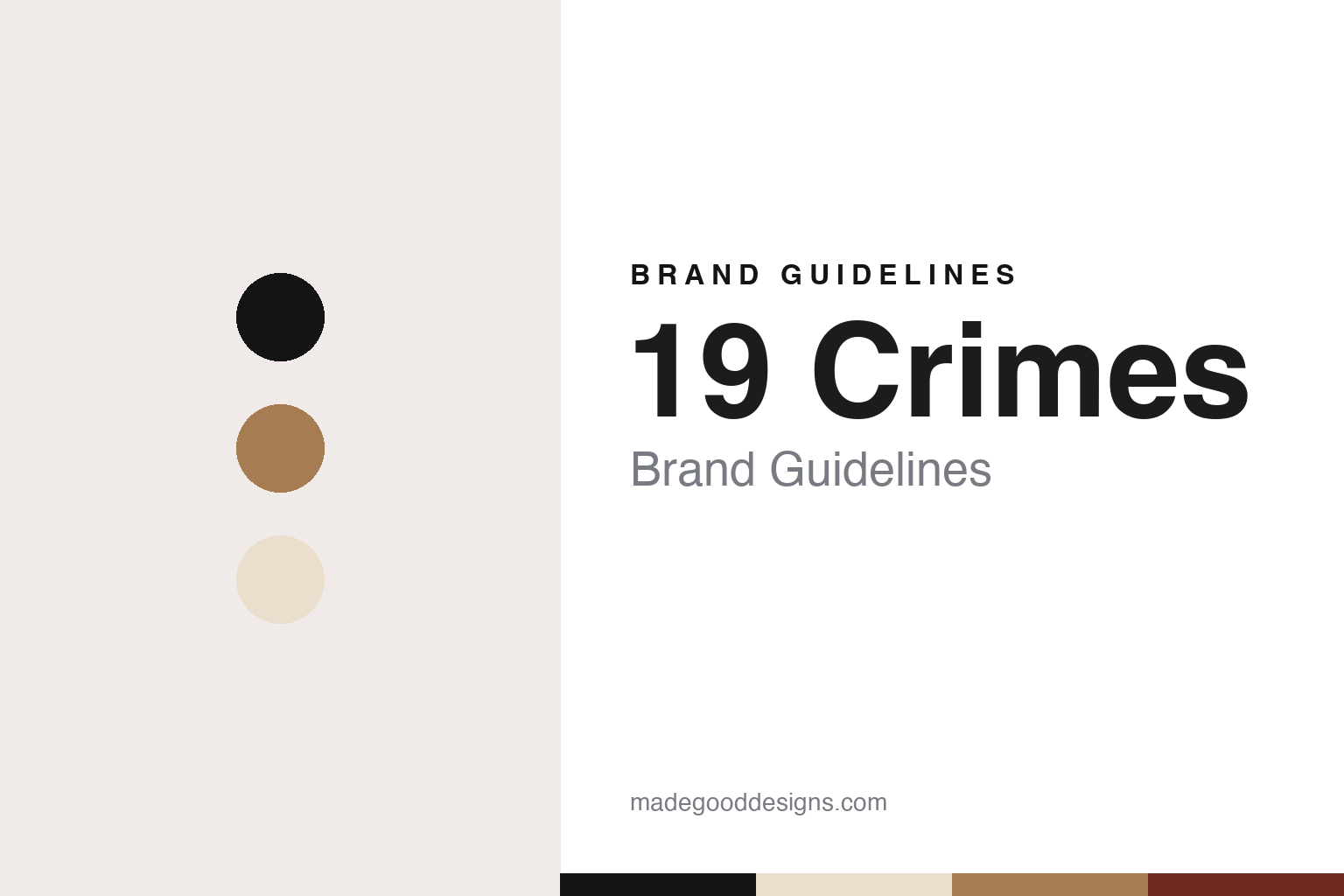
19 Crimes Brand Guidelines
Treasury’s convict-label wine, launched 2012.
Aa
Two constants: a label black, sepia and parchment palette and an old-style display serif register. Abstract homage — not a 19 Crimes product or mark; no label, logo or bottle is reproduced.
Nineteen ways to be banished
A wine brand built on a chapter of penal history.
19 Crimes is a wine brand of Treasury Wine Estates, the Melbourne wine company that was split from the brewer Foster’s Group in 2011 and listed separately on the Australian Securities Exchange, English Wikipedia records. VinePair reported in November 2021 that the brand debuted in 2012 and that its first release was a Cabernet Sauvignon. Treasury’s brand list on English Wikipedia gives 19 Crimes the appellation South Eastern Australia, and VinePair said most of its wines use Australian grapes.
The name is the idea. It refers to the offences for which British convicts could be sentenced to transportation to Australia, the penal system that began with the First Fleet of 1787. The brand’s own site tells the story through the Industrial Revolution, when, it says, prisons were overcrowded and petty crime was rising, and banishment to Australia was chosen as the answer. VinePair listed some of the crimes that the brand prints on its corks, among them stealing fish and impersonating an Egyptian.
Although Australian in origin, 19 Crimes found its first big audience abroad. Drinks Trade reported in June 2018 that the brand was only then launching in Australia, describing it as a “powerhouse brand” in the United States, where, according to Treasury, it had sold more than one million cases in the 2017 financial year. The same report noted that the American trade magazine Market Watch had named 19 Crimes its 2017 Wine Brand of the Year. In January 2022 Treasury said the brand sold more than two million cases a year in the US.
Colour
Mugshots, corks and a label that talks.
The label is a portrait. Each bottle carries the sepia, mugshot-style image of a convict sentenced to transportation, set against a black bottle, and the brand’s site calls these figures “the Gang” and invites visitors to read their stories. The corks extend the conceit: the brand says it has one cork for each of the nineteen crimes, so that the closure carries part of the story as well as the label.
Names and blends follow the same history. VinePair reported that The Banished was released in 2015 and that part of The Uprising is aged for 30 days in rum barrels, a nod to the Rum Rebellion of 1808 in New South Wales.
In 2017 the labels began to talk. Packaging News in Australia reported in August 2018 that Treasury had debuted augmented reality on 19 Crimes the year before: pointing a phone running the Living Wine Labels app at a bottle animates the convict, who tells his or her story. The magazine reported more than two million downloads since launch, and said Treasury had extended the technology to Wolf Blass Yellow Label and Matua. The University of Bologna’s packaging case-study archive dates the app’s development for the US market to 2016 and lists Tactic Studio, Wunderman Thompson and PTC’s Vuforia Engine among the suppliers behind it. Later special editions have kept to the idea; Beverage Dynamics reported in October 2023 on a Halloween pair with Universal Monsters, Dracula and Frankenstein, and a 2024 edition added glow-in-the-dark labels and an augmented-reality experience.
Typography
Design and documentation.
The seven brands in this group are all wine names sold in America: Gallo, Robert Mondavi, Kendall-Jackson, Sutter Home, Beringer, Apothic and 19 Crimes. Wine brands in general sit at many different points in the trade, from family houses that still carry a founder’s name to labels that now belong to much larger drinks groups, and a single brand can be sold everywhere from a corner shop to a restaurant list.
A wine brand’s identity is usually carried less by a single bottle than by a label, a name and the place it promises, because the company behind the name may have changed hands, moved its production or grown far beyond the place where it started. That makes the questions behind each name worth asking plainly: who started it, who owns it now, and where its wine is actually made and bottled.
Each guide separates what independent sources record from what the company says about itself — its founding story, its owners over time, where its wine is made and how its labels have changed — and marks plainly what rests only on the company’s own word.
Aa
An old-style display serif for a name set like a period broadsheet. (Specimen set in Playfair Display, a serif STAND-IN; NOT the 19 Crimes logo.)
19 Crimes
From South Eastern Australia to California, and a cast of famous names.
The brand moved into California through a celebrity. In 2020 Treasury announced a multi-year partnership with Snoop Dogg, and Snoop Cali Red, a blend of Petite Sirah, Zinfandel and Merlot sourced mainly from Lodi, went on sale across the US in July 2020; trade reports called it the brand’s first California bottling, with the rapper’s face on the label. Shanken News Daily reported that it was the top new wine item launched in 2020, according to IRI data. A Cali Rosé, a Cali Blanc and a sparkling Cali Gold followed, Wine Spectator and Market Watch reported, and Wine Spectator reported in March 2026 on a new Snoop Dogg red made by Treasury winemaker Michael Garrison as a tribute to Tupac Shakur.
A second famous name arrived in January 2022, when Treasury and Marquee Brands, owner of the Martha Stewart brand, announced Martha’s Chard, 19 Crimes’ first California Chardonnay, Wine Industry Advisor and Wine Spectator reported. Treasury’s Americas marketing executive John Wardley said Stewart, like Snoop Dogg, embodied the spirit of the brand.
In the US the brand sits in Treasury Americas, the group’s business in the United States and Canada, alongside Californian wineries such as Beringer, Beaulieu Vineyard and Stags’ Leap. Its official site is 19crimes.com. For the lettering on the bottle, see our note on the 19 Crimes font.
For a design guide, 19 Crimes shows how a single historical idea — a list of crimes, a convict’s portrait and a cork for each offence — can carry a wine from South Eastern Australia to American shelves and on into California. Compare Penfolds, Treasury’s South Australian winery behind Grange, and Beringer, its Napa Valley house. For this guide we use label black, sepia and parchment with an old-style serif, an unofficial interpretation; no product or logo is reproduced.
Explore & save
Keep 19 Crimes’s identity on hand — save it to a board in the Made Good inspiration library.
19 Crimes identity set
Pin the 19 Crimes label black, sepia and parchment palette and the old-style display serif register to your own board.