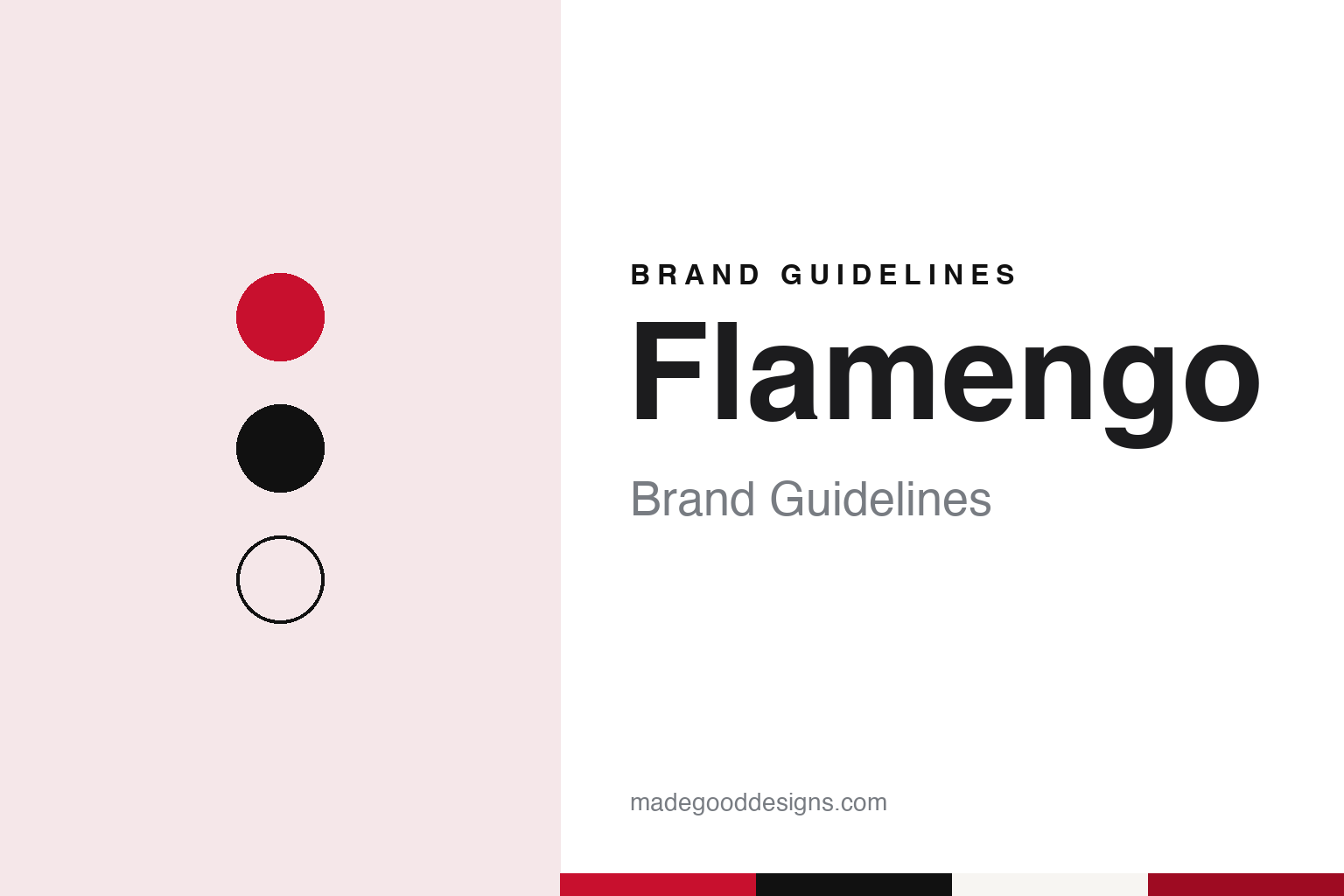
Flamengo Brand Guidelines
Red and black hoops, a rowing monogram and a vulture adopted from the stands.
Aa
Two constants: a Rubro red, urubu black and monogram white palette and a tall boathouse sans register. Abstract homage — not a Flamengo product or mark; no crest, shirt or logo is reproduced.
Clube de Regatas do Flamengo
A rowing club on Flamengo Beach.
Flamengo began on the water. English Wikipedia says the club was founded on the night of 17 November 1895 by a group of rowers who met at the house of club member Nestor de Barros on Flamengo Beach in Rio de Janeiro. They named it the Grupo de Regatas do Flamengo, “Flamengo Rowing Group”, after the neighbourhood, and elected Domingos Marques de Azevedo as the first president. A few weeks later the name became Clube de Regatas do Flamengo, “Flamengo Rowing Club”, which the club still uses. The founders decided to mark the anniversary on 15 November, Republic Proclamation Day.
The Brazilian sports site ge (Globo Esporte), in an article by Matheus Frigols published on 15 November 2015 for the club’s 120th anniversary, described the same meeting: on 17 November 1895, eighteen men gathered at the house of Nestor de Barros, the club’s first secretary, on Praia do Flamengo, to found the Grupo de Regatas do Flamengo, the “group” that later became a “club”.
The rowers’ early boats came with stories of their own. Wikipedia says the group could at first afford only a used boat, the Pherusa, which had to be rebuilt; on its first outing, on 6 October 1895, strong winds overturned it and the crew were rescued by a fishing boat. The Pherusa was later stolen while under repair, and the group saved to buy another boat, which they renamed Scyra.
Football came sixteen years later, from a split at another club. Wikipedia says a group of ten players left Fluminense after a dispute with that club’s board, and chose Flamengo because their captain, Alberto Borgerth, was also a Flamengo rower. The new members were admitted on 8 November 1911. A motion against the club taking part in football tournaments was voted down, and the members established the football department on 24 December 1911. The team played its first official match in 1912.
The rowing origin is still written into the name, and into the anthem. Wikipedia says the official anthem, the “Hymno Rubro-Negro”, was written in 1920 by Paulo Magalhães, a former goalkeeper of the club, and that its refrain calls Flamengo “champion of land and sea”. A second, popular anthem by Lamartine Babo, first recorded in 1945, carries the line “Uma vez Flamengo, sempre Flamengo” — “once Flamengo, always Flamengo”. Supporters are known as the Nação Rubro-Negra, the “Scarlet-Black Nation”.
Colour
Blue and gold, then red and black.
The club’s first colours were not red and black. English Wikipedia says that at the 1895 founding meeting the official colours were set as blue and gold, standing for the sky of Rio de Janeiro and the riches of Brazil, and the rowers wore thick blue and gold horizontal stripes. ge reported in 2015 that the blue represented the sky over Guanabara Bay.
The colours lasted about a year. ge said the change came at an assembly on 23 November 1896. The treasurer, Felisberto Laport, had noticed that uniforms in the original colours came from England, and the blue and gold faded quickly in the sun and the salt water of Guanabara Bay. Without a win in a regatta, the club had also become known as the “Club de Bronze”. ge said it was Nestor de Barros who suggested red and black, saying the new colours would bring the club more luck. The statutes were changed, and with them the flag, the emblem and the uniform. The new flag, ge reported, kept twelve horizontal stripes, now alternating red and black; of the two anchors on the old flag one remained, and oars and the initials CRF were added.
The football shirt took several attempts. Wikipedia says that in 1912 the rowing team objected to the footballers wearing its uniform, so the football team wore a shirt divided into red and black quarters, known as the papagaio de vintém after a style of kite. It was replaced in 1913 by red and black horizontal stripes separated by thin white bands, nicknamed the cobra coral for its resemblance to a coral snake. The white bands were removed in 1916 because the pattern looked too much like the flag of Germany, which Brazil opposed in the First World War. The rowing team then allowed the footballers to use its colours, and the uniform of red and black hooped shirts, white shorts and red and black socks took its present form.
The monogram ties football to rowing. Wikipedia says the club uses three crests in different situations: the full crest as the official logo, a rowing crest for rowing uniforms and equipment, and a white “CRF” monogram, which is usually the only part of the crest worn on the main football shirt. Changes over the years have mainly been to the design of the monogram, and the latest redesign was unveiled in 2018. Since 2005, Wikipedia says, a single gold star has sat above the monogram on the shirts.
Typography
Design and documentation.
South American club identities often grew out of a small, fixed set of visual devices that later designers inherit rather than invent. Colours tend to come first: a pair of shades chosen in a club’s early years becomes the base layer for crests, shirts, stadium seating and printed matter, and later redesigns usually work within that pair instead of replacing it. Shirt patterns carry much of the recognition. A diagonal sash cuts across a plain shirt from shoulder to hip and reads clearly at a distance; horizontal hoops wrap the body in alternating bands; vertical stripes divide it into columns. Each pattern behaves differently when reduced to a badge, a scarf or a social-media avatar, so club graphics often simplify the shirt into a few flat shapes. Stadiums add a second vocabulary. Many grounds are known by affectionate nicknames rather than their official names, and those nicknames appear on signage, merchandise and broadcast graphics. Animal mascots form a third layer, often adopted from supporters’ chants or newspaper cartoons before clubs formalised them. For a designer, the useful lesson is how a few durable elements — two colours, one pattern, a nickname and a creature — can carry an identity across generations of kits and media.
Aa
A tall boathouse sans — the register of a shirt number and a stand banner. (Specimen set in Big Shoulders Display, a sans-serif STAND-IN; NOT the Flamengo logo.)
Flamengo
White shirts, a vulture and two grounds.
The alternative kits have their own history. Wikipedia says that in 1938 the club’s Hungarian manager Dori Kürschner suggested a secondary white shirt to improve visibility in night matches. It carried two red and black stripes across the chest until 1979, when the chest became plain white with stripes on the sleeves. For the centenary in 1995, the club wore a papagaio de vintém shirt in friendlies, and in 2010 the kit supplier Olympikus produced a blue and gold alternative shirt recalling the original rowing colours, which was not well received. On 1 April 2026, Wikipedia says, the club announced it would stop calling the white kit an “away” shirt, renaming it “Manto 1 Branco”.
The mascot began as a taunt. Wikipedia says the club’s first mascot was Popeye, the cartoon sailor, an idea of the Argentine cartoonist Lorenzo Molas, who linked the character to the club’s connection with the sea; it never became popular. In the 1960s, rival supporters began calling Flamengo fans urubus, “vultures”, as an insult. On 31 May 1969, before a match against Botafogo at the Maracanã, a Flamengo supporter released a vulture with a Flamengo flag tied to its feet; when it landed on the pitch the crowd chanted “É urubu, é urubu”. From then on the vulture replaced Popeye. Wikipedia says the cartoonist Henfil drew it in newspaper and magazine cartoons, and that in 2000 the mascot received an official design and the name Samuca, although supporters still call it simply Urubu.
The club’s grounds split administration and match days. Wikipedia says Flamengo’s first official home ground was the Estádio da Rua Paysandu, rented from the Guinle family and used from 1915 to 1932. The Estádio da Gávea, officially the Estádio José Bastos Padilha, opened on 4 September 1938 and is named after the president who oversaw its construction; it now serves as the club’s administrative headquarters and as a ground for youth and women’s matches. Senior matches are mainly played at the Maracanã, which Flamengo has typically used since its completion in 1950. The training centre is known as the Ninho do Urubu, the “Vulture’s Nest”.
For a design guide, Flamengo shows how a rowing club’s practical change of colours in 1896 became a football identity: red and black hoops, a monogram shared with the boats and a mascot taken from the stands. Compare it with Boca Juniors, another South American club whose colours came from the waterfront, and Benfica, whose crest also carries a mark from another sport. For this guide we use Rubro red, urubu black and monogram white with a sans, an unofficial interpretation; no product or logo is reproduced.
Explore & save
Keep Flamengo’s identity on hand — save it to a board in the Made Good inspiration library.
Flamengo identity set
Pin the Flamengo Rubro red, urubu black and monogram white palette and the tall boathouse sans register to your own board.