Benfica Brand Guidelines
Red for bravery, white for peace, and an eagle over the shield.
Aa
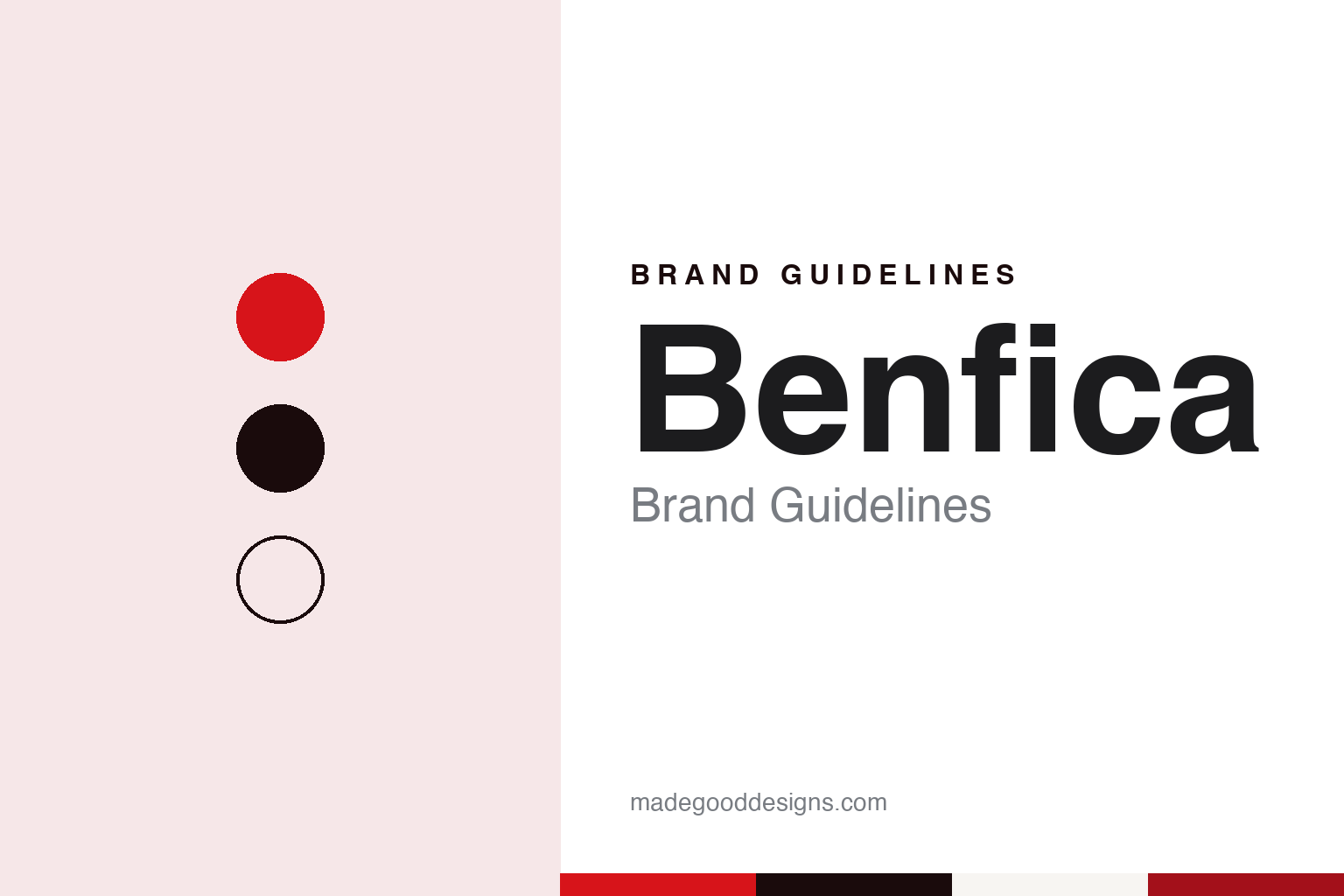
Two constants: an Encarnado red, eagle ink and shirt white palette and a condensed stadium sans register. Abstract homage — not a Benfica product or mark; no crest, shirt or logo is reproduced.
Sport Lisboa e Benfica
A pharmacy meeting in Belém and a merger four years later.
Benfica traces its start to a meeting on 28 February 1904. English Wikipedia says that after a football training session that day, a group of young players known as the Catataus and members of a local association met at the Farmácia Franco on Rua Direita de Belém, in western Lisbon, to form a social and cultural football club called Sport Lisboa, made up of Portuguese players only. Cosme Damião was among those present, and José Rosa Rodrigues was appointed the club’s first president.
The identity was decided at that same meeting. Wikipedia says the founders agreed that the club’s colours would be red and white and that its crest would be made up of an eagle, the Latin motto “E pluribus unum” and a football. Sport Lisboa played its first match on 1 January 1905, on a dirt field at Terras do Desembargador.
The name took its present form in 1908. According to Wikipedia, on 13 September 1908 Sport Lisboa took over Grupo Sport Benfica, a club from the Benfica district of Lisbon, by mutual agreement and changed its name to Sport Lisboa e Benfica. Each side brought something to the merged club. Sport Lisboa kept its football team, its shirt colours, the eagle and the motto; Grupo Sport Benfica brought its field, the Campo da Feiteira, its main directors and its clubhouse. The two agreed that the founding date would follow Sport Lisboa’s, so the club still counts its history from 1904.
The merger also changed the crest. Grupo Sport Benfica’s main sport had been cycling, so a bicycle wheel was added behind Sport Lisboa’s emblem to represent it. That wheel is still part of the badge today, more than a century after the merger, even though the crest has been redrawn several times since.
The modern business structure dates from 2000. Wikipedia says that on 10 February 2000 the club created Sport Lisboa e Benfica – Futebol, SAD, a public limited sports company, to run the professional football team, its broadcasting and image rights and the use of the Benfica brand at football events. The company’s shares trade on the Lisbon stock exchange, and Wikipedia says the club, directly and through its holding company Benfica SGPS, held a majority of the SAD’s share capital by September 2021. In May 2025, it adds, the United States company Lenore Sports Partners acquired a minority stake in the SAD.
Colour
Eagle, shield, motto and wheel.
Each part of the crest carries a meaning that the club has written down. English Wikipedia describes the badge as an eagle, a symbol of independence, authority and nobility, set on top of a shield in red and white, with red standing for bravery and white for peace. Below sits the motto “E pluribus unum”, Latin for “out of many, one”, which the club uses to express union among its members. The initials SLB sit over a football, and the whole arrangement is laid over the bicycle wheel inherited from Grupo Sport Benfica.
The badge has been redrawn rather than replaced. Wikipedia says the club has had four main crests since 1904: the original Sport Lisboa emblem, used from 1904 to 1908, the version created after the 1908 merger, a redrawing in 1930 and another in 1999. Portuguese Wikipedia also shows the separate emblem of Grupo Sport Benfica, used from 1906 until the merger. English Wikipedia says the main changes in the latest redrawings were the modification and repositioning of the eagle and a reduction in the size of the wheel. Since the 2008–09 season, stars have been placed above the crest on the football shirts.
The eagle also gives the club a nickname. Wikipedia says Benfica are called As Águias, “the Eagles”, for the bird on top of the crest. Portuguese Wikipedia adds a live version of the emblem: before each home match, a bald eagle named Vitória flies several laps around the Estádio da Luz before landing on top of a Benfica shield, completing the badge in front of the crowd.
The colours were chosen for practical reasons. Wikipedia says José da Cruz Viegas was responsible for selecting the kit in 1904, and that red and white were picked because they stood out clearly to the players’ eyes. A year after the club’s founding, the team settled on red shirts with white collars, pockets and cuffs, worn with white shorts and black socks.
The shirt colour also shaped a second nickname, through censorship. Wikipedia says Benfica and their supporters were long known in Portugal as Vermelhos, “Reds”. In 1936, with the start of the Spanish Civil War, the censorship commission of the Portuguese Estado Novo banned the word, because communists in Spain were known by the same name. From then on the club became known as Encarnados, another word for red with a different connotation, and the name has stayed.
Typography
Design and documentation.
Football club identities tend to be built from a small set of recurring parts, and each part carries its own design job. A motto, often written in Latin or in the club’s home language, is usually set on a ribbon or band around the crest, where it has to stay legible at the size of a phone screen as well as on a stadium façade.
Animal emblems are another common device. A bird, a big cat or a mythical creature gives a club a mascot, a nickname and a shape that can be drawn as a full heraldic figure, a flat silhouette or a costumed character on matchdays. The same animal may appear in several drawings at once, each tuned to a different medium.
Stadium names work as a second brand. Some grounds carry a historic place name, some honour a person and some are sold to a sponsor for a fixed term, which changes the signage, the wordmark and the way broadcasters refer to the venue. Kit sponsors add a third layer: a shirt front shared with a partner’s logo means the club’s colours and crest have to hold their own beside another company’s mark, season after season.
Aa
A condensed stadium sans — the register of a shirt number and a gate sign. (Specimen set in Barlow Condensed, a sans-serif STAND-IN; NOT the Benfica logo.)
Benfica
Red shirts, sponsors and the Luz.
The home kit has kept to one colour. Wikipedia says Benfica have always worn red shirts, and that a white alternative kit was used officially for the first time in the 1944–45 season, when another red-shirted club, Salgueiros, reached the first division. Wikipedia lists the club itself as kit maker until 1970. Wikipedia lists Lacoste as supplier for 1971–72 and Adidas from 1977, followed by spells with Hummel and the Portuguese brand Olympic in the 1990s. Adidas returned in 1997 and has supplied the kit since, renewing its contract in 2014.
Shirt sponsors arrived in the 1980s. Wikipedia lists Shell as main sponsor from 1984, followed by names including FNAC, Parmalat, Telecel and Vodafone, and then Portuguese telecoms brands such as PT, TMN and MEO. The current partner is Emirates. Arabian Business reported on 19 May 2015 that the airline had announced a three-year shirt sponsorship with Benfica, signed by Emirates president Tim Clark and Benfica president Luís Filipe Vieira at the Estádio da Luz, and that the Fly Emirates logo would appear on the front of the Benfica jersey until the end of the 2017–18 season. A special version of the new season’s kit with the Emirates branding was unveiled at the signing. Wikipedia lists Emirates as main sponsor from 2015 to the present.
The ground has carried the same name across two buildings. Wikipedia says that in its first decades Benfica played mostly on rented fields, opened its own Estádio das Amoreiras in 1925 and later used the municipal Estádio do Campo Grande. From 1954 to 2003 the club played at the original Estádio da Luz. It was demolished between 2002 and 2003, and a new Estádio da Luz was completed in 2003. Like its predecessor, Wikipedia says, it is officially named the Estádio do Sport Lisboa e Benfica. The new ground hosted matches at UEFA Euro 2004, including the final, and the UEFA Champions League finals of 2014 and 2020.
For a design guide, Benfica shows how a crest built in 1904 and extended in 1908 can carry its history in its parts: an eagle from the founders, a wheel from the merger and a motto about union, all redrawn rather than replaced. Compare it with Adidas, the club’s kit supplier, and FC Porto, another Portuguese club whose crest grew out of an earlier emblem. For this guide we use Encarnado red, eagle ink and shirt white with a sans, an unofficial interpretation; no product or logo is reproduced.
Explore & save
Keep Benfica’s identity on hand — save it to a board in the Made Good inspiration library.
Benfica identity set
Pin the Benfica Encarnado red, eagle ink and shirt white palette and the condensed stadium sans register to your own board.