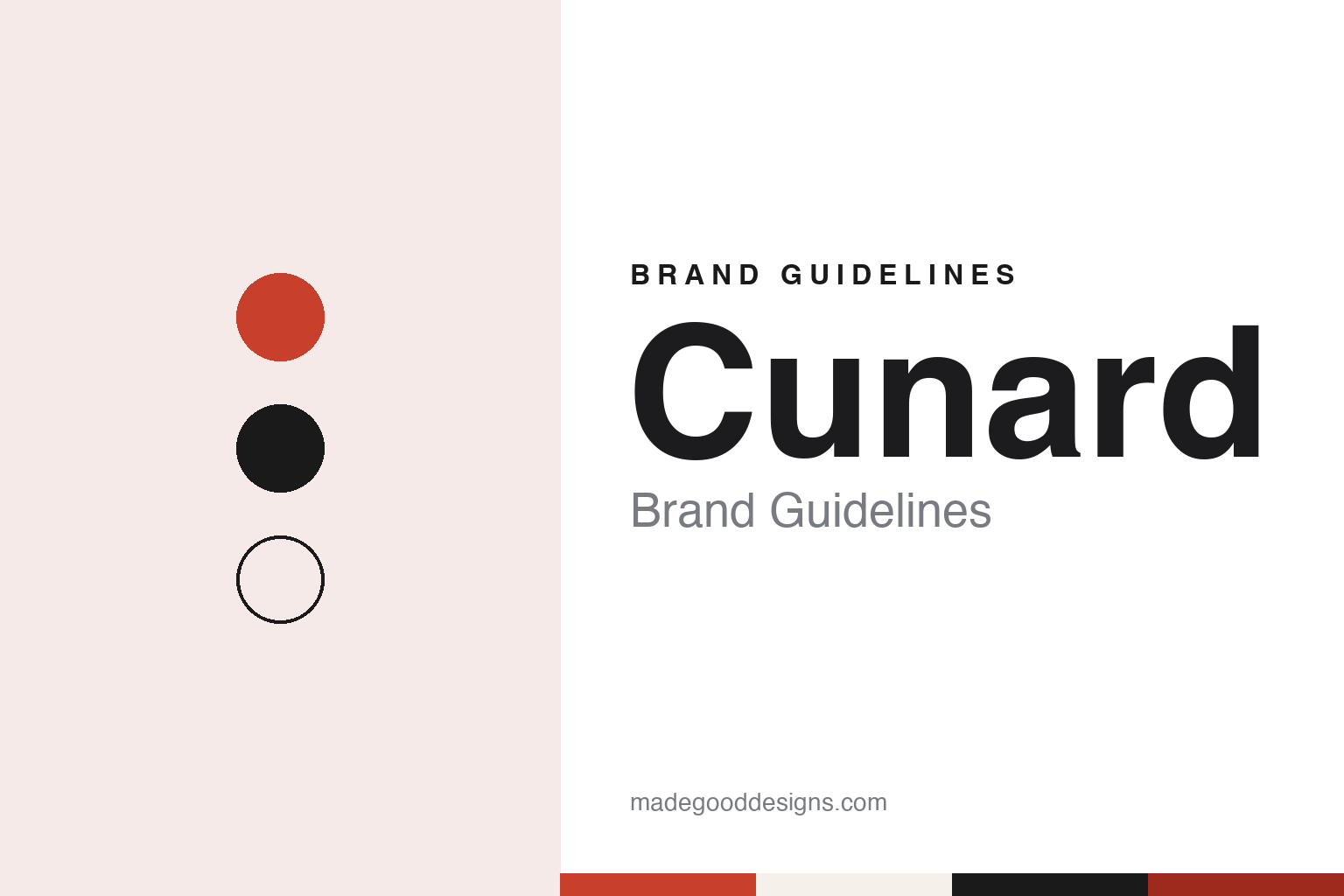
Cunard Brand Guidelines
A red funnel with black bands and a black top.
Aa
Two constants: a red, black and ivory palette and a Liner serif register. Abstract homage — not a Cunard asset or mark; no logo, crest or wordmark is reproduced.
A mail contract and a paddle steamer
Samuel Cunard’s line of 1840.
Cunard is a British cruise line based at Carnival House in Southampton, operated by Carnival UK and owned by Carnival Corporation. Its story begins with a mail contract. English Wikipedia says that in 1839 Samuel Cunard was awarded the British transatlantic steamship mail contract, and that the next year he formed the British and North American Royal Mail Steam-Packet Company in Glasgow together with the shipowner George Burns and the engineer and shipbuilder Robert Napier.
The new company was set up to run four paddle steamers on a route from Liverpool to Halifax and Boston. English Wikipedia records that the lead ship of the four ocean-going steamers of the Britannia class left Liverpool in 1840. She was named Britannia and sailed on 4 July, a date with patriotic weight on both sides of the Atlantic. Her sisters followed, and the name set the tone for a long run of ship names.
The company’s formal name changed as the business grew. In 1879 it was reorganised as the Cunard Steamship Company Ltd to raise capital, according to English Wikipedia. In 1919 Cunard moved its British home port from Liverpool to Southampton, to be closer to travellers from London, and the city has remained its base. In 1934, as a condition of government loans to finish Queen Mary and build a second ship, Queen Elizabeth, Cunard merged with the White Star Line to form Cunard-White Star Line; the White Star name was later retired.
One line is enough for the wars. English Wikipedia notes that the liner Lusitania was sunk in 1915 during the First World War.
Ownership changed twice in the late twentieth century. English Wikipedia says the conglomerate Trafalgar House bought the line in 1971, and that in 1998 Cunard was acquired by the Carnival Corporation, which has owned it since. The fleet in service today carries royal names: Queen Mary 2, which took over the transatlantic runs from Queen Elizabeth 2 in 2004, and Queen Victoria, Queen Elizabeth and Queen Anne. English Wikipedia adds that since 2011 Cunard and its ships have been registered in Hamilton, Bermuda.
Cunard still runs a scheduled passenger crossing between Europe and North America, which English Wikipedia describes as a service that QM2 was designed for. That link to the original mail route is part of what the brand trades on, alongside the name Samuel Cunard gave it.
Colour
Red, black bands and a black top.
The central element of the Cunard look is the funnel. English Wikipedia says that from the beginning the line’s ships used a red funnel with two or three narrow black bands and a black top. It credits the feature to Robert Napier, whose Glasgow yard had used the same combination in 1830 on Thomas Assheton Smith’s private steam yacht Menai. When the Glasgow Museum of Transport restored a model of that yacht, English Wikipedia records, it found vermilion funnels with black bands and a black top.
That scheme has outlived several changes of owner and of hull. It has also been used as a test of belonging. When Cunard bought Royal Viking Sun in 1994, Cruise Industry News reported on 15 July 1994 that chief executive John Olsen suggested some subtle changes to the ship’s colour scheme, including a red-painted funnel to fit Cunard’s identity. The same report said he expected to keep the Royal Viking sea eagle symbol.
The 1994 report also described a change of lettering. Cunard was then grouping its ships under three names, Cunard QE2, Cunard Crown and Cunard Royal Viking, and Cruise Industry News said a new logo had been designed for the Cunard umbrella name, retaining the red, uppercase lettering but with what Olsen called a more friendly typeface. Logos were also created for each of the three brands.
Ship names are the second strand. English Wikipedia says the line adopted a naming convention using words ending in “-ia”, a pattern that ran from Britannia through ships such as Mauretania and Lusitania. The royal names of the twentieth century, starting with Queen Mary and Queen Elizabeth, began a second family, and every Cunard ship now in service is a Queen.
Advertising has drawn on the crossing itself. English Wikipedia records the slogan “Getting there is half the fun,” aimed at the tourist trade of the post-war years, when the line was carrying holidaymakers as well as business travellers and emigrants.
Typography
Cruise and rental identities.
Cruise lines and car rental firms carry their identities on surfaces that most consumer brands never touch. On a ship, the funnel is the most visible mark: its colour bands, a crest or a monogram can be read from a quayside long before any lettering on the hull. Hull colours, the line painted at the waterline and the name lettered at the bow and stern add further layers, and they are repainted as fleets are refreshed, so a livery can change across decades while the funnel stays recognisable.
Ship names are a brand system in their own right. Lines tend to follow a convention, such as a shared prefix, a suffix, a family of words or a run of royal or geographic names, so that each new vessel slots into a series that passengers can recognise.
Rental brands work at the other end of the scale. The counter at an airport or a station, the uniform, the key fob and its tag, the paperwork wallet and the decals or wraps on a car are the touchpoints a customer handles. A single strong colour tends to do most of the work, because it has to read across a busy terminal hall and on a car park sign alike.
Aa
A liner serif — after red uppercase lettering on a dark hull. (Specimen set in Playfair Display, a serif STAND-IN; NOT the Cunard logo or its typeface.)
Cunard
A funnel that outlasts the ships.
The Cunard identity is built on three things that have each lasted far longer than any one ship. The funnel in red with narrow black bands and a black top goes back, by English Wikipedia’s account, to the paddle steamers of 1840 and before that to Robert Napier’s yard. The name itself is the founder’s surname, kept through the change from the British and North American Royal Mail Steam-Packet Company to the Cunard Steamship Company and on through the merger with White Star. The ship names run in families, from the -ia endings of the nineteenth century to the Queens of today.
The red lettering of the wordmark belongs to the same system. When Cruise Industry News reported on the new umbrella logo in July 1994, the point it recorded was what had been kept: the red, uppercase letters, with the typeface alone changed. The funnel and the lettering share a colour, which lets the brand read the same on a ship, a brochure or a ticket.
Owners have used that colour as a signal of membership. Painting a newly acquired ship’s funnel red, as Olsen proposed for Royal Viking Sun in 1994, was a way of bringing the ship into the Cunard family without renaming it. Under Carnival Corporation since 1998, Cunard has kept its own funnel and its own names while sharing an owner with other lines.
The connection to Southampton is part of the picture as well. Cunard moved its home port there from Liverpool in 1919, and English Wikipedia places its base at Carnival House in the city, the port from which the Queens sail on the scheduled crossing to New York.
For a design guide, Cunard shows how one colour combination on a funnel can carry a company’s identity across nearly two centuries of ships, owners and names. Compare Princess Cruises, which shares Carnival Corporation as owner, and MSC Cruises, with its compass on the hull. For this guide we use red, black and ivory with a serif, an unofficial interpretation; no product or logo is reproduced.
Explore & save
Keep Cunard’s identity on hand — save it to a board in the Made Good inspiration library.
Cunard identity set
Pin the Cunard red, black and ivory palette and the Liner serif register to your own board.