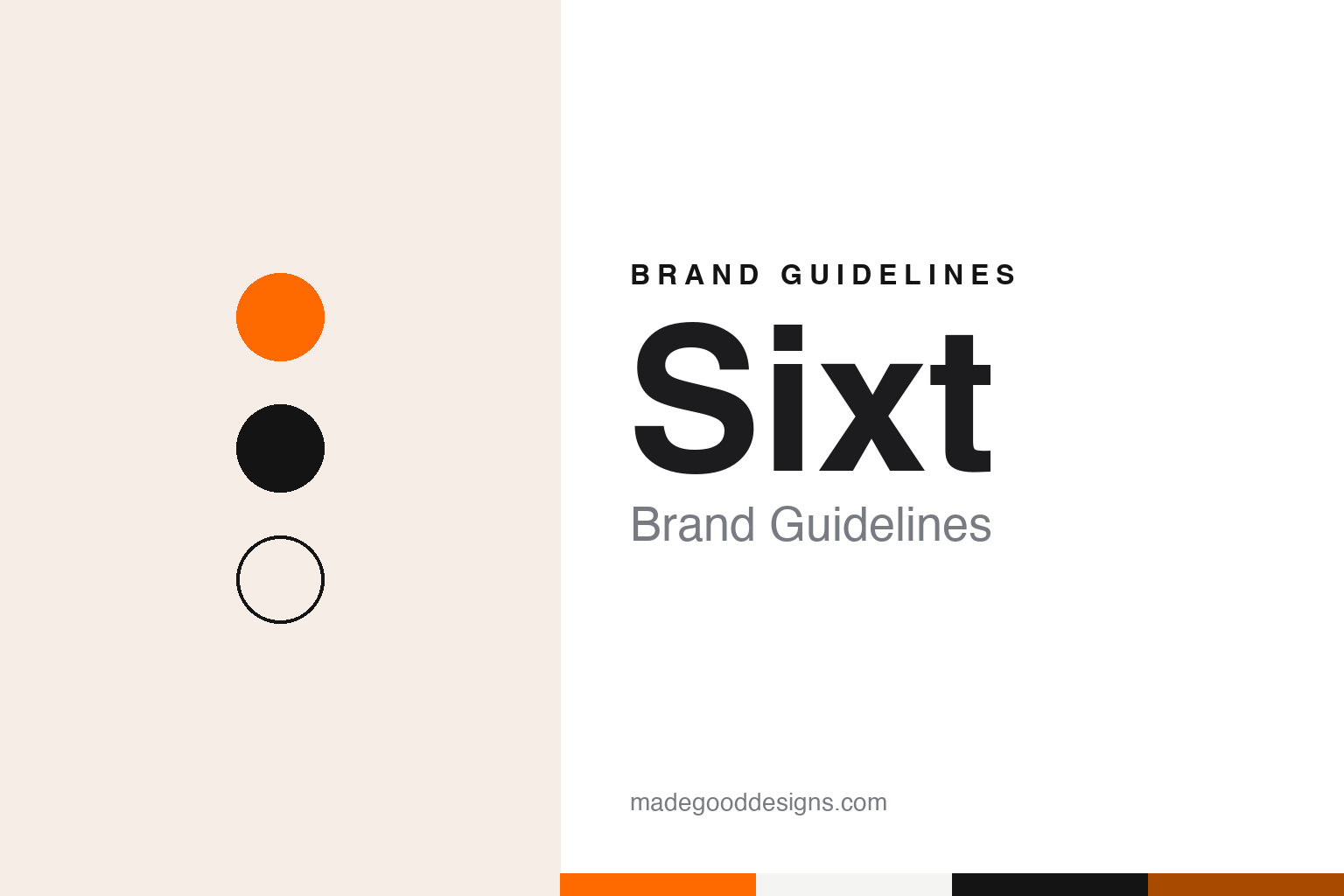
Sixt Brand Guidelines
Orange on black, set in a headline.
Aa
Two constants: an orange, black and white palette and a Heavy grotesque register. Abstract homage — not a Sixt asset or mark; no logo or wordmark is reproduced.
A Bavarian rental firm
Martin Sixt’s cars of 1912.
Sixt is a German car rental and mobility company. Its parent, Sixt SE, is the holding company of the Sixt Group, and English Wikipedia says the majority of the company is owned by the Sixt family, who also manage it, with the rest of the shares traded on the stock exchange. HORIZONT places the company in Pullach, just outside Munich, and the brand has always carried the family surname.
The business dates to 1912. English Wikipedia says Martin Sixt founded the company that year with a small fleet of cars, as a rental firm in Bavaria. The wars interrupted it twice; English Wikipedia records that the fleet was taken for military use in both world wars. After 1945 the company rebuilt with a taxi service, and in Munich it ran radio taxis.
The rental name in its modern form came later. English Wikipedia says the car rental company Auto Sixt was founded in 1951. In 1982 Auto Sixt was renamed Sixt Autovermietung GmbH, and for a time the logo carried the name Sixt/Budget, reflecting a link to the Budget rental brand. In 1986 the company became Sixt AG, a corporation listed on the German stock exchange, and in 1988 it set up a leasing subsidiary.
The structure changed again in the 1990s and 2000s. English Wikipedia says that in 1993 the operating business passed to a subsidiary, Sixt GmbH & Co Autovermietung KG, with Sixt AG acting as the group’s holding company. In 2013 Sixt AG became a European company, a Societas Europaea, and has been called Sixt SE since then.
The brand moved outside Europe in stages. English Wikipedia records that Sixt opened a branch in Florida in 2011, took on concessions at US airports from Advantage Rent a Car in June 2020, and expanded to Australia through a partnership with the motoring club NRMA in December 2021, with branches there franchised under the Sixt name.
The company has also widened what the name covers. English Wikipedia says that from February 2019 Sixt combined car rental, car sharing, ride-hailing and car subscriptions in a single app, under one brand, and that in 2020 it sold its leasing business to focus on mobility services.
Colour
Black and orange, and an agency with a sense of mischief.
Sixt’s visual identity is carried above all by colour. HORIZONT, in an article by Marco Saal dated 18 October 2012, described the Sixt print motifs as traditionally kept in black and orange, made by the company together with its lead agency Jung von Matt, and appearing regularly in national newspapers and large magazines. Print, the same article said, had long been the main channel for Sixt’s advertising.
That relationship with Jung von Matt is the thread that runs through the brand’s campaigns. On 26 November 2012, HORIZONT’s Jessica Becker reported on a spot by Jung von Matt/Fleet starring members of the former German pop-rap band Tic Tac Toe, who reworked their 1995 hit for the film. In the spot, three women ride into a Sixt branch in chariots painted red, green and yellow; HORIZONT noted that these were the colours of the rival rental brands Europcar, Avis and Hertz. The creative directors named were Jan Rexhausen and Dörte Spengler-Ahrens, and the campaign had its own website where users could make their own versions of the video.
The same HORIZONT article recalled an earlier piece of the same kind. In summer 2007, it said, Sixt and Jung von Matt had the singer Matthias Reim re-record his 1990s hit “Verdammt, ich lieb dich” as “Verdammt, ich hab nix,” with the answer to the problem given as Sixt. Marco Saal’s October 2012 article added that Sixt’s last major television campaigns had come in 2007 and 2008, featuring Reim and Jopi Heesters.
Orange also appears in the brand’s stunts. On 17 December 2014, HORIZONT’s Katrin Ansorge reported that a performer in a black bodysuit with a large orange snail shell on his back had crawled through Munich Airport from late September that year, carrying the message “Achtung Schleichwerbung. Sixt ist günstig,” a pun on stealth advertising and a snail’s pace. The work was credited to Jung von Matt/Alster.
Not every campaign used the house agency. The October 2012 HORIZONT article covered a winter spot made by the Frankfurt agency Lommel Ludwig, in which animals scratch themselves before the line “Schluss mit Kratzen” introduces a rental car with auxiliary heating, released as an online video rather than on television.
Typography
Cruise and rental identities.
Cruise lines and car rental firms carry their identities on surfaces that most consumer brands never touch. On a ship, the funnel is the most visible mark: its colour bands, a crest or a monogram can be read from a quayside long before any lettering on the hull. Hull colours, the line painted at the waterline and the name lettered at the bow and stern add further layers, and they are repainted as fleets are refreshed, so a livery can change across decades while the funnel stays recognisable.
Ship names are a brand system in their own right. Lines tend to follow a convention, such as a shared prefix, a suffix, a family of words or a run of royal or geographic names, so that each new vessel slots into a series that passengers can recognise.
Rental brands work at the other end of the scale. The counter at an airport or a station, the uniform, the key fob and its tag, the paperwork wallet and the decals or wraps on a car are the touchpoints a customer handles. A single strong colour tends to do most of the work, because it has to read across a busy terminal hall and on a car park sign alike.
Aa
A heavy grotesque — after short, loud headlines in black and orange. (Specimen set in Archivo, a sans STAND-IN; NOT the Sixt logo or its typeface.)
Sixt
A surname, a colour and a punchline.
The Sixt identity is simple to describe. It is a family surname, four letters long, kept as the brand name since the company’s Bavarian beginnings; it is orange and black, the pair HORIZONT called traditional for the company’s print work in 2012; and it is a tone of voice, built over many years with Jung von Matt, that HORIZONT summed up in 2012 by noting that Sixt’s liking for provocative advertising was well known.
Colour is what lets that tone work. The Tic Tac Toe spot of 2012, as HORIZONT described it, put the red, green and yellow of three rivals on chariots and set them against a Sixt branch, leaving orange, the brand’s own colour, as the one absent from the chariots. The orange snail shell at Munich Airport in 2014 relied on the same recognition: a single colour, worn by a performer among the rental counters, was enough to signal the advertiser before the slogan was read.
The name has stayed constant through every legal form, from Auto Sixt in 1951 to Sixt Autovermietung GmbH in 1982, Sixt AG in 1986 and Sixt SE in 2013. For a period after 1982 the logo read Sixt/Budget, as English Wikipedia records. The brand now covers rental, car sharing, ride-hailing and subscriptions in one app, all under the same four letters.
Sponsorship has carried the colour into sport. English Wikipedia records a deal with the Turkish football club Galatasaray from the 2020–21 season and, from October 2023, sponsorship of the NBA teams the Los Angeles Lakers and the Chicago Bulls.
For a design guide, Sixt shows how a single colour and a consistent agency partnership can make advertising recognisable before a logo appears. Compare Hertz, the Chicago rental firm in yellow and black, and Avis, in red. For this guide we use orange, black and white with a sans, an unofficial interpretation; no product or logo is reproduced.
Explore & save
Keep Sixt’s identity on hand — save it to a board in the Made Good inspiration library.
Sixt identity set
Pin the Sixt orange, black and white palette and the Heavy grotesque register to your own board.