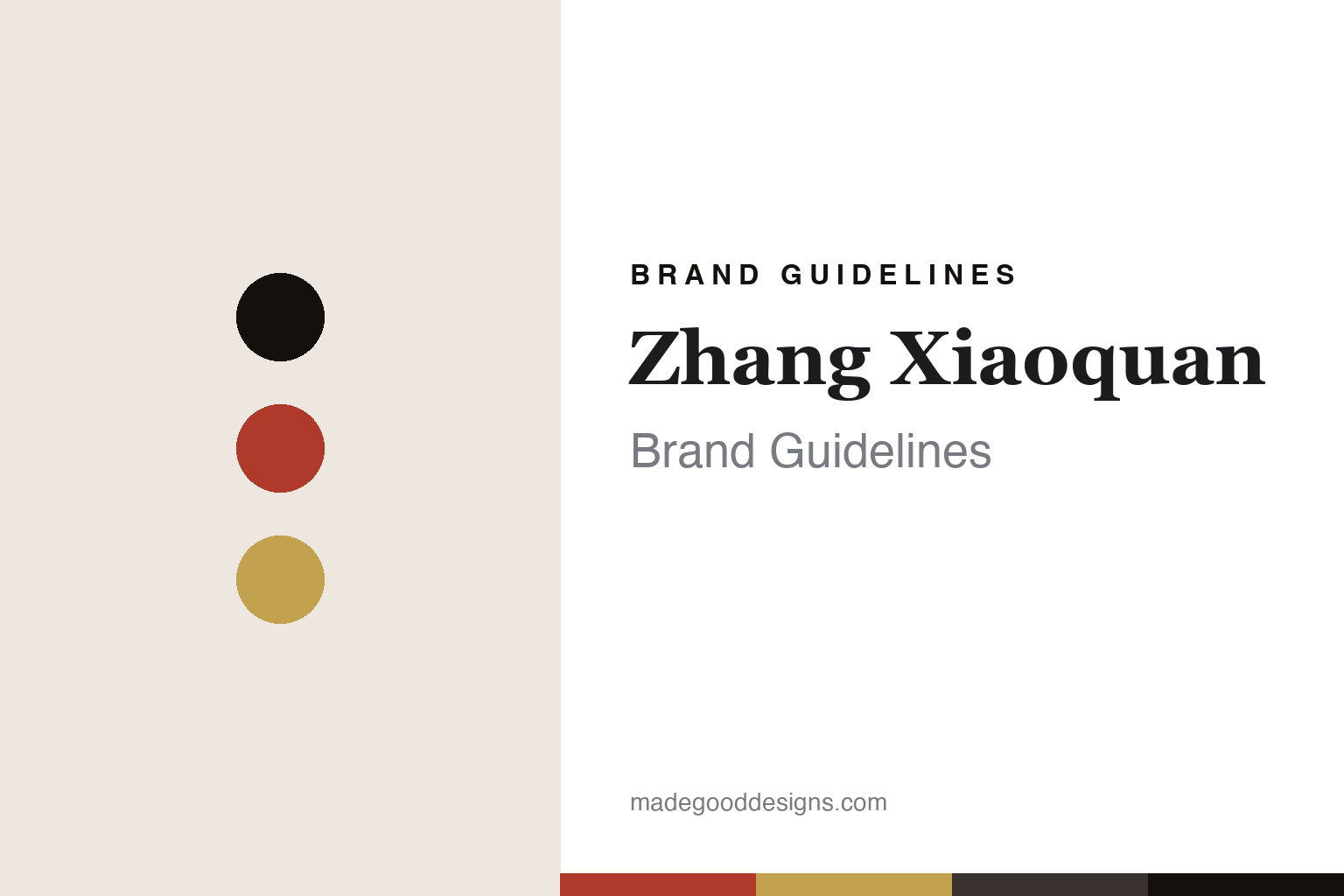
Zhang Xiaoquan Brand Guidelines
China’s time-honoured blade.
Aa
Two constants: a vermilion palette and a heritage-serif register. Abstract homage — not a Zhang Xiaoquan blade, mark or wordmark.
China’s time-honoured blade
Zhang Xiaoquan is a centuries-old Hangzhou cutlery name — a China Time-Honoured Brand — made in China.
Zhang Xiaoquan is a lesson in a heritage name as the identity. Its brand traces to 1628, in Hangzhou, and it is one of China’s oldest and best-known cutlery names — historically famous for scissors, and today a maker of kitchen knives and cutlery too. Its answer to how a country carries a knife is a long one: a name that has stood for the everyday blade for centuries, recognised across China as a Time-Honoured Brand. A blade with four hundred years of name behind it.
Its identity is the everyday blade, carried by a centuries-old name. Zhang Xiaoquan’s heritage, its Hangzhou home and its scissors-and-knives cutlery are the work it is known for. A reputation, made a signature. A house whose name is the product.
(Honest notes, so the story stays precise. The Zhang Xiaoquan brand dates to 1628, in the late Ming, with a family-shop origin sometimes put around 1580; it is a designated China Time-Honoured Brand and famous first for scissors, later for kitchen knives and cutlery. Two honest notes on the modern reality: the name is carried today by a listed company — Zhang Xiaoquan Inc., incorporated in 2008 and floated on Shenzhen’s ChiNext board in 2021 — so we pair the centuries-old heritage with the fact that the trading company is modern, not four hundred years old; and there is a long-running Hangzhou-versus-Shanghai split over the name, with the listed company in the Hangzhou lineage. It is made in China, from Hangzhou. We note fairly and briefly that in 2022 a viral incident — a knife that broke while being used to crush garlic, and a tone-deaf public response — drew criticism, for which the company apologised and offered a replacement; it was a use-case and public-relations misstep, not a safety scandal. Its designs, marks and wordmark are its IP, described but never reproduced, and there is no official brand hex — these tones are an unofficial interpretation. This is design commentary and does not promote any product.)
Colour
Zhang Xiaoquan lives in a vermilion palette. Click a swatch to copy the hex.
Zhang Xiaoquan’s identity is historic, formal and Chinese — a vermilion, an ink, a gold, a char, and a chalk. The palette leans vermilion and gold: the register of a heritage seal and a lacquered sign. It signals age and standing over novelty. The honest caveat: with no published brand hex, these values are an original, unofficial interpretation, not first-party colours.
The lesson is a vermilion palette signals a historic, Chinese identity. Zhang Xiaoquan’s world is a centuries-old, made-in-China, everyday-blade name. For designers, it is a reminder that a deep vermilion and a gold can carry a brand built on heritage — the red of a name-seal and the gold of an old shopfront — without copying any mark. Because these tones can fail as small text, keep type dark and let the colour live in the accents, palette and band. The takeaways: let the name carry weight; be honest about the modern company; keep the making in China; and treat any single hex as unofficial.
Typography
The register is a heritage serif — formal, rooted, dignified.
Zhang Xiaoquan’s identity carries a formal, rooted, dignified spirit — a heritage name, not a start-up. A heritage serif captures the mood: upright, classical and old, the register of a centuries-old house. Set in a vermilion palette, the heritage serif feels formal and rooted — exactly the personality the name carries. It is dignified rather than trendy, mirroring a four-hundred-year reputation. (Zhang Xiaoquan’s real designs and marks are things we describe but do not reproduce, and the exact typeface is not ours to use.) Because it is not ours to use, the honest description is “a heritage-serif spirit,” shown here in a stand-in. The type behaves like the name: formal, rooted and dignified.
Aa
A heritage-serif spirit — formal and rooted. (Specimen set in Noto Serif SC, a heritage-serif STAND-IN; NOT the Zhang Xiaoquan wordmark or any blade design.)
The knife around the world
Zhang Xiaoquan stands for the centuries-old name.
Zhang Xiaoquan is a lesson in making a heritage name the identity. A vermilion palette, a heritage serif and a centuries-old reputation make one thing — an everyday blade carried by an old, trusted name — the whole maker: historic, formal and Chinese. The name is the differentiator. The differentiator is longevity: a cutlery name that has meant scissors and knives to a country for centuries, now attached to a modern company.
Put to work, the identity is heritage as design. A maker building in this spirit would let a genuine long history do the work of trust, be honest that an old name can sit on a young company, and keep the making at home so the story holds. It would treat its recognisability as its most valuable asset, and protect it. It would answer a stumble — as any old house eventually faces — plainly and quickly, since a heritage name is only as strong as its latest conduct. A brand learning from it would guard the name like the asset it is, spending centuries of goodwill slowly and never in a careless moment. The lesson Zhang Xiaoquan teaches is that a name can build a brand: the heritage gives it authority, and the honest handling of the modern reality keeps it credible. The name is the personality, and the centuries are the proof.
For designers and brand-builders, Zhang Xiaoquan opens this round about the knife around the world on the heritage pole: let a centuries-old name carry the everyday blade, and be honest about the company behind it. The lessons: value the history; separate the heritage from the modern entity; keep the making at home; and never reproduce a protected mark. It is also a reminder to stay precise: Zhang Xiaoquan is a Chinese cutlery name dating to 1628, a Time-Honoured Brand famous for scissors and knives, carried today by a company listed in 2021 and made in China — with the palette here an unofficial interpretation. Zhang Xiaoquan made the name the maker — proof that heritage can be the difference.
Explore & save
Keep Zhang Xiaoquan’s identity on hand — save it to a board in the Made Good inspiration library.
Zhang Xiaoquan identity set
Pin the vermilion palette and the heritage-serif register to your own board.