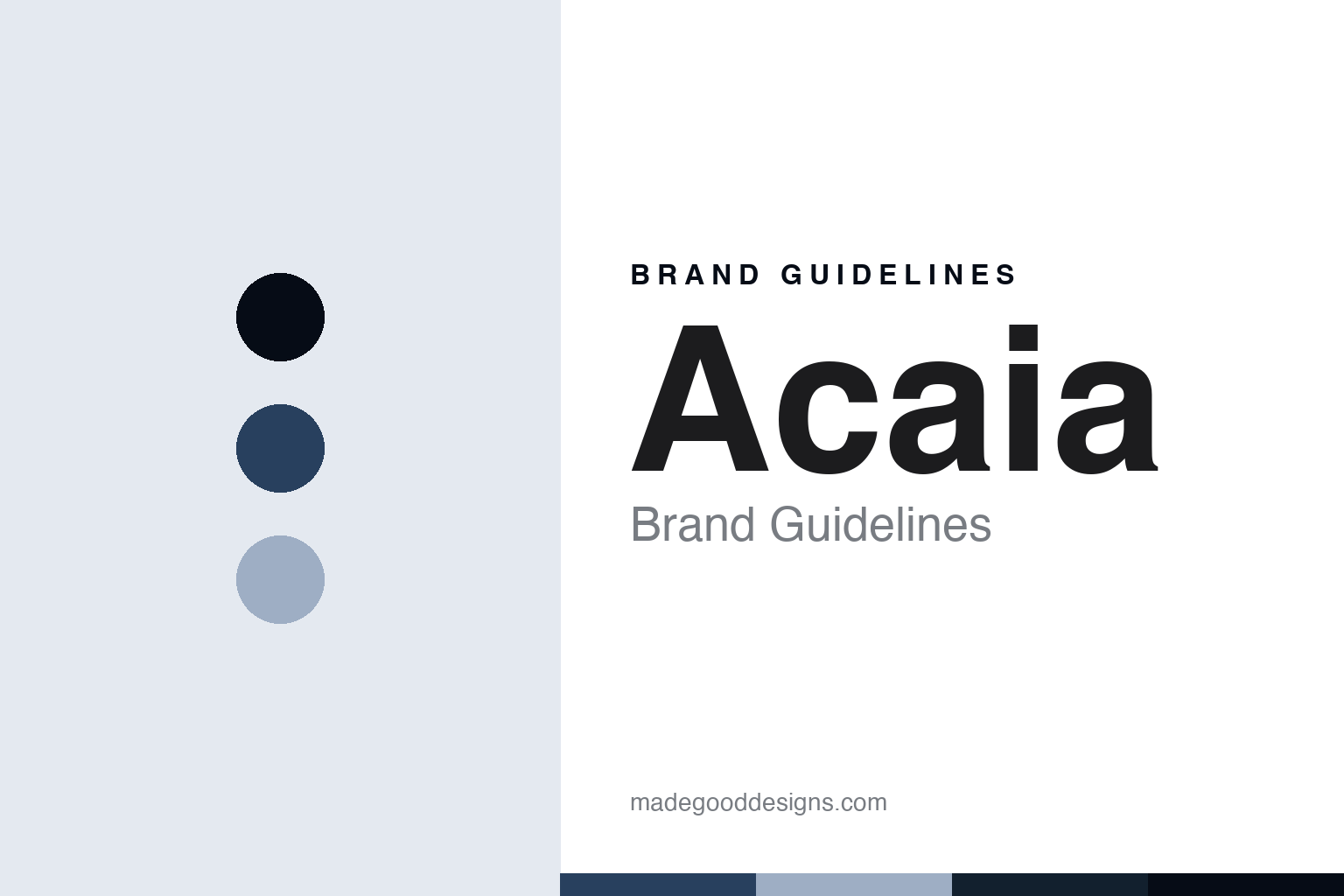
Acaia Brand Guidelines
The specialty scale.
Aa
Two constants: a navy palette and a scale-sans register. Abstract homage — not an Acaia product or mark.
The specialty scale
Acaia is the US brand whose Pearl and Lunar scales became the specialty-coffee standard, reported made in Taiwan.
Acaia opens the round as the precision anchor — the brand that made the scale a serious coffee tool. Acaia makes precision coffee scales and connected brewing gear, and it is known for the Pearl and the Lunar. Its answer to how a maker becomes a name is to own one measurement: build a scale so fast, accurate and app-connected that specialty baristas standardise on it, on the counter and at competition. A scale, that set the standard.
Its identity is the specialty scale. Acaia’s Pearl and Lunar, its precision and its app-connected features are the work it is known for. A scale, made in Taiwan. The specialty scale.
(Honest notes, so the story stays precise. Acaia — at acaia.co — makes precision coffee scales and connected brewing tools: the Pearl is the pour-over flagship, the Lunar the small-footprint espresso-tray standard, alongside the Umbra scales, the Orbit grinder and app-connected brewing devices. Its scales are known for fast, accurate weighing and real-time flow-rate tracking over Bluetooth. It began development in 2013 and was founded in 2014, winning a best-new-product award; the founder, reported as Rooney Wang, is not named on its own pages, so we present the name as reported. On where it is made — a theme of this round — Acaia’s head office is in the United States, in California, which is verified, while the manufacturing location is not stated on its site and is reported to be in Taiwan, so we treat it as a US-facing brand with Taiwan roots, reported made in Taiwan, rather than a confirmed fact. On ownership, it is reported independent. Its name and marks, and the scale’s form, are IP, described but never reproduced, and there is no official brand hex; these tones are an unofficial interpretation. This is design commentary and does not promote any product.)
Colour
Acaia lives in a navy palette. Click a swatch to copy the hex.
Acaia’s identity is precise, made and modern — a navy, an ink, a mist, a deep navy, and a paper. The palette leans navy and mist: a clean, technical register for a precision instrument. It signals a specialty coffee scale. The honest caveat: with no published brand hex, these values are an original, unofficial interpretation, not first-party colours.
The lesson is a navy palette signals a precise, modern identity. Acaia’s world is a precise, instrument-like object. For designers, it is a reminder that a deep navy and a soft mist can carry a coffee tool — the calm of a precise instrument and a clear display. Because these tones can fail as small text, keep type dark and let the colour live in the accents, palette and band. The takeaways: own one measurement; make it precise; be honest about the make; and treat any single hex as unofficial.
Typography
The register is a scale sans — clean, precise, modern.
Acaia’s identity carries a clean, precise, modern spirit — a precision instrument, not a gadget. A scale sans captures the mood: exact, technical and contemporary, the register of a tool measured to a tenth of a gram. Set in a navy palette, the scale sans feels clean and precise — exactly the personality Acaia carries. It is precision rather than a logo, mirroring a fast, accurate weigh. (Acaia’s real wordmark, and the scale’s form, are things we describe but do not reproduce, and the exact typeface is not ours to use.) Because it is not ours to use, the honest description is “a scale-sans spirit,” shown here in a stand-in. The type behaves like the scale: clean, precise and modern.
Aa
A scale-sans spirit — precise and modern. (Specimen set in Work Sans, a scale-sans STAND-IN; NOT the Acaia logo or screen.)
The brewing tools
Acaia stands for the specialty scale, reported made in Taiwan.
Acaia opens the round with the tool that made coffee a matter of grams. A navy palette, a scale sans and a precise weigh make one thing — the specialty scale — the whole identity: precise, made and modern. The category-standard scale is the differentiator, and the app-connected precision is the meaning. The point is a US brand whose Pearl and Lunar became the specialty scale, on the counter and at competition.
Put to work, the identity is precision, told straight, as design. A maker in this spirit would own one measurement and make it the standard — the scale, weighed to a tenth of a gram. A reader in this spirit would keep the make honest: Acaia’s head office is in California, which is verified, but its manufacturing is not stated and is reported to be in Taiwan, so a reader should treat the Taiwan make as reported, not confirmed. Acaia opens the round’s where-the-tool-is-made thread at the US-brand-Taiwan-made end, against the genuinely-made-at-home Kinu, Fiorenzato and Cafec, and it anchors the precision-and-marginal-gain thread that runs through the round. The honest editorial moves are to present the founder and the Taiwan make as reported, to verify the US head office, and to credit the Pearl and Lunar as category-shaping. The lesson Acaia teaches is that owning one measurement can hold an identity: the precision gives it substance, and the standard-setting keeps it credible. The specialty scale is the personality, and the Pearl and Lunar are the proof.
For designers and brand-builders, Acaia opens the brewing tools, from the USA: own one measurement — and be honest about the make. The lessons: make one precise tool the standard; connect it; present an unstated make as reported; verify what you can; and never reproduce a logo. It is also a reminder to stay precise: Acaia is the US brand whose Pearl and Lunar scales became the specialty-coffee standard, reported made in Taiwan — with the palette here an unofficial interpretation. The precision carries the substance, and the standard-setting carries the reputation; together they show that a single, well-made instrument can become the thing a whole trade weighs its coffee on, and that verifying a head office while calling the factory location reported is how a brand keeps its story honest. Acaia made the specialty scale the identity — proof that a tool, honestly told, can be the difference.
Explore & save
Keep Acaia’s identity on hand — save it to a board in the Made Good inspiration library.
Acaia identity set
Pin the navy palette and the scale-sans register to your own board.