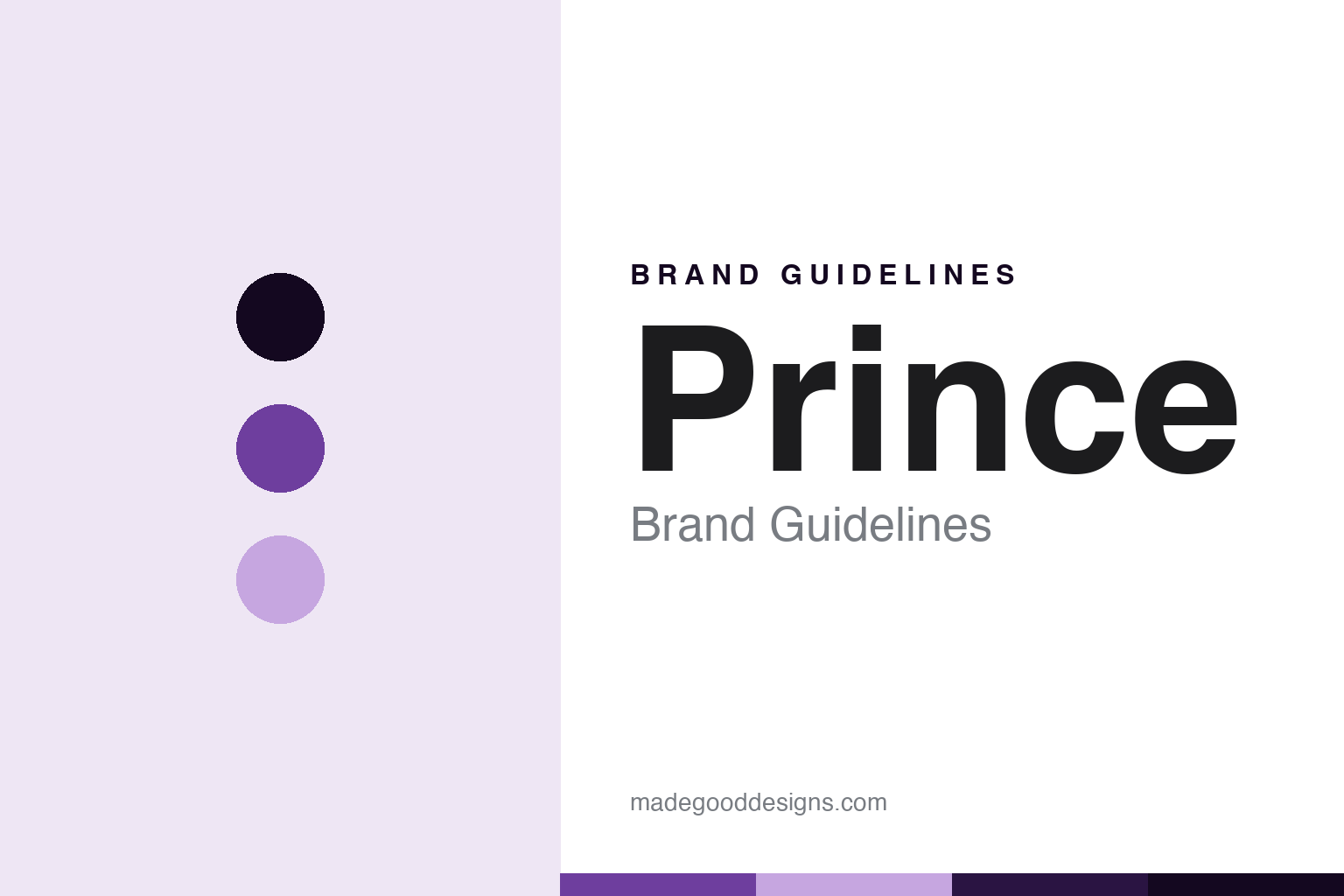
Prince Brand Guidelines
The brand that popularised the oversize racket.
Aa
Two constants: a royal-purple palette and an oversize-sans register. Abstract homage — not a Prince product or mark.
The brand that popularised the oversize racket
Prince is the tennis name that popularised the oversize racket — now a licensed heritage brand.
Prince brings the round its revolution — the tennis name that, through Howard Head, popularised the oversize racket and its big sweet spot, changing how the game is played, and now lives on as a licensed heritage brand. Prince makes tennis rackets, and its answer to a round about the racket makers is one landmark idea: the oversize head that made the game more forgiving. A brand, that supersized the racket.
Its identity is the brand that popularised the oversize racket. Prince’s oversize head, its Howard Head link and its licensed status are the story here. A brand, oversize. The brand that popularised the oversize racket.
(Honest notes, so the story stays precise. Prince — at princetennis.com, trading since 1970 — makes tennis rackets, balls, ball machines and now pickleball, and was founded in 1970 in Princeton, New Jersey by Robert McClure, originally making tennis ball machines, the name coming from the town. Its landmark contribution is the oversize racket, developed by Howard Head, the founder of Head, who joined Prince and created the aluminium Prince Classic. Two honest points matter. The company dates to 1970, but the oversize racket is commonly dated to 1976, so we keep both; and the oversize patent was later invalidated, since a German racket, the Bentley Fortissimo, preceded it, so we frame Prince as having popularised and made iconic the oversize racket rather than being indisputably the first. On where it is made — a theme of this round — it is an American name, but its rackets are made overseas, in Asia. On ownership, its arc is complex: after bankruptcy in 2012, its trademark was acquired by Authentic Brands Group, and the brand now runs as a licensed heritage brand, so we describe it as ABG-owned IP run under license, and we do not assert the exact current licensee, which we could not re-verify. Howard Head died in 1991. Its crown logo is IP we describe but do not reproduce; there is no official brand hex; these tones are an unofficial interpretation. This is design commentary.)
Colour
Prince lives in a royal purple. Click a swatch to copy the hex.
Prince’s identity is revolutionary, heritage and licensed — a royal purple, an ink, a lilac, a deep violet, and a paper. The palette leans royal purple and lilac: a regal register that nods to the Prince name and a landmark racket rather than a loud palette. It signals a heritage innovator. The honest caveat: with no published brand hex, these values are an original, unofficial interpretation, not first-party colours.
The lesson is a royal purple signals a revolutionary, heritage identity. Prince’s world is a revolutionary, made object. For designers, it is a reminder that a regal purple and a soft lilac can carry a sports brand — the tone of a landmark idea. Because these tones can fail as small text, keep type dark and let the colour live in the accents, palette and band. The takeaways: own an innovation honestly; credit the inventor; be candid about licensing; and treat any single hex as unofficial.
Typography
The register is an oversize sans — revolutionary, bold, plain.
Prince’s identity carries a revolutionary, bold, plain spirit — a heritage innovator, not a fashion. An oversize sans captures the mood: confident, landmark and a little regal, the register of the racket that grew the sweet spot. Set in a royal-purple palette, the oversize sans feels revolutionary and bold — exactly the personality Prince carries. It is an innovation rather than a logo, mirroring a strung sweet spot. (Prince’s real crown logo is a thing we describe but do not reproduce, and the exact typeface is not ours to use.) Because it is not ours to use, the honest description is “an oversize-sans spirit,” shown here in a stand-in. The type behaves like the brand: revolutionary, bold and plain.
Aa
An oversize-sans spirit — revolutionary and bold. (Specimen set in Libre Franklin, an oversize-sans STAND-IN; NOT the Prince logo.)
The racket makers
Prince stands for the brand that popularised the oversize racket.
Prince brings the round its revolution. A royal-purple palette, an oversize sans and a landmark idea make one thing — the brand that popularised the oversize racket — the whole identity: revolutionary, heritage and licensed. The oversize head is the differentiator, and the Howard Head link is the meaning. The point is a Princeton ball-machine company that, through Howard Head, popularised the oversize racket and its forgiving sweet spot, and now trades as a licensed heritage brand.
Put to work, the identity is a landmark innovation told straight, as design. A maker in this spirit would own an innovation honestly, credit the inventor, and be candid about licensing. A reader in this spirit would keep the facts right: Prince was founded in 1970 in Princeton by Robert McClure, first making ball machines; Howard Head developed its oversize racket, commonly dated to 1976; the oversize patent was later invalidated, so Prince popularised rather than indisputably invented it; its rackets are made overseas; and after a 2012 bankruptcy its trademark is owned by Authentic Brands Group and run under license. Prince sits in the round’s design-innovation thread with the oversize racket, and its Howard-Head connection links it to Head, two brands joined by one engineer. The honest editorial moves are to keep 1970 and 1976 distinct, to say popularised not first, to say made-overseas, and to describe the ABG-licensed status. The lesson Prince teaches is that a landmark innovation can be a whole identity, and honesty about the invalidated patent and the licensing keeps the innovation credible.
For designers and brand-builders, Prince continues the racket makers: own an innovation — honestly. The lessons: build a brand on a genuine landmark; credit the inventor; frame a disputed first as a popularisation; be candid when a heritage name becomes licensed IP; and never reproduce a logo. It is also a reminder to stay precise: Prince is the tennis name that popularised the oversize racket, now a licensed heritage brand — with the palette here an unofficial interpretation. Read that way, Prince is less a racket than a revolution: the oversize head that made the game forgiving, now a licensed name. The lesson for a brand is that an innovation and honesty about its history reinforce each other, and saying popularised keeps the innovation earned. Prince made the-brand-that-popularised-the-oversize-racket the identity — proof that one idea can define a brand.
Explore & save
Keep Prince’s identity on hand — save it to a board in the Made Good inspiration library.
Prince identity set
Pin the royal-purple palette and the oversize-sans register to your own board.