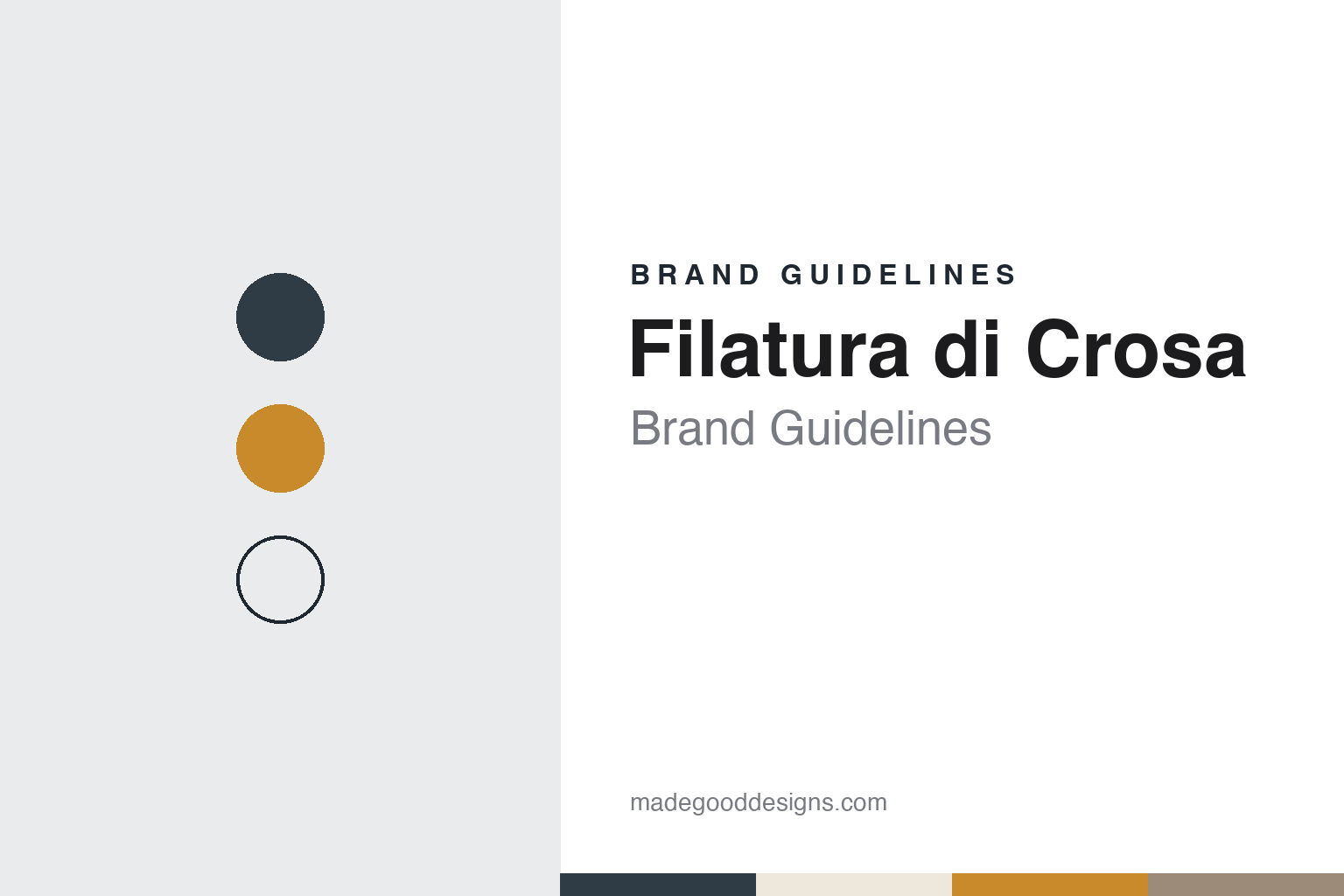
Filatura di Crosa Brand Guidelines
The Biella yarn house with the butterfly mark.
Aa
Two constants: a Filatura di Crosa slate, raw-white and saffron palette and an Italian serif register. Abstract homage — not a Filatura di Crosa product or mark; no yarn, butterfly logo or label is reproduced.
A mill in the Biellese
A village on the Strona di Mosso, a family and a flood.
Filatura di Crosa — “the Crosa spinning mill” — is an Italian hand-knitting yarn brand from the province of Biella in Piedmont. On its own website the company said it was founded in 1939 by Ettore Fileppo in Crosa, “a town located in the Biella province of Italy,” in an area known since the nineteenth century for fine wool and high-quality yarn. Crosa is a small place: Italian Wikipedia records it as a village of a few hundred people on the left bank of the Strona di Mosso torrent, a separate comune until the end of 2015, when it was merged into Lessona.
The family story the company told runs through two generations. Its English-language site said that Ettore’s sons, Germano and Giancarlo Fileppo, took the line beyond plain wool in the 1950s, into fancy yarns spun from mohair, cashmere, angora, alpaca, cotton, linen and silk. The Italian version of the same history, as captured in 2020, dates that turn to the 1970s and credits the brothers with refining the product and building up the business. We give both dates because the company gave both.
Both versions dwell on 1968. “Filatura di Crosa survived a catastrophic flood that devastated the province of Biella,” the English site said, and the Italian page described the disaster as the start of a relaunch, with modernised plant. The flood itself is well documented: Italian Wikipedia records that on 2–3 November 1968 torrential rain in the Valle di Mosso sent the Strona di Mosso and other streams over their banks and into roads, homes and industrial plants, killing 72 people.
The company also tied itself to Italian fashion. It said it worked with houses including Missoni, Krizia, Coveri, Valentino and Versace, supplying exclusive branded yarns — from the 1970s in the English text, during the 1980s in the Italian — and that in 1985 it published its first hand-knitting magazine, with pattern instructions in four languages. These are the company’s own accounts; we found no independent record of the collaborations.
Colour
Made in Biella, sold through New York.
Outside Italy, the brand reached knitters through importers rather than its own shops, and the clearest record of that is American. The New York company Tahki Stacy Charles said on its website, in versions captured from 2013 to 2020, that Stacy Charles had started his own company importing “the prestigious Filatura di Crosa line for the American market, along with countless designer labels, most notably MISSONI.” In the autumn of 1999 he and Diane Friedman, who had founded Tahki Yarns in 1968, agreed to merge their businesses, and Tahki Stacy Charles was formed in January 2000, according to the company; Craft Industry Alliance later dated the merger to 2001.
The importer was the brand’s face in American shops, not its maker or owner. In 2013 Tahki Stacy Charles called itself “the go-to source” for Filatura di Crosa and described the Italian firm as a mill, “since 1939,” that spun the extrafine merino “Zara family” and a “Golden Line” of cashmere and other luxury fibres, with new design collections each spring and autumn. By November 2018, Filatura di Crosa’s own site named a different American distributor, Alliance Knitters of New York, and by 2020 the importer’s list of its yarns no longer included the brand. Separately, Craft Industry Alliance reported in March 2018 that the owners of the Massachusetts yarn store WEBS were buying Tahki Stacy Charles.
The company’s distributor page in 2018 listed partners in Canada, Germany, Switzerland, Spain, Australia and New Zealand, China, Taiwan, Hong Kong, South Korea, Singapore and Russia, with the company itself selling in Italy. In 2017 its site also carried a second hand-knitting brand, La Lana del Cigno Nero — “the wool of the black swan” — which it said was founded in 1974 and was “made in Biella.” The same site announced a line of machine-knitting yarns for professionals and listed the Pitti Immagine Filati and Spinexpo trade fairs for 2017.
Where the yarn was made rests on the company’s word. In 2020 it said that “l’integrità del marchio e del Made in Italy è garantito” — the integrity of the brand and of Made in Italy is guaranteed. By then the operating company, Filatura di Crosa Italia S.r.l., gave its base as Sandigliano, a town near Biella, rather than Crosa. We found no source naming the mill that spun its later yarns.
Typography
Seven countries, seven ways to spin.
The seven brands in this group all sell yarn for hand knitting and crochet, and they come from seven countries: Sirdar from the United Kingdom, Lana Grossa from Germany, Ístex from Iceland, Manos del Uruguay from Uruguay, Brooklyn Tweed from the United States, Filatura di Crosa from Italy and Hjertegarn from Denmark. What sets them apart is less the colour card than the question behind every ball: where the wool comes from, and who spins it.
The answers differ widely. Some yarn is washed and spun by a national wool processor that takes in a country’s own fleece; some is made by artisan cooperatives, where the people who dye and twist the fibre share in the business; some comes out of an old spinning district, where generations of mills grew up beside the same rivers; and some is sold by brands that design the yarn and its colours but commission mills to make it. Each route leaves its mark on a brand’s name, its labels and the way it talks about wool.
Each guide also separates what independent sources record from what the company says about itself — who founded it, who owns it now and where its yarn is made — and marks plainly what rests only on the company’s own word.
Aa
An Italian serif — fashion-house polish for a mill brand. (Specimen set in Bodoni Moda, a serif STAND-IN; NOT the Filatura di Crosa logo.)
Filatura di Crosa
The butterfly, and a quiet website.
The company’s emblem was a butterfly. Its own pages called Filatura di Crosa “the butterfly brand,” and the mission statement on its website ended: “With the renewed passion for high quality handknitting the Butterfly is flying again.” Its pattern collections borrowed the names of Italian painters — Tintoretto, Caravaggio, Raphael — and in 2019 the site sold a bag to mark the brand’s 80th anniversary.
The company also said that “ownership over the brand has changed over the years,” while describing Filatura di Crosa as “still a family operation.” It did not say who the owners were, and we found no independent source that does.
Then the website went quiet. Captures by the Common Crawl web archive show that its latest news item was a holiday greeting from December 2020; in March 2023 the Italian pages said the site was temporarily offline for maintenance, and by October 2023 its shop, news and distributor pages returned errors. In October 2026 both filaturadicrosa.com and filaturadicrosa.it show domain-parking pages. The American retailer WEBS was still selling dozens of Filatura di Crosa knitting and crochet patterns as downloads, but no Filatura di Crosa yarn. We found no announcement of a closure, and no current source on whether the yarn is still produced.
For a design guide, Filatura di Crosa shows how a mill from a small Biellese village built its name on Italian fashion and a single emblem — and how much of a yarn brand’s story abroad can rest with the importers who carry it. Compare Lang Yarns, the Swiss family firm that turned a spinning mill into a yarn brand, and Jamieson’s of Shetland, a family mill spinning in its own wool region. For this guide we use a slate, a raw-white wool and a saffron with a serif, an unofficial interpretation; no product or logo is reproduced.
Explore & save
Keep Filatura di Crosa’s identity on hand — save it to a board in the Made Good inspiration library.
Filatura di Crosa identity set
Pin the Filatura di Crosa slate, raw-white and saffron palette and the Italian serif register to your own board.