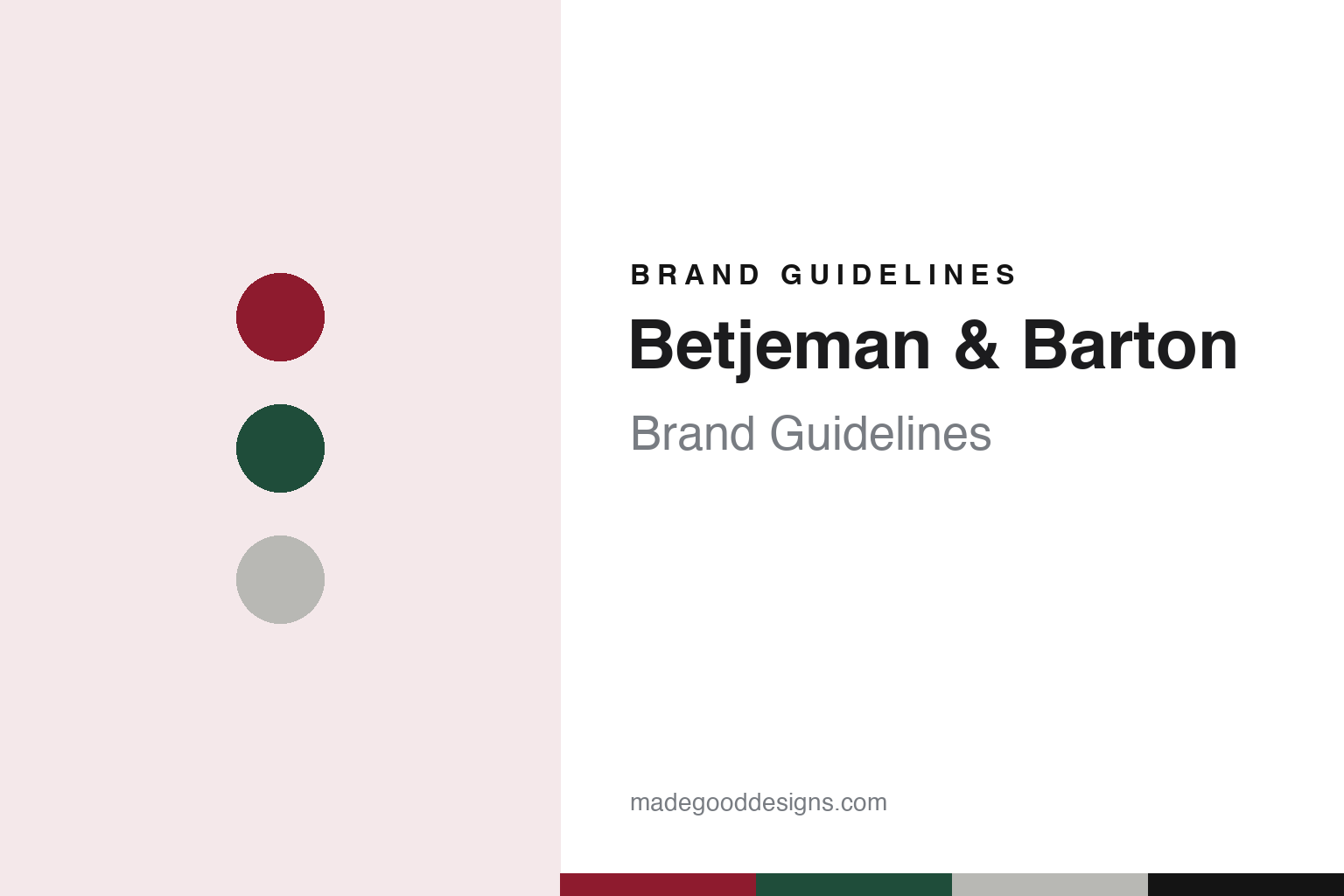
Betjeman & Barton Brand Guidelines
The Paris tea merchant of boulevard Malesherbes.
Aa
Two constants: a Betjeman & Barton red, green and silver palette and a Parisian serif register. Abstract homage — not a Betjeman & Barton product or mark; no tin, logo or label is reproduced.
The English Tea House
A tea shop in the 8th arrondissement.
Betjeman & Barton dates itself to 1919. The company says that in that year Arthur Betjeman opened a shop on the rue de Suresnes in Paris’s 8th arrondissement, then called “The English Tea House,” which sold tea alongside English groceries, and it calls this the first shop in Paris devoted to tea. Its archived English-language website, captured in 2004, said he had studied tea in Dublin and London and was related to the English poet Sir John Betjeman; those are the company’s own claims, and we give them only as such.
The double name came later, on the company’s current account. It says that in 1927 Arthur Betjeman hired Percy Barton as general manager and then took him into partnership, creating Betjeman & Barton. Not every telling agrees: a 2018 profile by The Star, republished by The Straits Times, put both men at the opening of the first shop in 1919. The company also says the shop moved in 1965 to 23 boulevard Malesherbes, a building formerly occupied by a florist, and that address is still its flagship and its registered office; French Wikipedia’s article on the boulevard lists the shop as “tea merchants in Paris since 1919.”
The house then passed through the founder’s family. The company says Arthur’s daughter Alix took charge in 1958, working with two women it names as Annie and Doris. Its 2004 website was more precise about what followed: it said the company had “known only three managers” since 1919, and that “at Mrs Betjeman’s request — the founder’s daughter — Didier Jumeau-Lafond took over the management of the company in 1978,” describing him as “born of a great family of tea merchants.” The current company history dates the handover to the 1970s and says the Betjeman women left for good in 1986.
Colour
Flavoured blends and a tin for every season.
Under Didier Jumeau-Lafond the house turned towards flavoured tea. The company says that in the 1980s he went beyond single-flavour teas to layered blends with poetic names, and it gives Eden Rose — black tea with bergamot, lavender and rose — as the example, a blend it says he composed as a tribute to his wife’s rose garden. It says he also introduced tea bags while keeping some grands crus loose-only, that the London store Harrods became a customer, and that at one point the house shipped up to 280,000 tins a year to English buyers; those figures are the company’s own. The 2004 site said Betjeman & Barton teas were exported “as far as Japan.”
The list is long. The company’s website gave “more than 250 different teas” in 2009, a figure English Wikipedia repeats from a 2014 Paris shopping guide, spanning origin teas from China, India and Ceylon, flavoured blends, rooibos and herbal infusions. In 2018, when the brand opened a tea salon in the Pavilion mall in Kuala Lumpur, The Star listed its bestsellers as Pouchkine, Eden Rose, Malesherbes and Des Amours, and reported that the teas were sealed and air-flown from France and sold in canisters made in France, with special canisters for Easter and Christmas.
The shop sold more than tea. The company says the boulevard Malesherbes space once stocked English marmalade, puddings, smoked salmon and spirits, which were gradually replaced by porcelain, Japanese cast iron and the “eccentric” teapots designed by Didier Jumeau-Lafond and made in Yorkshire. Its 2009 website said Katherine Gregory had run the artistic side of the business for more than twenty years and that those teapots were “much sought after by collectors.” Today the company says much of its work is bespoke blending for hotels and restaurants, naming the chefs Jean-Luc Lefrançois, Éric Fréchon and Frédéric Vardon among its collaborators, and that it has introduced tea bags made from corn starch.
Typography
The French tea house.
The seven brands in this group all sell tea, and they come from five countries: Taj Mahal Tea and Society Tea from India, Akbar and Mlesna from Sri Lanka, Betjeman & Barton from France, Hälssen & Lyon from Germany, and Nordqvist from Finland. Two of those countries grow tea on a large scale; the other three do not, so the tea sold under a brand from there was grown somewhere else.
That split makes the usual questions sharper. For a brand from a growing country, the label may promise a garden, a region or a national style of tea; for one from a country that grows none, the promise rests on the blend, the flavouring, the shop and the box. In both cases the name on the front and the place where the tea was grown, blended and packed can be several countries apart.
Each guide separates what independent sources record from what the company says about itself — who started it, who owns it now, where its leaf is bought and where its tea is actually blended and packed — and marks plainly what rests only on the company’s own word.
Aa
An elegant Parisian serif for a tea merchant’s shop. (Specimen set in Cormorant Garamond, a serif STAND-IN; NOT the Betjeman & Barton logo.)
Betjeman & Barton
Red for flavoured, green for classic, then silver.
Betjeman & Barton’s identity is built on its tins. The company says the house long followed a colour code: red tins for flavoured teas, green for the classics and black for its exceptional collections, with carrier bags in the same colours, and that its tins were inspired by antique Chinese tea boxes the founder brought back from his travels. Its 2004 website already described “the red and green caddies” of the Malesherbes shop and showed an image captioned “the original caddy, 1919.”
That code was redrawn in the 2000s. The company says Agnès Defontaine — previously a shop manager at the Paris grocer Hédiard and later at Lenôtre and on Alain Ducasse’s Be Boulangerie project — reworked the logo and replaced the red and green with a metallic silver-grey, made the tins rounder and introduced the “dôme” tin it now treats as a signature, while a brightly coloured “biberon” tin is credited to Katherine. Its 2009 website said Agnès, Katherine and the shop’s manager Myriam had given the brand “a new look,” drawing on the logo line “Paris tea merchants since 1919,” and a December 2008 press release announced two new collections of coloured metal tins for spring and summer 2009. Defontaine is named as the website’s director of publication.
The shops spread through franchises. The company dates its first, in Saint-Germain-en-Laye, to 1987; by 2004 its website listed branches in Deauville, Bordeaux, Montpellier, Nancy, Lille and Biarritz, in The Hague and near Geneva and Lausanne, and claimed more than twenty shops worldwide. The company says it opened the capital’s first tea bar at 24 boulevard des Filles du Calvaire in 2012, an address that already appeared on its 2004 shop list, and that it has since opened in Rouen, Tours, Lyon, Japan and Malaysia. Ownership changed most recently in 2018: the company says the house was bought that year by the Cluizel family, the French chocolate makers, with Defontaine remaining in charge.
For a design guide, Betjeman & Barton shows how a single colour code on a tin can carry a Paris tea house through a century of owners. Compare Dammann Frères, another French tea house, and Mariage Frères. For this guide we use deep red, caddy green, ink and silver with a serif, an unofficial interpretation; no product or logo is reproduced.
Explore & save
Keep Betjeman & Barton’s identity on hand — save it to a board in the Made Good inspiration library.
Betjeman & Barton identity set
Pin the Betjeman & Barton red, green and silver palette and the Parisian serif register to your own board.