Aunt Bessie’s Brand Guidelines
The Hull Yorkshire pudding brand that began with Butlin’s.
Aa
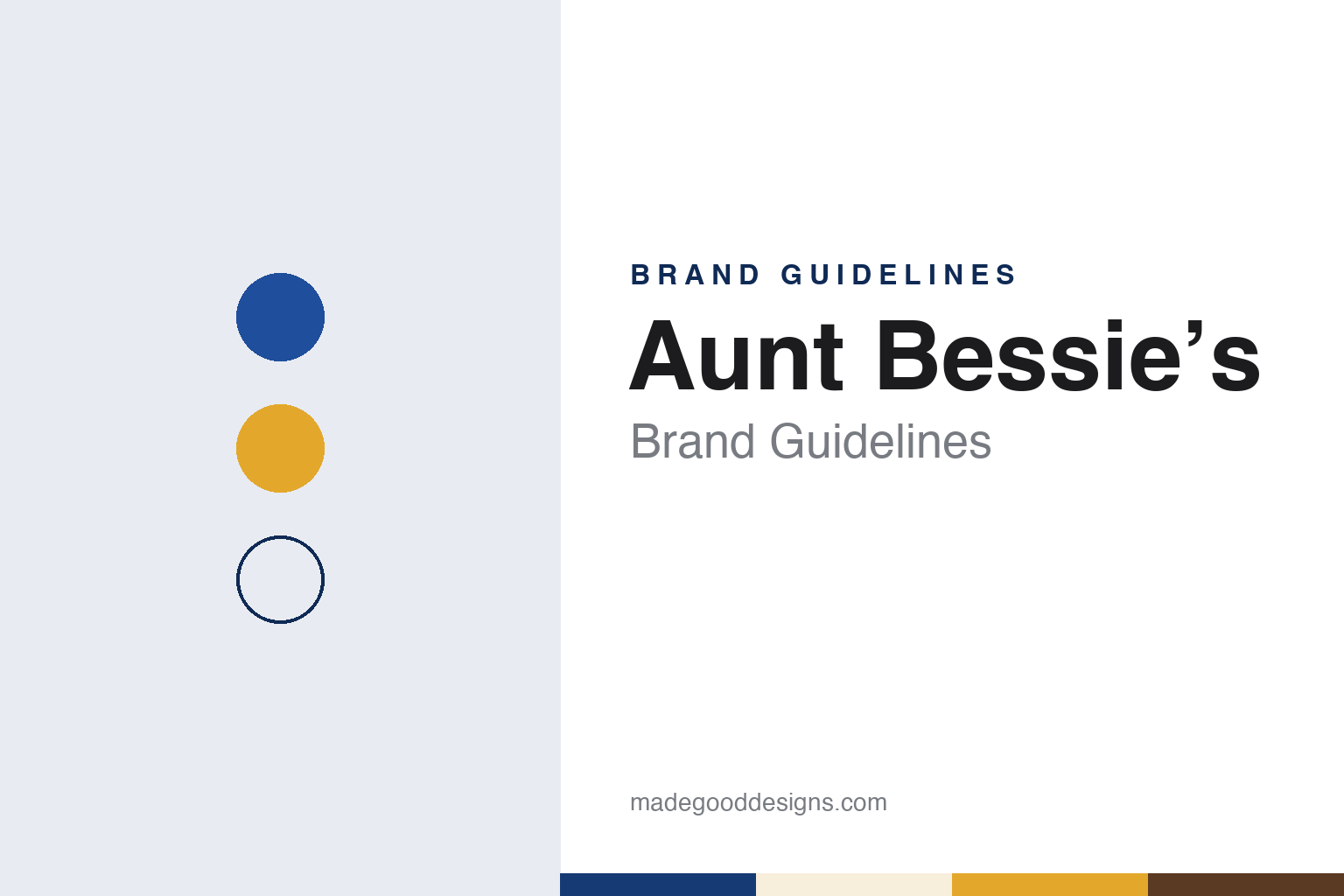
Two constants: a pack blue, pudding gold and batter cream palette and a soft homely serif register. Abstract homage — not an Aunt Bessie’s product or mark; no pack, logo or character is reproduced.
Puddings for Butlin’s
A Hull grocer, a holiday-camp order and a rejected name.
Aunt Bessie’s is a Hull brand with roots in a Victorian grocer’s shop. English Wikipedia says William Jackson (1828–1912) opened a grocer and tea dealer’s shop in Hull in 1851; the business added a bakery in 1891 and grew into the privately owned William Jackson Food Group, now based in nearby Hessle. In 1968, the same article says, the company developed a process for making Yorkshire puddings commercially.
The brand grew out of a catering order. In 1974 the holiday-camp operator Butlin’s asked for a Yorkshire pudding it could serve at its camps, and Jackson’s began supplying frozen puddings, English Wikipedia says; The Telegraph, writing in 2026, also traced the business to 1974 and Butlin’s. For two decades the puddings went mainly to caterers. When the group moved into the supermarkets in 1995, it set up a separate manufacturing company, Tryton Foods, to make them.
The retail name was settled before the puddings reached the shelf. According to English Wikipedia, market research found that shoppers linked the name Triton either with bathrooms and showers or with intercontinental ballistic missiles, so the puddings went on sale as Aunt Bessie’s instead. The manufacturing company kept the Tryton name until 2008, when it became Aunt Bessie’s Ltd, the same article says, citing Companies House.
Colour
From the pudding to the whole roast, and a face on every pack.
The range spread from the pudding to the rest of the roast dinner. Frozen roast potatoes arrived in 1999, and for years Aunt Bessie’s potatoes, chips and croquettes were made under licence by Heinz at its factory in Norfolk, until that contract ended in 2015, English Wikipedia says, citing the Norfolk press, Food Manufacture and just-food. By 2001 the brand’s retail value had passed £50 million and it ranked among Britain’s top 100 brands, The Yorkshire Post reported that year. In early 2008 sales of its Homestyle mashed potato doubled after Delia Smith used it for a shepherd’s pie in her book How to Cheat at Cooking, according to a 2009 Datamonitor case study cited by English Wikipedia. The Grocer’s list of Britain’s biggest brands placed Aunt Bessie’s 50th in 2016 and 55th in 2017.
Today the brand’s website groups its products around the roast: Yorkshire puddings, roast potatoes, mash, stuffing and dumplings, toad in the hole, vegetables and desserts. It also says it supports people living with sight loss through NaviLens technology and a partnership with the charity RNIB.
The figure on the pack is the brand’s main design asset. In October 2019, Potato Business reported, Aunt Bessie’s introduced new packaging that brought back its blue tones, with new product photography and a new logo showing a more modern Aunt Bessie figure. It was backed by a £5 million campaign from the agency St Luke’s, the brand’s largest-ever investment in marketing, according to Marketing Week.
A bigger change came in October 2026. The character, a grandmotherly cook with a mixing bowl, was redrawn as a younger woman with her arms open and the bowl gone. “Aunt Bessie is a national treasure who has been part of the family for decades, so we thought it was about time she received the glow-up that she deserves,” the head of marketing, Claire Hoyle, told The Telegraph; the open arms, she said, were about “welcoming people to the table, no matter what day of the week.” Reports credited the design to the Netherlands office of the agency 1HQ. Speaking to Metro, Sabrina Gottschalk, a marketing lecturer at Bayes Business School, said the old figure signalled a cook and the new one a host.
Typography
Design and documentation.
The seven brands in this group all make frozen food, pies or pasties sold in Britain: Birds Eye, McCain, Aunt Bessie’s, Young’s, Chicago Town, Ginsters and Pukka. Brands in this part of the British food trade sit at many different points in it, from family firms that still carry a founder’s name to names that now belong to much larger food groups, and a single brand can be sold everywhere from a football ground or a petrol-station counter to a supermarket freezer.
A frozen or savoury food brand’s identity is usually carried less by a single product than by a pack, a name and the meal it promises, because the company behind the name may have changed hands, moved its factory or grown far beyond the place where it started. That makes the questions behind each name worth asking plainly: who started it, who owns it now, and where its food is actually made and packed.
Each guide separates what independent sources record from what the company says about itself — its founding story, its owners over time, where its food is made and how its packaging has changed — and marks plainly what rests only on the company’s own word.
Aa
A soft homely serif for a brand fronted by a family cook. (Specimen set in Fraunces, a serif STAND-IN; NOT the Aunt Bessie’s logo.)
Aunt Bessie’s
From a Hull family group to Nomad Foods.
Aunt Bessie’s stayed with William Jackson for more than two decades. In 2018 the group sold it to Nomad Foods, the frozen-food group that owns Birds Eye. Nomad announced completion of the deal on 2 July 2018, for about €240 million, or about £210 million. Nomad said the purchase included a production facility in Hull, that Aunt Bessie’s held the number one position in frozen Yorkshire puddings and number two in frozen potatoes, and that the business had revenues of about €123 million in the year to April 2018. William Jackson Food Group kept its other businesses, among them the Jacksons bakery and the organic delivery company Abel & Cole, English Wikipedia says.
The brand is still made in Hull. Nomad’s 2018 announcement named the Hull plant, and in January 2024 the regional site Future Humber reported that the BBC series Inside the Factory had filmed its Yorkshire pudding episode at Aunt Bessie’s in the city. The brand’s website names Birds Eye Limited as its operating company, and The Telegraph described Aunt Bessie’s in 2026 as owned by Birds Eye.
For a design guide, Aunt Bessie’s shows how a single drawn character can carry a frozen-food brand from its 1995 launch to today, and how a redraw of that character becomes national news. Compare Birds Eye, its sister brand at Nomad Foods, and Bisto, another name built on the British roast dinner. For this guide we use a pack blue, a pudding gold and a batter cream with a soft serif, an unofficial interpretation; no product or logo is reproduced.
Explore & save
Keep Aunt Bessie’s’s identity on hand — save it to a board in the Made Good inspiration library.
Aunt Bessie’s identity set
Pin the Aunt Bessie’s pack blue, pudding gold and batter cream palette and the soft homely serif register to your own board.