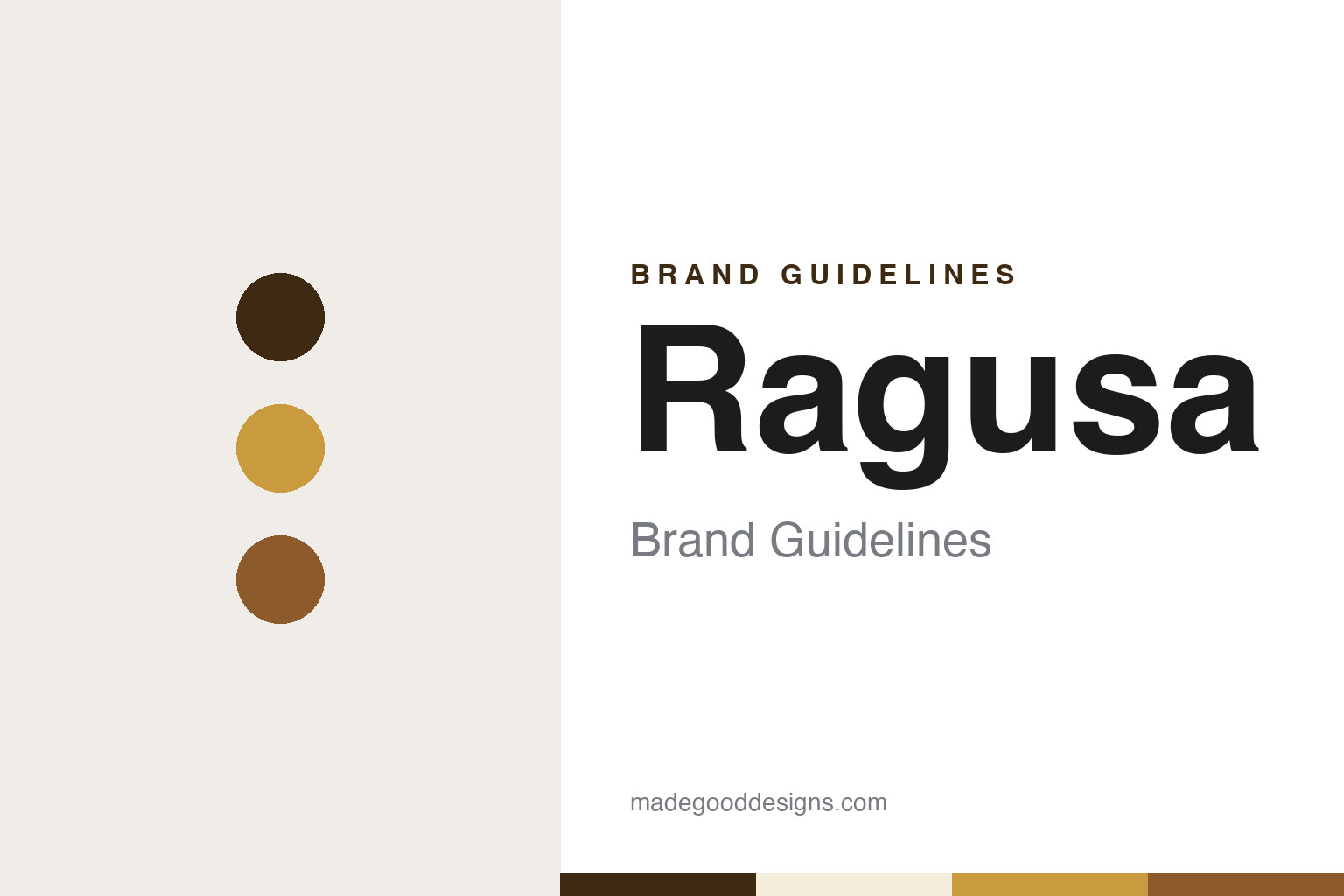
Ragusa Brand Guidelines
The wartime hazelnut bar from Courtelary.
Aa
Two constants: a cocoa brown, hazelnut and praliné gold palette and a high-contrast serif register. Abstract homage — not a Ragusa product or mark; no wrapper, logo or bar is reproduced.
Bern to the Jura
A chocolatier from Bern and a move to a Jura village.
Ragusa is the best-known product of Chocolats Camille Bloch, a family chocolate maker in the Bernese Jura. Its founder, Camille Bloch (1891–1970), started in Bern with a business called Chocolats et Bonbons fins Camille Bloch. The founding date differs between sources: German Wikipedia’s article on the company gives 1926, with registration as a public limited company in 1929, while the company’s own history and German Wikipedia’s biography of Bloch both give 1929.
In 1935 the firm moved to Courtelary, a French-speaking village in the Saint-Imier valley of the Bernese Jura, and took the name Chocolats Camille Bloch SA, German Wikipedia says. Courtelary remains its only production site.
The bar was a response to war. Switzerland was short of raw materials during the Second World War, and cocoa was scarce; hazelnuts, German Wikipedia says, could still be imported from Turkey. In 1942, the company says, Camille Bloch hit on the idea of grinding hazelnuts into a paste and adding whole hazelnuts to it. The result was a bar of hazelnut praliné studded with whole hazelnuts and enclosed in milk chocolate, and the Swiss farming paper Schweizer Bauer reported in 2017 that it was born of wartime chocolate scarcity.
Colour
A name from the Adriatic and four new wrappers.
The name came from a holiday. Camille Bloch had once stayed in Ragusa, the historic name of Dubrovnik on the Croatian coast, and chose it, the company says, because it worked in all of Switzerland’s national languages. German Wikipedia gives the same account.
The pack has been redrawn several times. The company dates its first Ragusa packaging to 1945 and lists redesigns in 1960, 1989 and 2007. The classic bar, German Wikipedia says, still follows the 1942 recipe.
Later variants added new chocolates. First came Ragusa Noir, with dark chocolate of 60% cocoa, in 2008, as the company and the regional paper Jungfrau Zeitung both date it; a separate German Wikipedia article gives 2010. Ragusa Blond followed in 2014, made with a light, caramelised chocolate of 31% cocoa around a praliné cream, according to German Wikipedia, which the company calls an entirely new category of chocolate. Other formats include Délice, small chocolate spheres, and Ragusa croissants, filled pastries, German Wikipedia says, adding that the cocoa for the bars comes from Ghana and Ecuador through a sourcing programme called Source Trust. The brand also tied itself to Swiss sport: Ragusa sponsored the ski racer Lara Gut-Behrami from 2012 to 2024, Blick and Watson reported when the partnership ended.
Typography
Design and documentation.
The seven brands in this group all make food, and all of them come from Greece, Switzerland or France: Lacta, Allatini, Papadopoulos, Minerva, Zweifel, Ragusa and Francine. Food brands from these three countries sit at many different points in the trade, from family firms that still carry a founder’s surname to names that now belong to much larger food groups, and a single brand can be sold everywhere from a corner shop to a supermarket shelf.
A food brand’s identity is usually carried less by a single product than by a pack, a name and the meal or snack it promises, because the company behind the name may have changed hands, moved its factory or grown far beyond the town where it started. That makes the questions behind each name worth asking plainly: who started it, who owns it now, and where its products are actually made and packed.
Each guide separates what independent sources record from what the company says about itself — its founding story, its owners over time, where its products are made and how its packaging has changed — and marks plainly what rests only on the company’s own word.
Aa
A high-contrast serif for a bar named after an Adriatic port. (Specimen set in Playfair Display, a serif STAND-IN; NOT the Ragusa logo.)
Ragusa
Three generations of Blochs in one village.
Chocolats Camille Bloch has stayed in the founding family. Camille Bloch’s son Rolf Bloch joined the firm in 1954, became a director in 1960 and took over its leadership in 1970, German Wikipedia says; he ran it day to day until 1997 and chaired its board until 2005. Outside the company he led the Jewish community of Bern from 1975 to 1985 and was president of the Swiss Federation of Jewish Communities from 1992 to 2000, and in 1997 the Swiss Federal Council appointed him to head a special fund for needy victims of the Holocaust, German Wikipedia says. He received an honorary doctorate from the University of Bern in 2000. The company marked its 75th anniversary in 2004 with a book, Camille Bloch – 75 Jahre süsse Genüsse, German Wikipedia notes.
His sons Daniel and Stéphane Bloch took over operational control in 1997. Daniel Bloch is chief executive and, since 2005, chairman of the board, and Stéphane Bloch leads sales and marketing, German Wikipedia says; the company calls Daniel the third generation to run the business. Besides Ragusa it makes Torino, an almond-filled chocolate, and since 2020 a line of coated nuts called So Nuts. German Wikipedia, citing the trade press, says Ragusa accounts for more than half of the company’s sales.
The company has opened itself to visitors. A visitor centre, Chez Camille Bloch, opened in Courtelary in 2017 and drew more than 100,000 people in its first year, German Wikipedia says, citing the trade magazine Lebensmittelindustrie; the same source says the company bought land in Georgia to grow hazelnuts in 2018. In 2023 the company had 180 employees, the trade site foodaktuell reported, and it says it makes several thousand tonnes of chocolate a year, about a fifth of it for export. In 2025 it replaced its oil-fired cocoa roasting with a plant running on renewable energy, foodaktuell and swissinfo reported.
For a design guide, Ragusa shows how a wartime workaround, a borrowed place name and a slowly updated wrapper can make one bar the centre of a family firm for more than eighty years. Compare Cailler, Switzerland’s oldest chocolate brand, and Frey, the Aarau chocolate maker. For this guide we use cocoa brown, hazelnut and praliné gold with a high-contrast serif, an unofficial interpretation; no product or logo is reproduced.
Explore & save
Keep Ragusa’s identity on hand — save it to a board in the Made Good inspiration library.
Ragusa identity set
Pin the Ragusa cocoa brown, hazelnut and praliné gold palette and the high-contrast serif register to your own board.