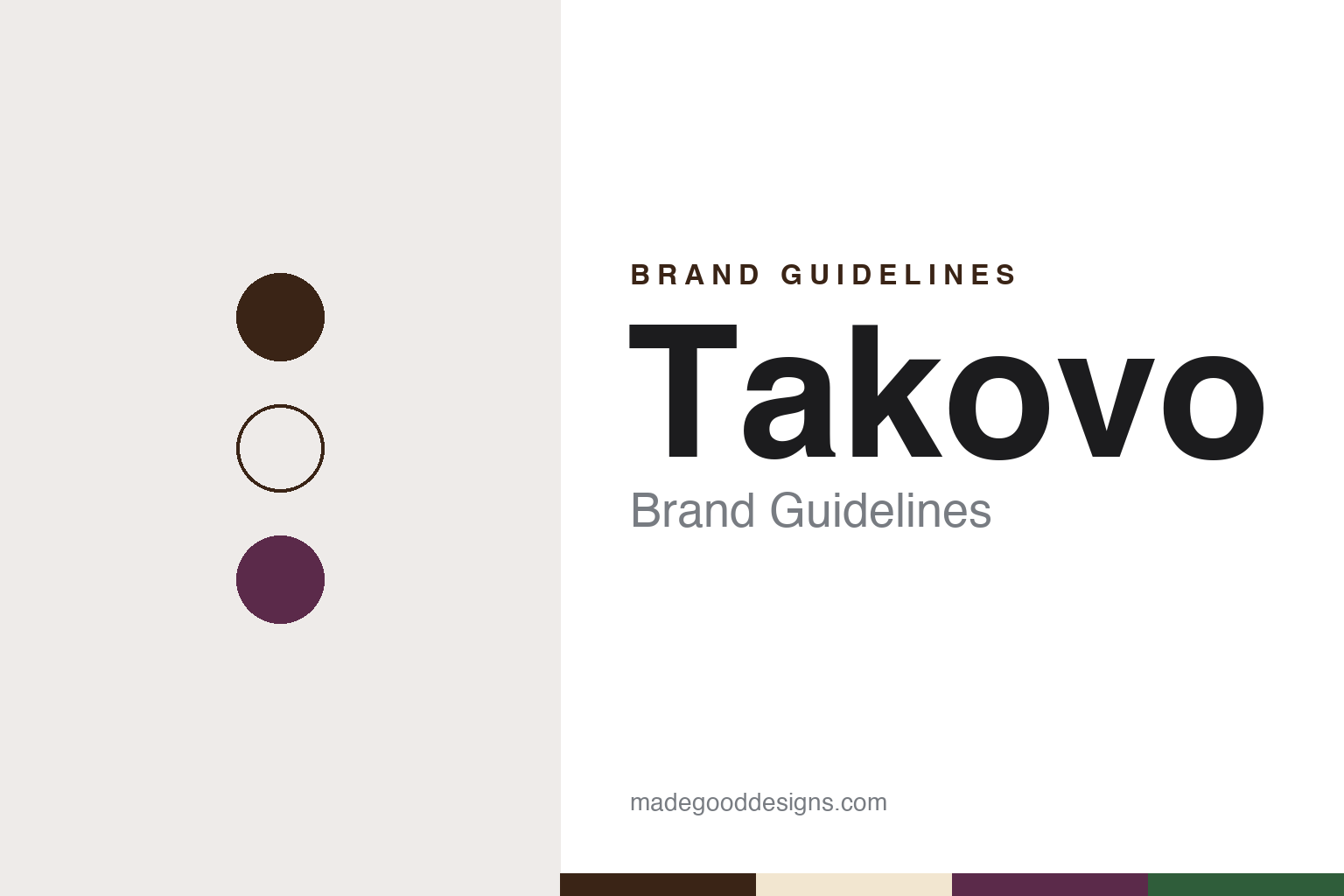
Takovo Brand Guidelines
The Gornji Milanovac combine behind Yugoslavia’s Eurokrem.
Aa
Two constants: a cocoa brown, hazelnut cream and plum palette and a warm editorial serif register. Abstract homage — not a Takovo product or mark; no jar, logo or label is reproduced.
From sweet shop to combine
A confectioner, a cooperative and a town in central Serbia.
Takovo is a food brand from Gornji Milanovac, a town in central Serbia about 120 kilometres south of Belgrade. It shares its name with the nearby village of Takovo, in the same municipality, where the Second Serbian Uprising against Ottoman rule began in April 1815. Its roots are in a confectioner’s shop, and the two main accounts date that shop differently. Serbian Wikipedia says the shop, called “Takovo,” was founded on 29 January 1941 by Ivan Milosavljević and kept working through the Second World War; English Wikipedia’s article on the Swisslion Group also gives 1941 and names him as founder. The company itself says Takovo grew from a sweet factory founded in 1922, which worked until 1941, when it stopped because of the bombing of the town.
After the war the business was turned into a factory for sweets and ratluk, the local Turkish delight, Serbian Wikipedia says, and was then taken from the Milosavljević family and became socially owned. The company says it has traded under the name Takovo since 1959, which it treats as its founding year. In 1962 the state sweet factory and a farming cooperative called Progres were combined into PIK “Takovo,” an agricultural and industrial combine, the daily Danas reported in 2018. That year, the company says, it decided to grow as an industrial food producer rather than in farming.
English Wikipedia describes the Yugoslav-era Takovo as state-owned and one of the country’s biggest industrial companies. The company says its workforce peaked at 4,200 in 1990.
Colour
Eurokrem, vodka and an Italian partner.
Takovo’s best-known product came from Italy. A former director, Jovan Tomović, bought the licence to make Eurokrem, a two-tone cocoa and hazelnut spread from the Italian maker Gandola, Serbian Wikipedia says, citing Mondo. The sources differ on the year. Serbian Wikipedia says the Eurokrem factory opened in 1970 with an annual output of 1,000 tonnes, and The Nutshell Times also gives 1970; the company and English Wikipedia’s Eurocrem article give 1972, the company saying it bought both the licence and the equipment, to the original Italian recipe. A larger Eurokrem factory opened in 1976, and by the early 1980s output had reached 13,000 tonnes a year, Serbian Wikipedia says. The company says Eurokrem still leads its category in Serbia and the surrounding countries.
Other plants followed, Serbian Wikipedia says: Baltik, for vodka; a packing centre; and Tako, for Tako cakes. In 1976 the combine produced 33,000 tonnes of food and employed 1,742 people. During the sanctions of the 1990s it kept supplying the home market and began making extruded snacks, and added a feed mill and a poultry farm. In 1995 its Tako unit became Takovo-Fabri, a joint venture with the Italian biscuit and cake maker Fabri. By 1997, Serbian Wikipedia says, the combine employed more than 3,500 people and exported to countries including Russia, the United States, Italy and Switzerland.
The PIK Takovo logo, which Serbian Wikipedia shows, was used from 1959 to 2004.
Typography
Design and documentation.
The seven brands in this group all make food or drink, and all of them come from Serbia: Jaffa, Takovo, Štark, Swisslion, Knjaz Miloš, Imlek and Zlatiborac. Serbian food and drink brands in general sit at many different points in the trade, from family firms that still carry a founder’s name to names that now belong to much larger food groups, and a single brand can be sold everywhere from a village shop to a supermarket shelf.
A food or drink brand’s identity is usually carried less by a single product than by a pack, a name and the taste or occasion it promises, because the company behind the name may have changed hands, moved its factory or grown far beyond the town where it started. That makes the questions behind each name worth asking plainly: who started it, who owns it now, and where its products are actually made and packed.
Each guide separates what independent sources record from what the company says about itself — its founding story, its owners over time, where its products are made and how its packaging has changed — and marks plainly what rests only on the company’s own word.
Aa
A warm editorial serif for a name taken from Serbian history. (Specimen set in Fraunces, a serif STAND-IN; NOT the Takovo logo.)
Takovo
A tender, a new owner and a name kept on the label.
Takovo was privatised in 2004. When the privatisation agency opened a public tender, four companies were interested, including the Gornji Milanovac company Metalac, which was not allowed to take part because it was not a food company, Serbian Wikipedia says, citing Blic and Večernje novosti. Early in 2004 the combine was bought by Swisslion, a food company from Novi Sad, the broadcaster B92 reported on 6 February 2004. The two businesses began trading together as Swisslion-Takovo, the company says.
Restructuring followed. The old combine was split into several linked companies, among them Kompanija Takovo, Takovija and Eurolion, and confectionery moved for a time to a Gornji Milanovac branch of another Swisslion company, so that Takovo itself stopped making sweets, Serbian Wikipedia says. In 2019 Kompanija Takovo took that branch back and resumed confectionery; in 2022 it was renamed Swisslion-Takovo d.o.o., with its seat in Gornji Milanovac; and in 2025 the factories in Vršac and Inđija were split off into separate companies within the Swisslion Group. English Wikipedia’s Eurocrem article says Swisslion registered a “Takovo Eurocrem” trademark in 2008, and that Gandola still makes its own Eurocrem in Italy.
The Takovo name survives across a wide range. Serbian Wikipedia lists products made in Gornji Milanovac including Takovo Eurokrem and its bar version, Eurokrem blok; Takovo ratluk and wafers; Takovo fruit juices, nectars, syrups, jams and soups; and fruit brandies such as Viljamovka Takovo and Takovo šljivovica, alongside Baltik vodka. The company says its Gornji Milanovac Eurokrem plant can make up to 80 tonnes a day, and that a ten-year investment cycle in its preparation and packing lines was completed in August 2017.
For a design guide, Takovo shows how a town’s historic name can carry a whole pantry, from a licensed Italian spread to plum brandy. Compare Swisslion, the Novi Sad group that owns it, and Nutella, Ferrero’s hazelnut spread. For this guide we use cocoa brown, a hazelnut cream and a plum with a serif, an unofficial interpretation; no product or logo is reproduced.
Explore & save
Keep Takovo’s identity on hand — save it to a board in the Made Good inspiration library.
Takovo identity set
Pin the Takovo cocoa brown, hazelnut cream and plum palette and the warm editorial serif register to your own board.