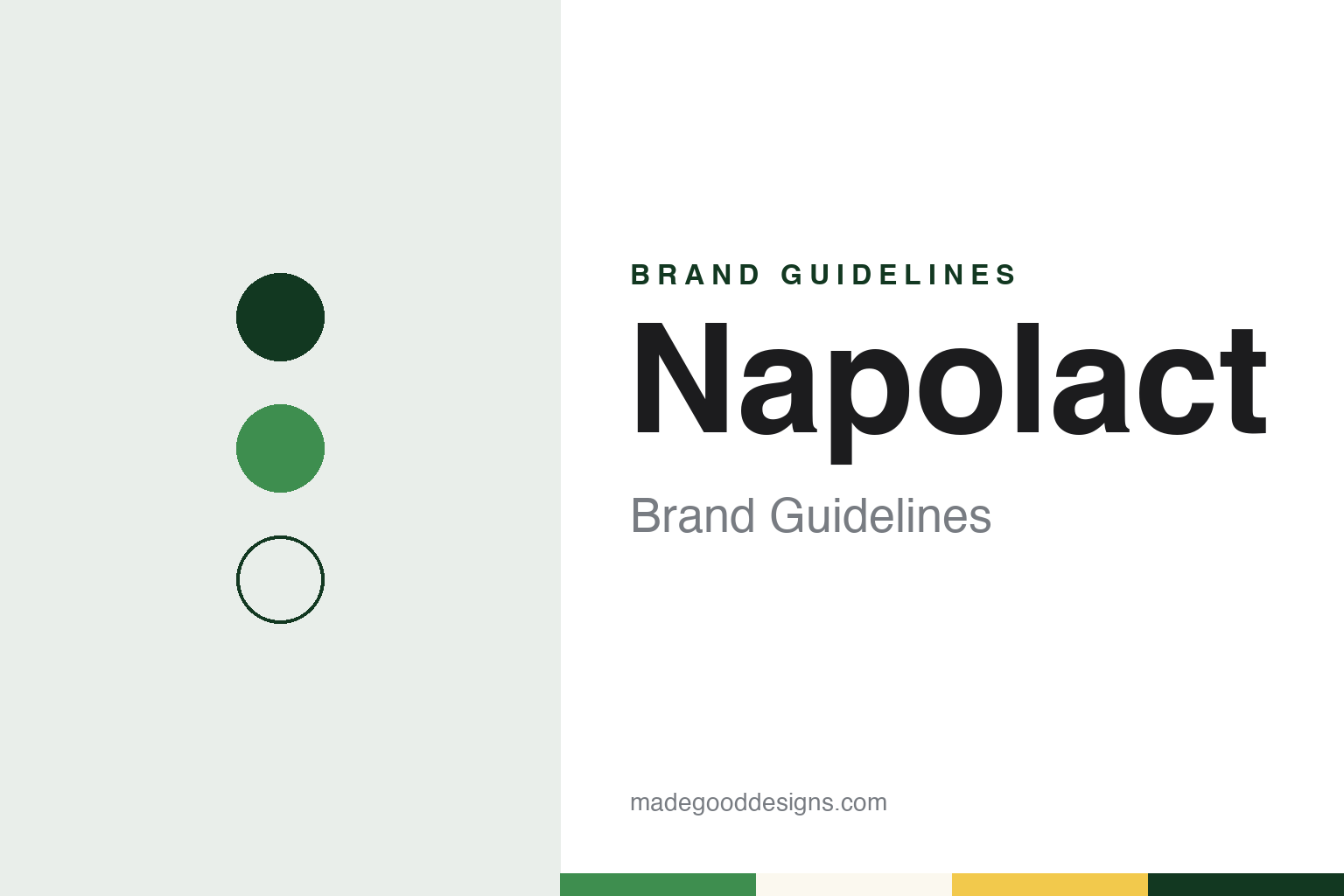
Napolact Brand Guidelines
The Transylvanian dairy brand from Cluj, made by FrieslandCampina Romania.
Aa
Two constants: a pasture green, milk white and butter yellow palette and a rounded sans register. Abstract homage — not a Napolact product or mark; no pack, logo or label is reproduced.
From workshop to state dairy
A Cluj dairy that took the Napolact name in 1990.
Napolact is a Romanian dairy brand from Cluj, in Transylvania. Romanian Wikipedia describes it as a brand of the Dutch dairy group FrieslandCampina that is used only in Romania, and it is the main brand of the group’s Romanian business, the company says.
Its history is older than its name. The company’s “about” page traces the brand to around 1905, when, it says, a place known as Atelierul lui Vlad — “Vlad’s Workshop” — became known in Transylvania for butter and cow’s-milk cheese. Romanian Wikipedia, citing the company, adds that by 1936 the business was also making yoghurt and fermented and processed cheeses. The company’s homepage gives a second starting point: it says “our story began in the heart of Ardeal, in 1955,” and speaks of more than seventy years of tradition. Both dates are the company’s own.
The documented turning points are the post-war ones. In 1948, when Romania’s communist state nationalised private enterprises, the small Cluj dairy became the Întreprinderea de Industrializare a Laptelui Cluj, the Cluj milk-processing enterprise, according to Romanian Wikipedia and the company’s timeline. The company’s timeline adds that a sister enterprise for the Mureș region, the Întreprinderea de Industrializare a Laptelui Mureș, followed in 1955.
After the end of communism, the Cluj enterprise was renamed. In 1990 it took the name Napolact, Romanian Wikipedia says, and the company dates the brand itself to that year. Romanian Wikipedia, citing the business magazine Capital, says that by 1998 Napolact had become Romania’s leading dairy producer, and that from 1994 it received a series of awards from the Romanian state.
Colour
Dutch ownership, Transylvanian milk.
Napolact came under Dutch ownership in 2004. English Wikipedia lists Napolact among the acquisitions of Campina in that year, while Romanian Wikipedia says it was taken over by Friesland, after which European standards were introduced at its plants in Baciu, just outside Cluj-Napoca, and Târgu Mureș. The company’s own timeline fills in the group side: Friesland România was formed in 2002 from the merger of the local companies Belcar Bela-Deta and Someșana; it took the name FrieslandCampina Romania in 2009, after the Dutch cooperatives Friesland Foods and Campina combined; and in 2016 today’s FrieslandCampina Romania was formed by merging Napolact S.A. with IL Mureș.
The parent group itself has changed again. Royal FrieslandCampina, headquartered in Amersfoort in the Netherlands, was established on 30 December 2008, and its merger with the Belgian dairy cooperative Milcobel took effect on 1 January 2026, according to English Wikipedia.
Where Napolact is made is stated plainly. In 2015, Romanian Wikipedia says, production ran at three plants: the dairies at Baciu and Târgu Mureș and a cheese plant at Țaga, in Cluj county, which reopened in November 2014, the business daily Ziarul Financiar reported. Today the company’s website speaks of “two factories with tradition in Cluj-Napoca and Târgu-Mureș” and of more than 1,100 partner farmers. The company has said that all Napolact products use raw milk collected from farmers in Transylvania, Romanian Wikipedia reports, citing an interview with a company executive.
The range covers the staples of a Romanian dairy aisle: fresh milk, yoghurt, drinking yoghurts, fresh and matured cheeses, cașcaval, smântână (soured cream) and butter. Several products have been registered with Romania’s Ministry of Agriculture as traditional Romanian products, Romanian Wikipedia says, among them the Huedin telemea, the Dej cașcaval and the Năsal cheese. In April 2015 the brand launched an organic line, Napolact BIO, Ziarul Financiar reported, and in 2014 it opened its first shop with a café area in Cluj-Napoca, Romanian Wikipedia says.
Typography
Design and documentation.
The seven brands in this group all make food or drink, and all of them come from Romania or Bulgaria: Ursus, Timișoreana, Borsec, Dorna, Napolact, ROM and Zagorka. Food and drink brands from these two countries in general sit at many different points in the trade, from names that still carry a town or a region to names that now belong to much larger international groups, and a single brand can be sold everywhere from a village shop to a supermarket shelf.
A food or drink brand’s identity is usually carried less by a single product than by a pack, a name and the taste or occasion it promises, because the company behind the name may have changed hands, moved its production or grown far beyond the place where it started. That makes the questions behind each name worth asking plainly: who started it, who owns it now, and where its products are actually made and packed.
Each guide separates what independent sources record from what the company says about itself — its founding story, its owners over time, where its products are made and how its packaging has changed — and marks plainly what rests only on the company’s own word.
Aa
A rounded, friendly sans for a dairy brand. (Specimen set in Nunito, a sans STAND-IN; NOT the Napolact logo.)
Napolact
A local name inside a multinational.
Napolact’s look has been reworked under its Dutch owner. The company’s timeline records that in 2013 Napolact, “the main brand of FrieslandCampina Romania,” changed its visual identity. More recently the brand has put packaging at the centre of its communication: its website promotes a new Napolact PET bottle and a recycling programme, and the company says the radio station Europa FM gave it a “Green Medal” for launching more environmentally friendly packaging.
Its advertising has a long record at Romania’s marketing-effectiveness awards. The company lists Effie Romania awards in most years from 2008 to 2014 — silver in the food-products category in 2008, 2009 and 2011, gold in 2010, bronze in 2012 and 2013, and gold for “sustained success” in 2010 and 2014 — and a bronze for packaged food in 2020. In 2013 Napolact was named the most trusted dairy brand in the Reader’s Digest Trusted Brands study for Romania, Romanian Wikipedia says, a survey that asks consumers to name brands without prompting. The company says the magazine BIZ named it the first Romanian dairy brand in its “Top 100 Romanian brands” for the tenth year running in 2020.
For a design guide, Napolact shows how a regional name can keep its local identity — Transylvanian milk, Cluj and Mureș dairies, traditional cheeses — while being run as part of an international cooperative. Compare Lurpak, a Danish dairy mark owned by the Arla cooperative, and Président, the Lactalis cheese label. For this guide we use pasture green, milk white and butter yellow with a rounded sans, an unofficial interpretation; no product or logo is reproduced.
Explore & save
Keep Napolact’s identity on hand — save it to a board in the Made Good inspiration library.
Napolact identity set
Pin the Napolact pasture green, milk white and butter yellow palette and the rounded sans register to your own board.