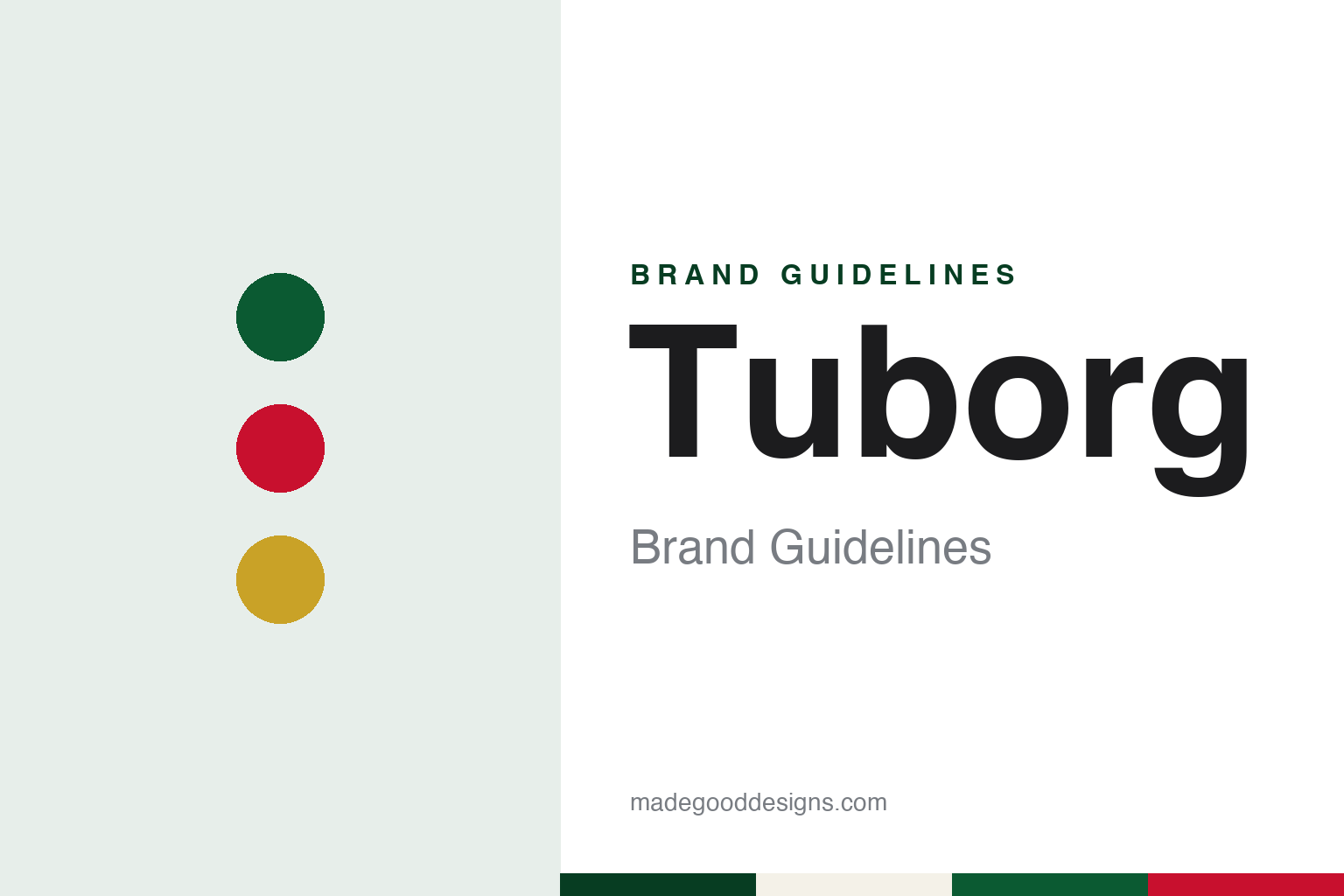
Tuborg Brand Guidelines
The Hellerup harbour brewery behind Grøn Tuborg.
Aa
Two constants: a Grøn green, Rød red and Guld gold palette and a bold Danish grotesque register. Abstract homage — not a Tuborg product or mark; no bottle, label or logo is reproduced.
A brewery on a harbour
An export plan, a fertiliser works and a pilsner.
Tuborg began as a harbour venture rather than a brewery. Danish Wikipedia says A/S Tuborgs Fabrikker was founded at Hellerup, just north of Copenhagen, on 13 May 1873, on the initiative of the wholesaler and slaughterhouse owner Philip W. Heyman, who had learned that the shipowner H.P. Prior was willing to sell the land and harbour he had built there in 1869–72. Heyman brought in the financier C.F. Tietgen, who became the first chairman, the wholesaler Rudolph Puggaard and the lawyer Gustav Brock. The plan was an export brewery for South America, with a glassworks to make its bottles and factories for sulphuric acid and fertiliser alongside.
The name is older than the company. English Wikipedia, citing Berlingske in 2008, traces it to Thuesborg, “Thue’s castle,” an inn from the 1690s on the site; the brand itself tells the same story, saying locals gave a small, haphazard inn the joking nickname of a castle. The first beers, including a lager later known as Rød Tuborg, went on sale on 13 July 1875, Danish Wikipedia says, brewed under the Norwegian brewmaster Hans Bekkevold.
The export plan failed, and in 1880 Heyman took over as both managing director and chairman. He sold the glassworks to Kastrup Glasværk in 1881, closed the fertiliser works in 1882, and turned to Denmark. That same year, 1880, the brewery brought out what Danish Wikipedia calls the country’s first pilsner, Grøn Tuborg — “green Tuborg” — first brewed by Bekkevold after the beers of Pilsen. The brand today dates itself “since 1880,” from that beer.
Colour
Parasols, a giant bottle and a thirsty man.
Heyman built the brand as much as the brewery. Danish Wikipedia says that while other Copenhagen brewers sold beer in casks to independent bottlers, who put their own labels on it, Tuborg bottled at its own works, so every bottle carried the same Tuborg look; the company says this let it sell direct to shops at a fixed price. Heyman also devised the Tuborg parasols that shaded the drivers of its beer wagons and announced the brand on the street.
His best-known stunt came in 1888. For the Nordic industrial, agricultural and art exhibition in Copenhagen he built the Tuborg bottle, a giant bottle that worked as a viewing tower with a hydraulic lift; the company puts its height at 26 metres. After the exhibition it was set up by the brewery on Strandvejen, where it still stands. The wagon roofs left a mark on the Danish language too: Danish Wikipedia says the curly brackets { } are often called tuborgklammer because they resemble them.
Danish Wikipedia says Heyman was succeeded in 1893 by his son-in-law Benny Dessau. For the 25th anniversary of the first brew in 1900, Dessau held a poster competition. J.F. Willumsen won it, but the poster that lasted was Erik Henningsen’s Den tørstige Mand, “The Thirsty Man,” of the same year, Danish Wikipedia says. Guld Tuborg followed in 1895, and in 1932 Dessau made “Rød” and “Grøn” the official names of the two main beers. The company says a Danish motto of Heyman’s, “Stilstand er tilbagegang” — “standing still is going backwards” — is printed on its bottles.
Later rituals were built around seasons. Tuborg Julebryg, a Christmas beer, arrived in 1981, and since 1990 its release has been staged as J-dag, “J-day,” moved in 1999 to the first Friday in November; Politiken reported in 2006 on the police preparations for the evening.
Typography
Design and documentation.
The seven brands in this group all make food or drink, and all of them come from Denmark or Sweden: Tuborg, Faxe Kondi, Cocio, Harboe, Carletti, Festis and Loka. Danish and Swedish food and drink brands in general sit at many different points in the trade, from family firms that still carry a founder’s surname to names that now belong to much larger groups, and a single brand can be sold everywhere from a kiosk to a supermarket shelf.
A food or drink brand’s identity is usually carried less by a single product than by a pack, a name and the taste or occasion it promises, because the company behind the name may have changed hands, moved its production or grown far beyond the town where it started. That makes the questions behind each name worth asking plainly: who started it, who owns it now, and where its products are actually made and packed.
Each guide separates what independent sources record from what the company says about itself — its founding story, its owners over time, where its products are made and how its packaging has changed — and marks plainly what rests only on the company’s own word.
Aa
A bold grotesque for a brand that names its beers by colour. (Specimen set in Archivo, a sans STAND-IN; NOT the Tuborg logo or the brand’s own typeface.)
Tuborg
From rival to Carlsberg brand.
Tuborg’s independence ended in stages. In 1894 it joined De forenede Bryggerier, a group of Copenhagen breweries, and in 1903 Dessau and Carlsberg’s director agreed a cooperation pact: the two stayed separate companies but shared profits and investments, with an option to merge. That merger came in 1970, effective from 1969, Danish Wikipedia says, and English Wikipedia counts Tuborg as part of the Carlsberg Group since 1970.
Production moved away from the harbour. In 1979 Carlsberg chose Fredericia, in Jutland, for a new brewery, and the last beer was brewed in Hellerup in 1996. The old works were demolished in 1998–2000 except for five buildings, among them Anton Rosen’s 1913 office building, listed in 2007, and the former bottling halls, now the Experimentarium science centre, Danish Wikipedia says. Grøn Tuborg is brewed at Carlsberg’s Fredericia brewery, and was also brewed at Valby until that brewery closed in 2008.
Abroad, Danish Wikipedia says, Tuborg is sold mostly as Grøn and Guld. The company says its beer is sold in more than 72 countries, and Danish Wikipedia says Tuborg is the largest beer brand brewed under licence in Russia. Its sponsorships lean on music: Tuborg became official beer of the Reading and Leeds festivals in 2008, Strictly Reading reported, it calls itself a long-time main sponsor of Roskilde Festival, and it runs a music platform called Tuborg Open. A rap project in China, “Why Not!,” was reported by Dao Insights in 2022. The brand’s website loads a custom typeface named Tuborg Grotesque.
For a design guide, Tuborg shows how naming beers by the colour of their labels — green, red, gold — can turn a palette into a product range. Compare Harboe, another Danish brewer, and Faxe Kondi, the Danish soft drink. For this guide we use a Grøn green, a Rød red and a Guld gold with a bold grotesque sans, an unofficial interpretation; no product or logo is reproduced.
Explore & save
Keep Tuborg’s identity on hand — save it to a board in the Made Good inspiration library.
Tuborg identity set
Pin the Tuborg Grøn green, Rød red and Guld gold palette and the bold Danish grotesque register to your own board.