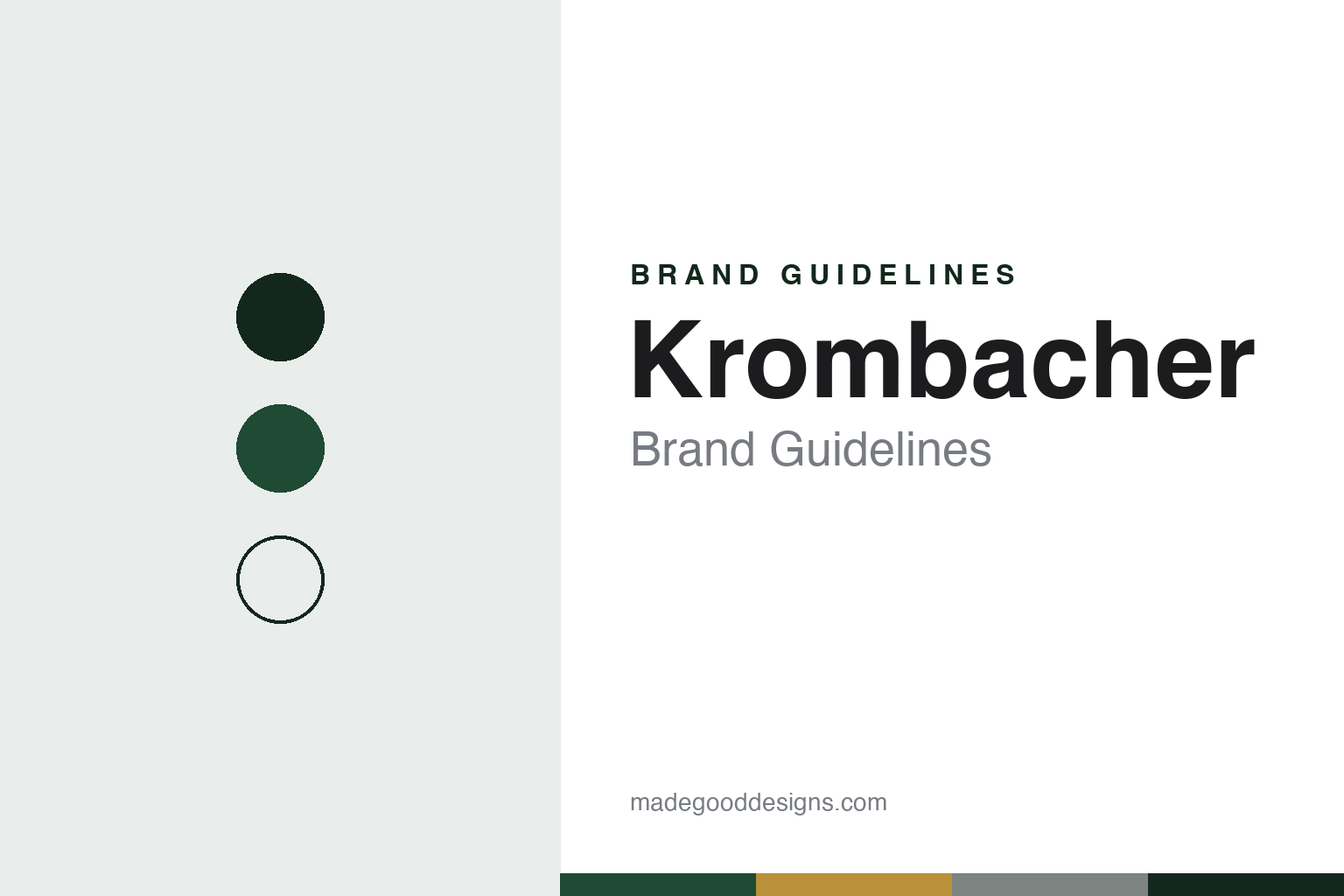
Krombacher Brand Guidelines
The Siegerland Pils brewed on a rock-spring story.
Aa
Two constants: a Krombacher green, gold and grey palette and a traditional serif register. Abstract homage — not a Krombacher product or mark; no bottle, label or emblem is reproduced.
Krombach
A village tavern’s brewhouse in the Siegerland.
Krombacher is named after Krombach, a village that is now part of the town of Kreuztal, near Siegen in North Rhine-Westphalia, at the foot of the Rothaargebirge hills. German Wikipedia says the brewery was first documented on 4 February 1803, under Johannes Haas, whose father Johann Eberhard Haas ran an inn in the village. Under a regulation of 1618, only inns with their own brewhouse and malt kiln were allowed to serve beer, so Haas set up a brewery in the family business. English Wikipedia gives the founding date as 7 February 1807; the company itself uses 1803, and its international website describes it as a brewery “since 1803.”
The water story begins earlier. German Wikipedia says the rock spring that still supplies the brewery was found in 1722 by a mining inspector named Fresenius, who had been sent by the Prince of Siegen to look for precious metals. At first the water was carried to the brewhouse in barrels on an ox cart, and in 1854 the owner was paying the church a yearly rent for a water pipe across its land. The brewery moved to its present site at some point between 1858 and the early 1880s, when two rock cellars were dug to store the beer. German Wikipedia, citing a 2005 history of brewing in the Siegerland, says the first known advertisement for Krombacher Pilsner appeared in the Siegener Zeitung in 1889.
In 1896 Hermann Haas sold the brewery to Otto Eberhardt of Dortmund, who ran it as a limited partnership, Hasbrauerei Eberhardt und Cie., and turned it into a joint-stock company in 1905. In October 1922 Bernhard Schadeberg took over the management, and the brewery has been run as a Schadeberg family business ever since, German Wikipedia says.
Colour
Felsquellwasser and the Kindelsberg tower.
The modern brand was built after the Second World War. Friedrich Schadeberg, a trained brewing engineer, joined Krombacher in 1953 and from 1961 owned it together with his sister Barbara Lambrecht-Schadeberg; German Wikipedia, citing Der Spiegel, credits him with turning the small village brewery into one of Germany’s largest private breweries. Its figures show output rising from about 500,000 hectolitres in 1967 to about six million by 2018.
The brand’s central phrase is a piece of copywriting. The slogan “mit Felsquellwasser gebraut” — “brewed with rock-spring water” — was coined in 1962 by the agency of the copywriter Hubert Strauf, according to German Wikipedia, and has stayed in the advertising ever since. “Felsquellwasser” has been a registered word mark since 2010. A Neuss lawyer won a first-instance ruling against the mark in 2017, the Westdeutsche Zeitung reported, but the brewery won on appeal at the Higher Regional Court in Hamm, the Handelsblatt reported in January 2019, so it keeps exclusive use of the word.
The emblem is local as well. Wikipedia in both languages says it shows the Kindelsberg tower, Kreuztal’s landmark, with the Littfe, the stream that runs through Krombach, below it; German Wikipedia cites a February 2025 Siegener Zeitung report on a new Krombacher logo themed on closeness to nature. Its television advertising made a small island in the nearby Wiehl reservoir known across Germany, German Wikipedia says. From March 1995 Krombacher spots introduced episodes of the ARD crime series Tatort, until a change in broadcasting rules ended such evening sponsorship spots in 2013, the Westfalenpost reported in December 2012.
The bottle is part of the identity too. Krombacher uses its own returnable bottles, with the name embossed at the neck, rather than a shared standard bottle; the Frankfurter Allgemeine Zeitung reported in 2017 that such bottles complicate the returnable system, and the company gives product differentiation as its reason. In November 2020 the Federal Cartel Office approved a joint company, GeMeMa, set up by Bitburger, Krombacher, Radeberger and Warsteiner to manage a shared pool of 0.33-litre returnable bottles, about-drinks reported.
Typography
Design and documentation.
The seven brands in this group are all German beer brands: Beck’s, Krombacher, Warsteiner, Bitburger, Paulaner, Erdinger and Radeberger. German beer brands in general sit at many different points in the trade, from family firms that still carry a founder’s name to names that now belong to much larger brewing and drinks groups, and a single brand can be sold everywhere from a corner shop to a supermarket shelf.
A beer brand’s identity is usually carried less by a single product than by a bottle, a label, a name and the town it comes from, because the company behind the name may have changed hands, moved its production or grown far beyond the place where it started. That makes the questions behind each name worth asking plainly: who started it, who owns it now, and where its beer is actually brewed and bottled.
Each guide separates what independent sources record from what the company says about itself — its founding story, its owners over time, where its beer is brewed and how its packaging has changed — and marks plainly what rests only on the company’s own word.
Aa
A traditional serif — for a brand built on a spring and a tower. (Specimen set in Playfair Display, a serif STAND-IN; NOT the Krombacher logo or lettering.)
Krombacher
A family brewery with a soft-drinks arm.
Krombacher is still privately owned. German Wikipedia names the owners as Barbara Lambrecht-Schadeberg and Friedrich Schadeberg’s children, Bernhard Schadeberg and Petra Schadeberg-Herrmann, both of whom the company’s imprint lists as partners and managing directors. The beer is brewed in Krombach. In June 2024 the hop merchant BarthHaas ranked Krombacher 31st among the world’s brewers, with sales of 5.74 million hectolitres in Germany in 2023, according to German Wikipedia.
The group has grown by acquisition. It took over production of Rhenania Alt from the Krefeld brewery Rhenania in 2002, bought the Rolinck private brewery in Steinfurt in 2007, and in September 2016 took over the malt-drink brand Vitamalz outright after becoming its sole licensee that July, according to the company’s press releases. A sister group owned by the family has held the German and Austrian brand and sales rights for Schweppes, Orangina and Dr Pepper since 2006, German Wikipedia says. Besides the Pils the range includes a Radler, an alcohol-free Pils and a Weizen, which English Wikipedia, citing a company press release, says was added in 2007.
The best-known campaign was environmental. In 2002 Krombacher launched its rainforest project with the WWF, fronted by the television presenter Günther Jauch; its advertising said a square metre of rainforest would be protected for every crate sold, and the project worked in the Dzanga-Sangha reserve in the Central African Republic. The Higher Regional Court in Hamm found the advertising partly anticompetitive in 2003, but the Federal Court of Justice set that ruling aside in October 2006 and sent the case back, German Wikipedia says. The company says that in 2011 it became the first national German brewery to publish a sustainability report.
For a design guide, Krombacher shows how a place — a spring, a tower and a stream — can carry a whole brand story. Compare Bitburger and Warsteiner, two of its partners in the shared bottle pool. For this guide we use fir green, gold and rock grey with a serif, an unofficial interpretation; no product or logo is reproduced.
Explore & save
Keep Krombacher’s identity on hand — save it to a board in the Made Good inspiration library.
Krombacher identity set
Pin the Krombacher green, gold and grey palette and the traditional serif register to your own board.