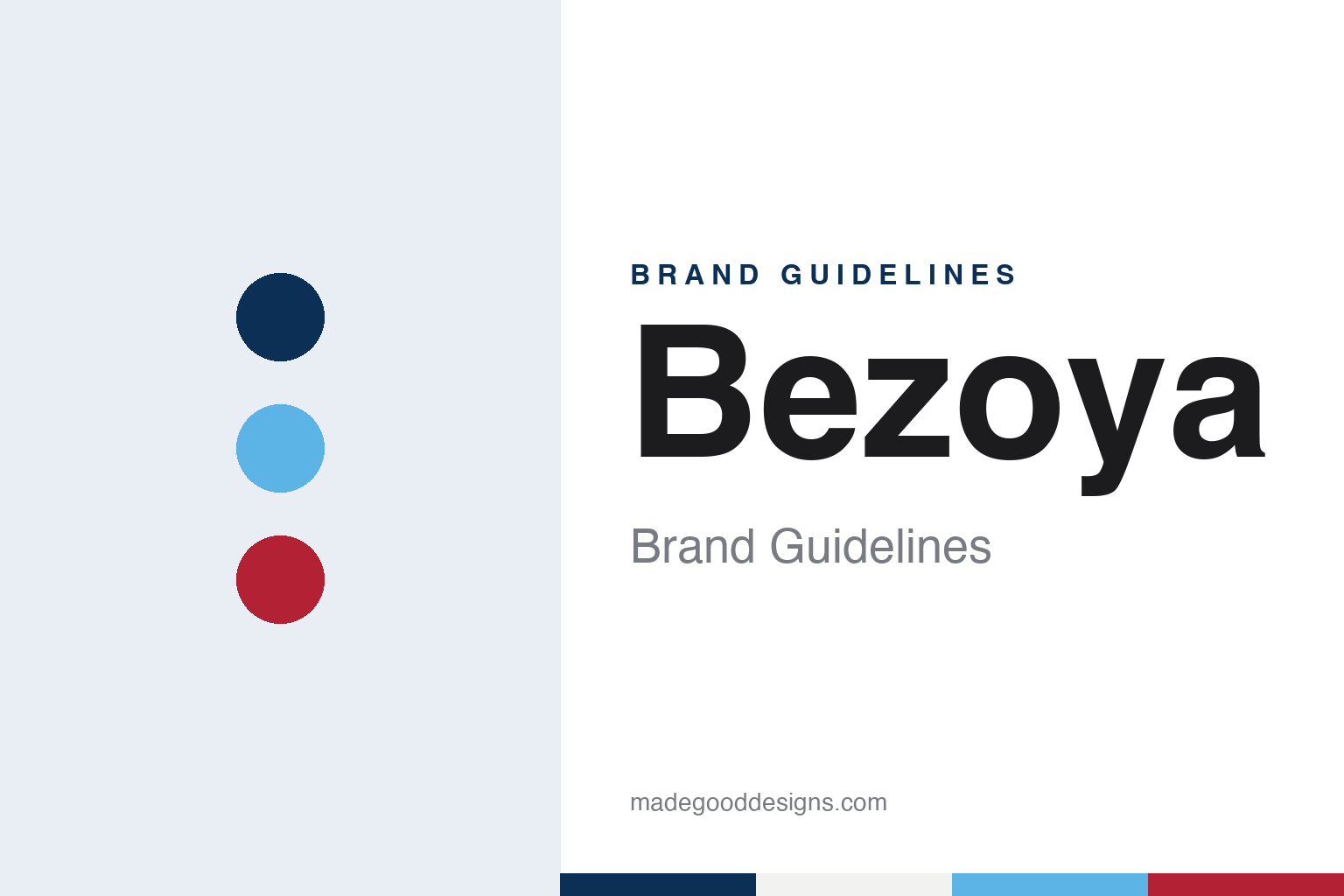
Bezoya Brand Guidelines
The Segovia spring water of the Pascual family since 1974.
Aa
Two constants: a mountain blue, sky and label red palette and an open modern sans register. Abstract homage — not a Bezoya product or mark; no bottle, label or logo is reproduced.
A dairy group finds a spring
Tomás Pascual, Aranda de Duero and Ortigosa del Monte.
Bezoya is a natural mineral water from the province of Segovia, in Castilla y León, owned by the Spanish food group Calidad Pascual. It is named after the Bezoya spring at Ortigosa del Monte, a village whose spring, El Norte de Castilla wrote in 2020, has given the place an international name.
The brand began in 1974. Spanish Wikipedia, in its article on Calidad Pascual, says that in that year the company obtained the concession for the Ortigosa del Monte spring, which allowed it to sell the Bezoya mineral water; El Norte de Castilla in 2020 and the food magazine Origen in 2017 both describe the spring as acquired in 1974, the newspaper naming the buyer as the Segovian entrepreneur Tomás Pascual. Bezoya’s own website says simply that it has been at work “since 1974.”
The group that bought it was then only five years old. Spanish Wikipedia, citing El Mundo, says Pascual was founded in 1969, when a group of businessmen from Burgos led by Tomás Pascual Sanz, who was born in the province of Segovia, took over a bankrupt dairy cooperative in Aranda de Duero and renamed it Industrias Lácteas Pascual. Its breakthrough came in 1973, the same source says, when it brought carton packaging and long-life milk to the Spanish market. Bezoya was an early step beyond milk; the Zumosol juices followed in 1986.
Colour
Two springs, glass for bars and a bottle called Pi.
Bezoya comes from two places in Segovia. Spanish Wikipedia names the Bezoya spring at Ortigosa del Monte and the Siete Valles spring, beside the río Cambrones at Trescasas, citing a study of the region’s mineral waters by the Spanish geological survey, the IGME; each village has its own extraction and bottling plant. The local news site Segovia al día reported that the Trescasas factory had reached “zero waste.” Bezoya itself says that all the energy used at its bottling plants comes from renewable sources, and that its newer plant at Ortigosa del Monte holds LEED certification from the U.S. Green Building Council.
The clearest documented design change concerns the bottle sold to bars and restaurants. Origen reported in January 2017 that in 2016 Bezoya gave its glass bottle for the hospitality trade a new style, with labels in the shape of its drop in three colours — blue, black and red — and a new easy-open cap, which the magazine said would make bottles easier for bar staff to open; the aim, it added, was a more careful, modern and attractive design. The same article said Bezoya had been serving hospitality customers for more than 20 years, through a network of 27 sales branches.
Plastic has been the other theme. Bezoya says that all of its bottles are now made of 100% recycled plastic, and it presents its packaging under the heading “Compromiso Bezoya,” covering the spring, the bottling plant, transport and recycling.
Its most playful pack is recent. In 2026 the brand’s website introduced the Pi bottle, which holds 3.14159265359 litres — a very large format, the company jokes, with a name as small as Pi. Bezoya says the bottle is made from other bottles, entirely of recycled plastic, and shaped to be easy to grip, for the table or the fridge.
Typography
Design and documentation.
The seven brands in this group are all soft drink and water names from Spain and Italy: La Casera, Trina, Font Vella, Bezoya, Aquarius, Lemonsoda and Levissima. Spanish and Italian soft drink and water brands in general sit at many different points in the trade, from family firms that still carry a founder’s name to names that now belong to much larger food and drink groups, and a single brand can be sold everywhere from a corner bar to a supermarket shelf.
A soft drink or water brand’s identity is usually carried less by a single product than by a bottle, a label, a name and the drink it promises, because the company behind the name may have changed hands, moved its bottling or grown far beyond the place where it started. That makes the questions behind each name worth asking plainly: who started it, who owns it now, and where its drinks are actually made and bottled.
Each guide separates what independent sources record from what the company says about itself — its founding story, its owners over time, where its drinks are made and how its packaging has changed — and marks plainly what rests only on the company’s own word.
Aa
An open modern sans for a mountain spring water. (Specimen set in Manrope, a sans STAND-IN; NOT the Bezoya logo.)
Bezoya
A family group that renamed itself.
Bezoya has stayed with the Pascual family since 1974. Spanish Wikipedia describes Calidad Pascual as a family company controlled by the Pascual family since its foundation, with its head office in Aranda de Duero, in the province of Burgos, and commercial offices in Madrid. Its other brands, according to the same article, include Leche Pascual milk, the ViveSoy plant drinks and the Bifrutas milk-and-juice drinks.
The founder led the group for 37 years. Tomás Pascual Sanz died on 16 February 2006 at the age of 79, El País and El Mundo reported, and his eldest son, Tomás Pascual Gómez-Cuétara, became chairman. At the end of 2013 the group sold the Zumosol juice brand to the Turkish group Toksöz, RTVE reported. In early 2014 Grupo Leche Pascual announced a new corporate identity and a new name, Calidad Pascual, chosen to reflect a business that had grown beyond dairy, the blog Branding Source reported in January 2014.
Bezoya presents itself through that group story. Its website says the company’s history is “the story of an entrepreneur,” Tomás Pascual Sanz, and gives the group’s purpose as “dar lo mejor” — to give the best — for the future of food, organised around wellbeing, development and the environment. The site is published by Calidad Pascual, S.A.U., and points readers to the group’s other brands and to Pascual Profesional, its service for the hospitality trade.
For a design guide, Bezoya shows a water brand working with a drop shape that Origen called iconic, and with the bottle itself — recycled plastic, a three-colour glass range, a litre count borrowed from mathematics. Compare Font Vella, the Catalan mineral water owned by Danone, and Mattoni, from Bohemia. For this guide we use mountain blue, sky and label red with an open modern sans, an unofficial interpretation; no product or logo is reproduced.
Explore & save
Keep Bezoya’s identity on hand — save it to a board in the Made Good inspiration library.
Bezoya identity set
Pin the Bezoya mountain blue, sky and label red palette and the open modern sans register to your own board.