Koigu Brand Guidelines
The Ontario farm family that hand-paints merino.
Aa
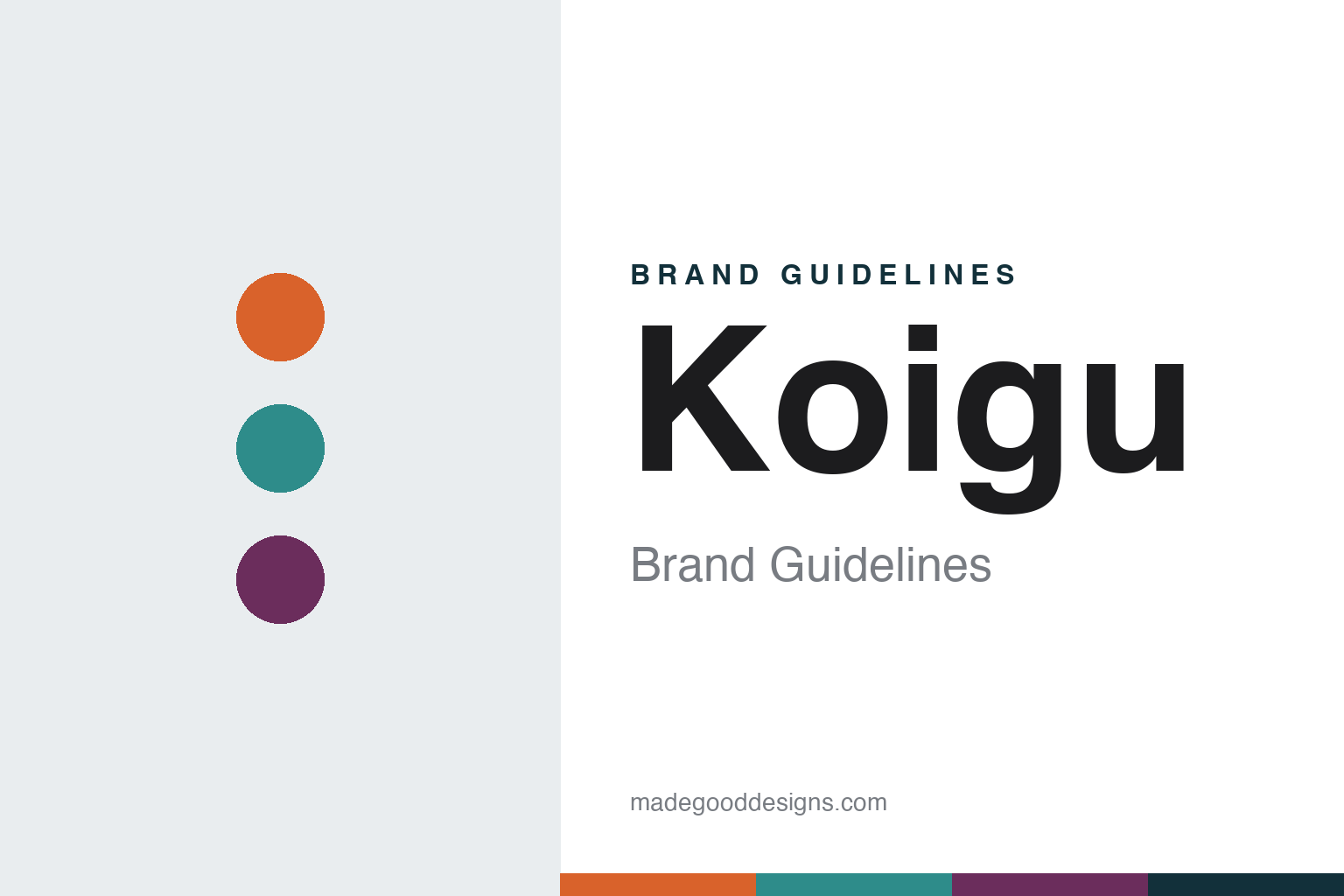
Two constants: a teal, orange and plum palette and a painterly serif register. Abstract homage — not a Koigu product or mark; no skein, label or sheep logo is reproduced.
A farm named after a village
Toronto artists, an Ontario sheep farm and an Estonian name.
Koigu Wool Designs — known to knitters simply as Koigu — is a hand-painted yarn company on a sheep farm in Grey County, Ontario. The company places its headquarters near Chatsworth; a 2022 article in Eesti Elu, the Toronto Estonian weekly, put the farm just outside Owen Sound, in rural Dornoch. Both describe the same corner of the county.
The farm came first. The company says it was bought by Maie and Harry Landra in 1972, when the family moved from Toronto with no farming experience, and that their flock of sheep at its peak numbered more than 200. They named it after the family’s ancestral home in Estonia. Koigu is a small village in Otepää Parish, Valga County, in the south-east of the country, and the Eesti Elu article says the name was chosen to honour that place.
The founder of the yarn business is Maie Landra. The company says she studied at the Ontario College of Art and Design, and Eesti Elu says she was first known in Toronto’s Estonian community as an ink artist and painter in the Society of Estonian Artists in Toronto. Her daughter Taiu Landra, who the company says has a degree in agricultural business, has worked with her from the start.
Koigu does not give a precise founding year in the sources we checked. Its about page says it has been run by the Landra women “for over 30 years.” The publisher’s description of Maie Landra’s 2006 book said mother and daughter had been selling their yarns “for over ten years,” which places the business in the first half of the 1990s.
Colour
Painter’s Palette Premium Merino.
The yarn grew out of Maie Landra’s art. Eesti Elu says the family first used fleece from their own sheep in woven tapestries and knitwear, and that a wide range of colours in merino yarn was hard to find in the late 1980s and early 1990s, so the yarns were “born out of necessity.” The company says mother and daughter experimented with hand-dyeing small batches in the farmhouse kitchen.
Demand soon outgrew the flock. According to the company, a retired industrialist with a background in textiles put the Landras in touch with a mill that would spin fine merino to their specification — the mill is not named — and that produced Koigu Painter’s Palette Premium Merino, known as KPPPM. The company describes it today as a 100% merino, superwash, fingering-weight yarn of 170 yards per 50 grams, sold in variegated colourways, with dye lots of 20 to 22 skeins. Its solid-coloured counterpart is KPM.
For the first five years, Eesti Elu says, KPPPM was dyed in the farmhouse kitchen and dried on pine trees or over the bathtub. The company says it built a wool shed in the early 2000s: about 5,500 square feet, with separate areas for dyeing and drying, reeling yarn into skeins, storage, shipping and a showroom.
The range has since widened to more than ten yarns, including merino in heavier weights and blends with Corriedale, Gotland and Lincoln wool. Koigu also sells KPPPM in small-skein sets — Pencil Box packs of ten 25-gram skeins and Paint Cans — and releases a monthly “Collector Colour.” The company says it still uses machines where it can, but that every skein is painted by hand and that the yarn is dyed, hanked, labelled and shipped by the Landra women and a few local employees.
Typography
The hand-dyed yarn trade.
The seven brands in this group all sell yarn for hand knitting and crochet, and they come from six countries on two continents: Filcolana from Denmark, Kelbourne Woolens and Harrisville Designs from the United States, Rosários 4 from Portugal, La Bien Aimée from France, Koigu from Canada and Atelier Zitron from Germany. Most knitters meet them first as a name on a ball band or a skein tag in a yarn shop, rather than as a company.
Behind those labels the yarn trade takes several shapes. Some brands own the mill that spins their fibre; others design a yarn and its colours and have it spun, dyed or finished by partners; still others dye undyed yarn by hand in small batches. A label’s country is not always the country where every step happened, and “made in” can mean spinning, dyeing or only the final winding.
Each guide sets out what independent sources record about the brand — who founded it, who owns it and where its yarn is made — and separates that from what the company says about itself, marking plainly what rests only on the company’s own word.
Aa
A painterly serif for a family of painters and dyers. (Specimen set in Fraunces, a serif STAND-IN; NOT the Koigu logo.)
Koigu
Three generations and a hand-drawn sheep.
Koigu has stayed in the family. In a Vogue Knitting “Knitterviews” podcast episode published in November 2019, Taiu Landra was introduced as the owner and creative voice of Koigu Wool Designs “along with mother Maie and daughter Kersti,” and we found no record of an outside owner in the sources we checked. The third generation, Kersti Landra, grew up on the farm; Eesti Elu reported in 2022 that Taiu and Kersti had been at the helm for several years, with Maie still giving creative direction. The company says it has fewer than ten employees.
Design has always been part of the business. Maie Landra’s book Knits from a Painter’s Palette was published by Sixth&Spring Books in 2006, and Wrapped in Color, a collection of 30 shawls, followed in 2015. The company has published ten issues of its own Koigu Magazine and pattern books including Vill — Estonian for “wool” — and its designs have appeared in Vogue Knitting. With a knit-along that ran into January 2026, it brought back ten colourwork sweaters that Maie designed in the 1980s and 1990s as a Heritage Sweater Collection, drawing on Estonian motifs from regions such as Halliste and Muhu.
The brand’s one documented visual asset is its mark. The company says the hand-drawn Koigu sheep logo was created by Maie Landra, and it turned the sheep into one of the heritage sweater charts. It publishes no brand colours or typeface, and we found no design awards in the sources we checked. The company sells wholesale to yarn shops, and its store finder lists stockists in Canada, the United States, Europe, Asia, Australia and New Zealand; it also runs its own online shops in Canadian and US dollars.
For a design guide, Koigu shows how a painter’s eye for colour can become a whole yarn brand, made on a family farm. Compare malabrigo, another hand-dyed merino that began at home, and Manos del Uruguay. For this guide we use teal, orange and plum with a serif, an unofficial interpretation; no product or logo is reproduced.
Explore & save
Keep Koigu’s identity on hand — save it to a board in the Made Good inspiration library.
Koigu identity set
Pin the Koigu teal, orange and plum palette and the painterly serif register to your own board.