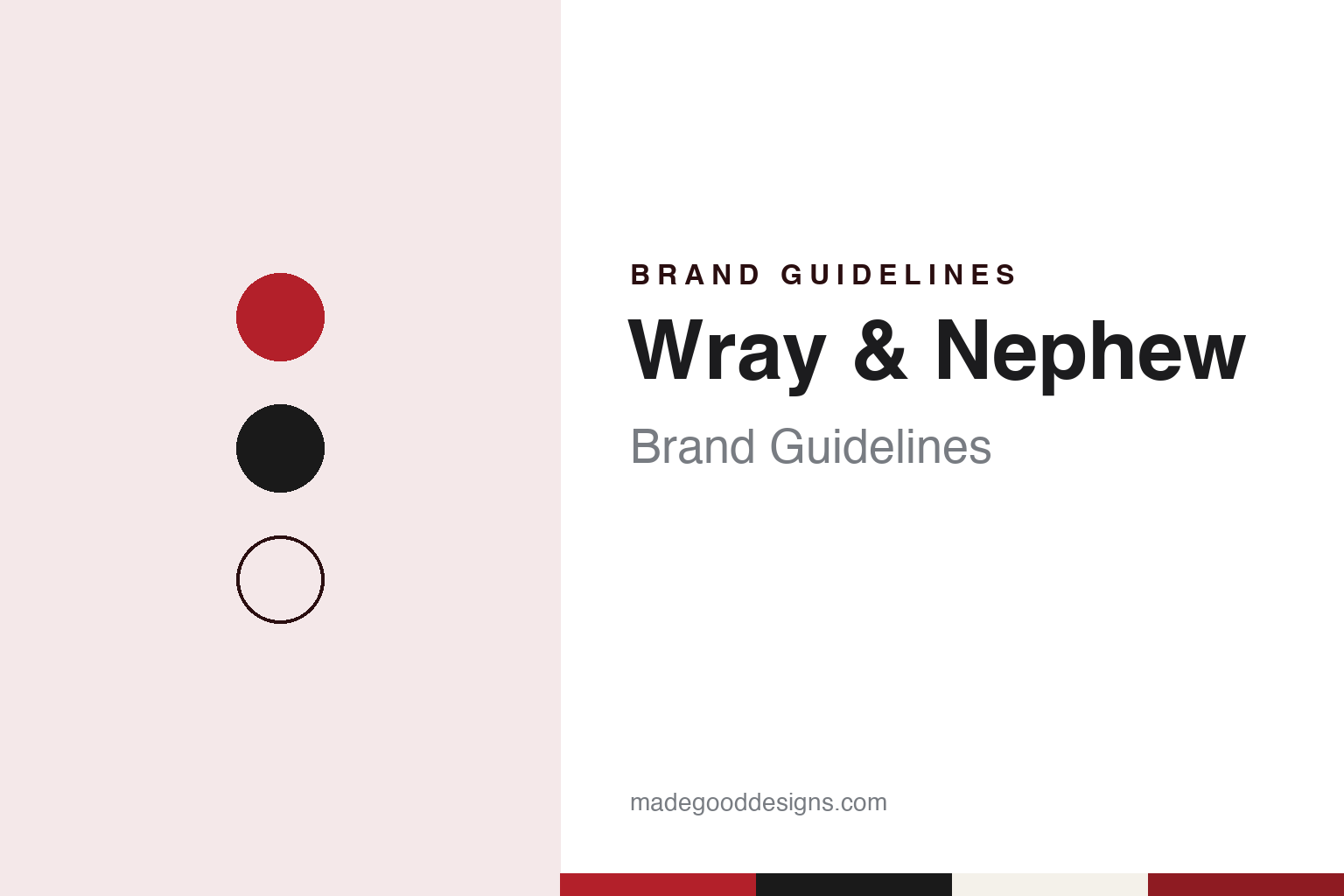
Wray & Nephew Brand Guidelines
Kingston’s 1825 rum house and its White Overproof.
Aa
Two constants: an overproof red, Kingston black and cane white palette and a condensed sans register. Abstract homage — not a Wray & Nephew product or mark; no label, logo or bottle is reproduced.
A tavern by the theatre
A wheelwright, a nephew and a rum business in Kingston.
J. Wray & Nephew traces its beginning to 1825, when John Wray, a wheelwright, opened the Shakespeare Tavern in Kingston, Jamaica, beside the city’s Theatre Royal. The company tells the story on its own site, and English Wikipedia gives the same account. The company also calls itself “the oldest registered company in Jamaica.”
The name came in 1860, when Wray brought his nephew, Charles James Ward, into the business as a partner and it became J. Wray & Nephew. Wray retired in 1862, the company says, and under Ward the firm grew into what it calls one of Jamaica’s largest exporting commercial enterprises. Ward’s name survives in the city as well as on the bottle: the Theatre Royal was rebuilt after the 1907 Kingston earthquake, and in 1912 Ward gave the new building to the city. It is still called the Ward Theatre, the Jamaica Observer noted in July 2025.
The firm’s reputation was made at international exhibitions. English Wikipedia says J. Wray & Nephew won three gold medals at the 1862 International Exhibition in London, for rums aged 10, 15 and 25 years in Jamaica. The company itself ties gold medals at world fairs in London, Paris and Jamaica to its White Overproof rum.
Ownership passed through several Jamaican hands in the twentieth century. English Wikipedia says the Lindo family bought the business in 1916, the year the Appleton Estate sugar and rum estate in St Elizabeth joined the company. A consortium that included shareholders of the trading house Lascelles deMercado bought it in 1957, and Lascelles deMercado took full ownership in 1989, English Wikipedia says.
Colour
Strength, medals and a white rum for every occasion.
The brand’s best-known product is Wray & Nephew White Overproof, an unaged white rum bottled at 63% ABV, the strength the brand and retailers list. English Wikipedia says it is made at the company’s New Yarmouth Estate in Clarendon parish, an estate the group acquired with the Henriques Brothers business in 1986, while Appleton’s rums are distilled at the Appleton Estate in St Elizabeth on pot and column stills.
The label carries the company’s history with it. The label wording filed with the United States Patent and Trademark Office names the exhibitions of London 1862, Paris 1878 and Jamaica 1891 alongside the words “White Overproof Rum” and “Product of Jamaica.” The medals give the bottle the look of a nineteenth-century trade label rather than a modern lifestyle brand.
In Jamaica the rum is as much a part of daily life as a drink for export. The drinks magazine PUNCH wrote in August 2018 that Wray & Ting, the rum mixed with the Jamaican grapefruit soda Ting, is often called the island’s unofficial drink. English Wikipedia, citing the Jamaica Observer, says that in 2024 White Overproof and the company’s Charley’s JB together held about 90% of Jamaica’s white overproof rum market. For the United Kingdom the company also makes Wray’s 43, a lower-strength version, according to English Wikipedia.
The corporate identity has been redrawn before. Marketing Week reported on 3 April 2003 that the design agency AD Creative had created a new corporate identity for J. Wray & Nephew; the report gave no further detail of the work.
Typography
Design and documentation.
The seven brands in this group are all rum and bitters names: Diplomático, Gosling’s, Myers’s, Lamb’s, Wray & Nephew, El Dorado and Angostura. Rum and bitters brands in general sit at many different points in the trade, from family houses that still carry a founder’s name to labels that now belong to much larger drinks groups, and a single brand can be sold everywhere from a corner shop to a cocktail bar.
A rum or bitters brand’s identity is usually carried less by a single bottle than by a label, a name and the place it promises, because the company behind the name may have changed hands, moved its production or grown far beyond the place where it started. That makes the questions behind each name worth asking plainly: who started it, who owns it now, and where its rum or bitters is actually made and bottled.
Each guide separates what independent sources record from what the company says about itself — its founding story, its owners over time, where its rum or bitters is made and how its labels have changed — and marks plainly what rests only on the company’s own word.
Aa
A condensed sans for a label built on names, dates and medals. (Specimen set in Oswald, a condensed sans-serif STAND-IN; NOT the Wray & Nephew logo.)
Wray & Nephew
From a Jamaican trading house to an Italian drinks group.
The current ownership dates from 2012. The trading house Lascelles deMercado had been bought in 2008 by the Trinidad-based conglomerate CL Financial, English Wikipedia says. In September 2012 the Italian drinks group Campari announced an agreement with members of the CL Financial group, holders of an 81.4% stake, to buy control of Lascelles deMercado, the parent of J. Wray & Nephew. Campari’s 2012 annual report recorded the deal as completed that year, giving the group the Appleton Estate, Wray & Nephew and Coruba rum brands and the business’s Jamaican distilleries and distribution.
Under Campari the company has kept its Jamaican base. English Wikipedia says the group moved its headquarters to Spanish Town Road in Kingston in 1971, and that J. Wray & Nephew also produces Kingston 62, the name given in 2020 to the former Appleton Special and White, and holds the right to make Captain Morgan rum for the Jamaican market. Appleton Estate’s master blender, Joy Spence, appointed in 1997, is described by English Wikipedia as the first woman to hold the role in the rum industry.
The company has also been at the centre of a dispute over what Jamaica rum may be. It supports the island’s 2016 geographical indication for Jamaica rum and the 2024 amendments by the Jamaica Intellectual Property Office that bar ageing abroad; National Rums of Jamaica complained of anti-competitive conduct, the Fair Trading Commission opened an investigation in June 2025, and on 19 September 2025 the Supreme Court granted a temporary injunction against the amendments, English Wikipedia reports, citing the Jamaica Observer.
The name needs a little care. Searches for “Wray” can surface the Wray & Ting serve or the separate soft-drink brand Ting; the company’s own site is wrayandnephew.com.
For a design guide, Wray & Nephew shows how a two-word family name, a founding date and a row of exhibition medals can carry a white rum for two centuries without needing a mascot. Compare Appleton Estate, the aged rum from the same company, and Red Stripe, the Jamaican lager. For this guide we use overproof red, Kingston black and cane white with a condensed sans, an unofficial interpretation; no product or logo is reproduced.
Explore & save
Keep Wray & Nephew’s identity on hand — save it to a board in the Made Good inspiration library.
Wray & Nephew identity set
Pin the Wray & Nephew overproof red, Kingston black and cane white palette and the condensed sans register to your own board.