Aberlour Brand Guidelines
James Fleming’s Speyside malt, distilling since 1879.
Aa
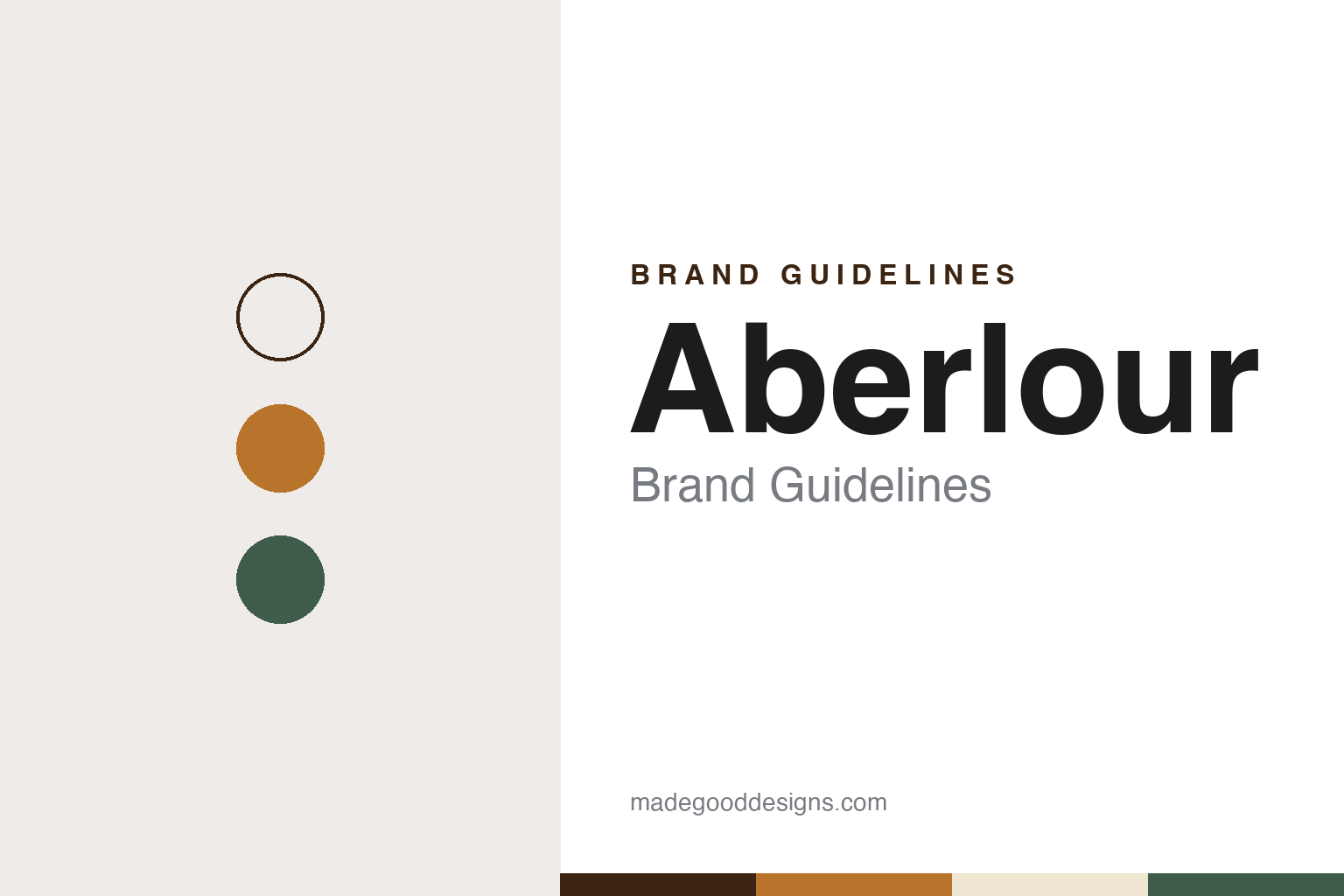
Two constants: a cream, sherry amber and oak brown palette and a classical book serif register. Abstract homage — not an Aberlour product or mark; no label, logo or bottle is reproduced.
A banker’s distillery on the Spey
From a feu granted in 1879 to the drinks group that bought it in 1975.
Aberlour is a Speyside single malt Scotch whisky made at the distillery of the same name in the village of Aberlour, in Moray. English Wikipedia gives the village’s formal name as Charlestown of Aberlour, founded in 1812 by Charles Grant of Elchies, and places the distillery where the Lour Burn runs into the River Spey, below the hill of Ben Rinnes. The village is also where the bakery Walker’s Shortbread makes its biscuits; the two businesses are unrelated.
The founder was James Fleming, a local man who, according to English Wikipedia, had leased the nearby Dailuaine distillery for about ten years from the mid-1860s. In 1879 he obtained a feu for the Aberlour site from the Earl of Fife, and production began in December 1880, English Wikipedia says, citing The Elgin Courant of that month. The company gives 1879 as its founding year, and Fleming’s motto, “Let the deed show,” is still used by the brand.
Fleming did not keep the distillery long. In 1892 he sold it to Robert Thorne & Sons, who had acted as his agents, English Wikipedia says, citing The Scotsman of June that year. The retailer Master of Malt’s distillery history says the site was rebuilt in 1898 after a fire, to a design by the distillery architect Charles Doig. Robert Thorne & Sons sold Aberlour in 1920 to W. H. Holt & Sons, a brewing family from near Manchester, and in 1945 it passed to S. Campbell & Sons. The distillery was re-equipped with four stills in 1973.
The modern owner arrived in 1975, when Pernod Ricard bought Campbell Distilleries, English Wikipedia says. In 2001 the business was combined with Chivas Brothers, the group’s Scotch whisky company, alongside The Glenlivet and the blend Chivas Regal. A modernised visitor centre opened in 2002.
Colour
A well, a tree, a motto and a signature.
Aberlour’s pack has been redrawn several times under Chivas Brothers, and each round has worked with the same small set of symbols. Drinks International reported in July 2010 that a relaunch of the 12, 16 and 18 year olds and A’bunadh replaced the old red Aberlour logo with an embossed cream one, redrew the illustration of St Drostan’s Well in a contemporary style, and swapped the “Let the Deed Show” seal for James Fleming’s signature. A’bunadh moved to rough-textured paper for its label and canister. Neil Macdonald, then Chivas Brothers’ brand director for malts, told the magazine the new look struck “the perfect balance between tradition and modernity.”
The next refresh was by the agency Nude Brand Creation, Packaging of the World reported in April 2020. The brand mark was redrawn with a purer logotype and a simplified well and tree icon, the Aberlour name was embossed into the bottle itself, and the motto came back as a stamp on each bottle. A case study by the label printer McC describes the master distiller’s signature added to every label, the founder’s signature on the tamper strip, gold foil on the 12 year old and fluted embossing on the tube wrap; it quotes Miriam Eceolaza, Aberlour’s marketing director, saying the look was “designed to entice a new generation of craft seekers.”
The signature product is A’bunadh, whose name is Gaelic for “the original,” according to the auction house Whisky Auctioneer. It is bottled at cask strength without an age statement and released in numbered batches; Whisky Auctioneer’s collector notes say Campbell Distillers introduced it in 1997. English Wikipedia lists a core range at 10, 12, 15, 16 and 18 years, and says most Aberlour matures in American ex-bourbon casks, with some whiskies finished in sherry casks. McC’s case study notes that the 12 year old’s label highlights its Double Cask Maturation.
In February 2025 The Moodie Davitt Report described a travel-retail trio — a 13 year old, a 16 year old Double Charred Selection and Suthainn — in a new label showing an oak tree over water, a reference to the Lour Burn, in a warm, earthy palette, with a recyclable canister and a bottle 16% lighter than the previous design.
Typography
Design and documentation.
The seven brands in this group are all Scotch single malts: The Balvenie, Glenfarclas, Aberlour, Bowmore, Bruichladdich, Oban and Springbank. Single malt brands in general sit at many different points in the trade, from family companies that still own their distillery to names that now belong to much larger drinks groups, and a single brand can be sold everywhere from a corner shop to a specialist whisky bar.
A single malt’s identity is usually carried less by a single bottle than by a label, a name and the place it promises, because the company behind the name may have changed hands, changed how it makes its whisky or grown far beyond the place where it started. That makes the questions behind each name worth asking plainly: who started it, who owns it now, and where its whisky is actually distilled, matured and bottled.
Each guide separates what independent sources record from what the company says about itself — its founding story, its owners over time, where its whisky is made and how its labels have changed — and marks plainly what rests only on the company’s own word.
Aa
A classical book serif for an old Speyside name and a founder’s motto. (Specimen set in Cormorant Garamond, a serif STAND-IN; NOT the Aberlour logo.)
Aberlour
A village distillery inside a global drinks group.
The distillery is being enlarged. In April 2022 Chivas Brothers announced an expansion of Aberlour and its sister distillery Miltonduff; the company said Aberlour’s capacity would double to 7.8 million litres of alcohol a year, that a new still house would have large windows looking out over the woods and the River Spey, the distillery’s water source, and that both sites were expected to reach full production by mid-2025. The coppersmiths Forsyths said in an October 2025 case study that it had built eight new copper stills for the project.
The release placed Aberlour in Chivas Brothers’ plans for lower-carbon distilling, with new bio plants and mechanical vapour recompression on the pot stills, a technology the company said it would roll out across its viable sites. English Wikipedia names Chivas Brothers, part of Pernod Ricard, as the distillery’s owner today.
The name needs a little care. Aberlour is also the village itself, home to unrelated businesses such as Walker’s Shortbread; the whisky brand’s own site is aberlour.com.
For a design guide, Aberlour shows how a Speyside distillery can keep returning to the same few marks — a holy well, a tree, a founder’s signature and a five-word motto — and redraw them for each generation of drinkers without losing them. Compare The Glenlivet, its Speyside stablemate at Chivas Brothers, and Chivas Regal, the group’s best-known blend. For this guide we use cream, sherry amber and oak brown with a classical serif, an unofficial interpretation; no product or logo is reproduced.
Explore & save
Keep Aberlour’s identity on hand — save it to a board in the Made Good inspiration library.
Aberlour identity set
Pin the Aberlour cream, sherry amber and oak brown palette and the classical book serif register to your own board.