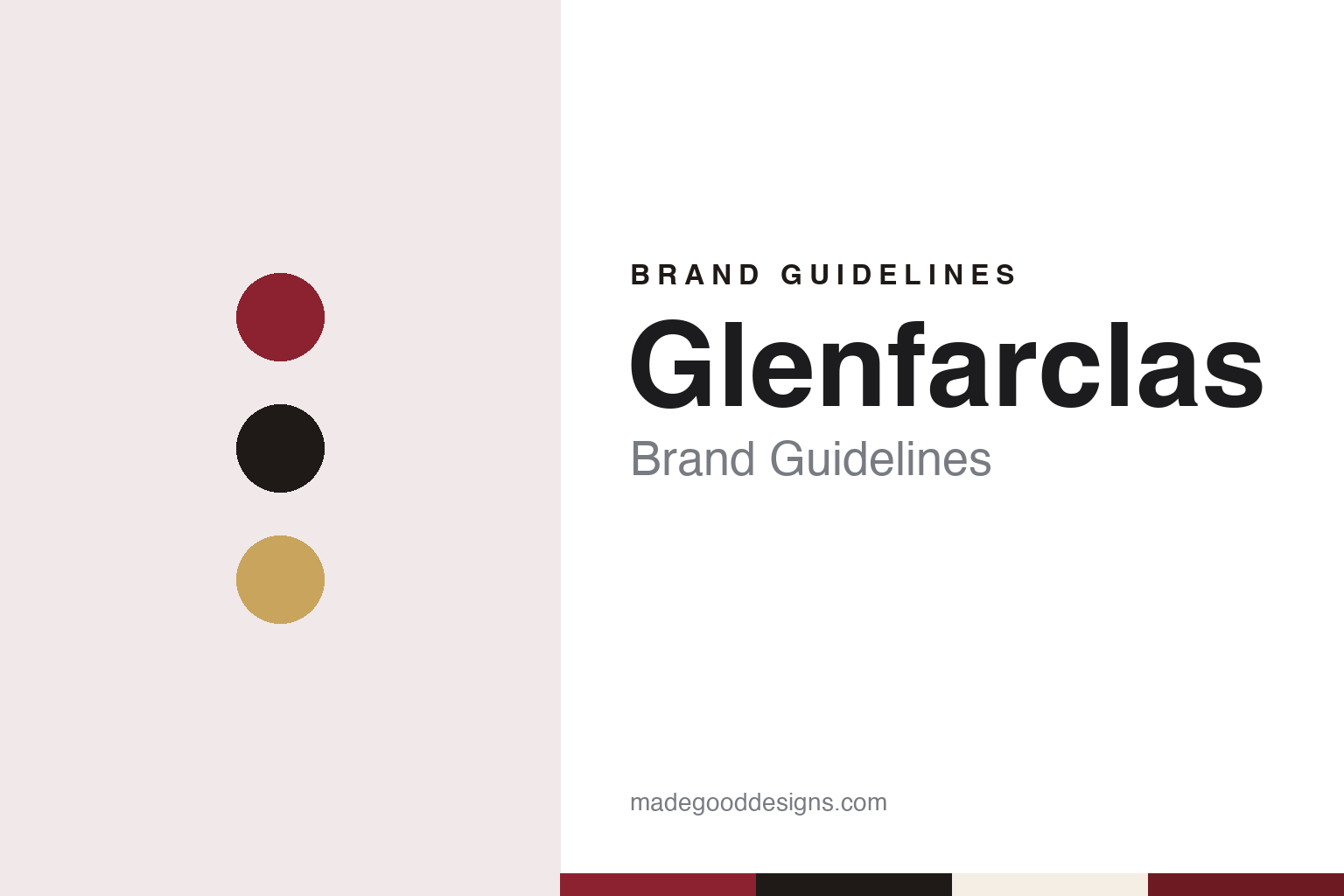
Glenfarclas Brand Guidelines
One Grant family’s Speyside malt since 1865.
Aa
Two constants: a sherry red, oloroso and gilt palette and a classical serif register. Abstract homage — not a Glenfarclas product or mark; no label, logo or bottle is reproduced.
A farm, a still and a family
Bought by a cattle breeder in 1865 and never sold.
Glenfarclas is a Speyside single malt Scotch whisky made at Ballindalloch, in the north-east of Scotland, and it is one of the few Scottish distilleries still owned and run by a single family. English Wikipedia says there is evidence of distilling on the site before 1791, and that it was first granted a licence in 1836, when it was run by Robert Hay; the company dates its legal distilling from that year.
The family story begins in 1865. The company says John Grant, a cattle breeder, took on the tenancy of the neighbouring Rechlerich farm and bought the distillery on 8 June 1865, a date English Wikipedia also gives. At first he let the distillery to John Smith, who later left to build the Cragganmore distillery, and in 1870, the company says, John Grant took his son George into partnership. The licence later passed to George’s widow, Elsie, and their sons John and George.
The family name invites confusion. These Grants are not the Grants of The Balvenie and Glenfiddich: The Drinks Business reported in 2012 that the Glenfarclas-owning family is not related to the company behind the Scotch of the same name, William Grant & Sons.
Independence was nearly lost once. English Wikipedia says the Grants went into partnership with Pattisons Ltd, a Leith firm, in August 1896, at the height of a whisky boom, and resumed full ownership after the crash that followed. The company says the brothers then formed J. & G. Grant, the name the business still trades under, and describes the episode as the root of what it calls the family’s “spirit of independence.” English Wikipedia records that Glenfarclas became a private limited company in 1947, owned by George S. Grant and John P. Grant.
Colour
Six generations, six stills and one style.
The family has run the distillery in a clear line. The company says John L. S. Grant joined the business in 1974 and became chairman in 2002; English Wikipedia gives 1973 as the year he joined. His son George Grant, described by the company and the trade press as the sixth generation of the family, has served as the brand’s ambassador and its public face.
The whisky itself is built around a few constants. English Wikipedia says the distillery has six stills, the largest on Speyside, and that they are heated directly by gas burners rather than by steam. It describes Glenfarclas as a traditional malt with a heavy sherry influence, and says around 68,000 casks mature on site in traditional dunnage warehouses, with stock from every year since 1953.
That stock became a brand of its own. The company says that when demand fell and a major blending contract was lost in the late 1960s, George S. Grant laid down more stock for the distillery’s own bottlings. In 2007 Glenfarclas launched The Family Casks, which English Wikipedia describes as a collection of 43 single-cask bottlings, one from each year from 1952 to 1994, since extended. In 2015 the company marked 150 years of family ownership with a limited Family Reserve bottling sold with a copy of the original bill of sale.
The distillery has been recognised by the trade. English Wikipedia records that Whisky Magazine named Glenfarclas Distiller of the Year in 2006, 2020 and 2023, and that its 40-year-old was named Scotch single malt of the year at the Malt Advocate Whisky Awards in 2011.
Typography
Design and documentation.
The seven brands in this group are all Scotch single malts: The Balvenie, Glenfarclas, Aberlour, Bowmore, Bruichladdich, Oban and Springbank. Single malt brands in general sit at many different points in the trade, from family companies that still own their distillery to names that now belong to much larger drinks groups, and a single brand can be sold everywhere from a corner shop to a specialist whisky bar.
A single malt’s identity is usually carried less by a single bottle than by a label, a name and the place it promises, because the company behind the name may have changed hands, changed how it makes its whisky or grown far beyond the place where it started. That makes the questions behind each name worth asking plainly: who started it, who owns it now, and where its whisky is actually distilled, matured and bottled.
Each guide separates what independent sources record from what the company says about itself — its founding story, its owners over time, where its whisky is made and how its labels have changed — and marks plainly what rests only on the company’s own word.
Aa
A classical serif for a family-owned, sherry-led malt. (Specimen set in EB Garamond, a serif STAND-IN; NOT the Glenfarclas logo.)
Glenfarclas
A visitor centre, a ship’s panelling and a racecourse.
Glenfarclas opened its doors early. English Wikipedia says it was one of the first distilleries to open a visitor centre, in 1973, and that the centre includes the Ship’s Room, a tasting room fitted with panelling from the liner RMS Empress of Australia. In August 2021 the distillery received approval to build two more warehouses, English Wikipedia records, and in May 2022 thieves broke into the visitor centre and took whisky.
The brand reaches drinkers through partners as well as its own name. English Wikipedia says that since 2006 Glenfarclas has been distributed in the United Kingdom by Pol Roger Ltd and that in 2008 the company began sponsoring the Glenfarclas Cross Country Handicap Chase at Cheltenham.
The name needs a little care. The company says its 1890s partnership traded as the Glenfarclas-Glenlivet company, but Glenfarclas is a separate distillery from the one behind The Glenlivet, and the distillery’s own site is glenfarclas.com.
For a design guide, Glenfarclas shows how a single malt can make continuity itself the message — one family, one site, one sherry-led style and a run of vintages that lets the stockroom tell the family’s history year by year. Compare The Balvenie, the Dufftown malt of the unrelated William Grant & Sons, and The Macallan, another Speyside malt known for sherry casks. For this guide we use sherry red, oloroso and gilt with a classical serif, an unofficial interpretation; no product or logo is reproduced.
Explore & save
Keep Glenfarclas’s identity on hand — save it to a board in the Made Good inspiration library.
Glenfarclas identity set
Pin the Glenfarclas sherry red, oloroso and gilt palette and the classical serif register to your own board.