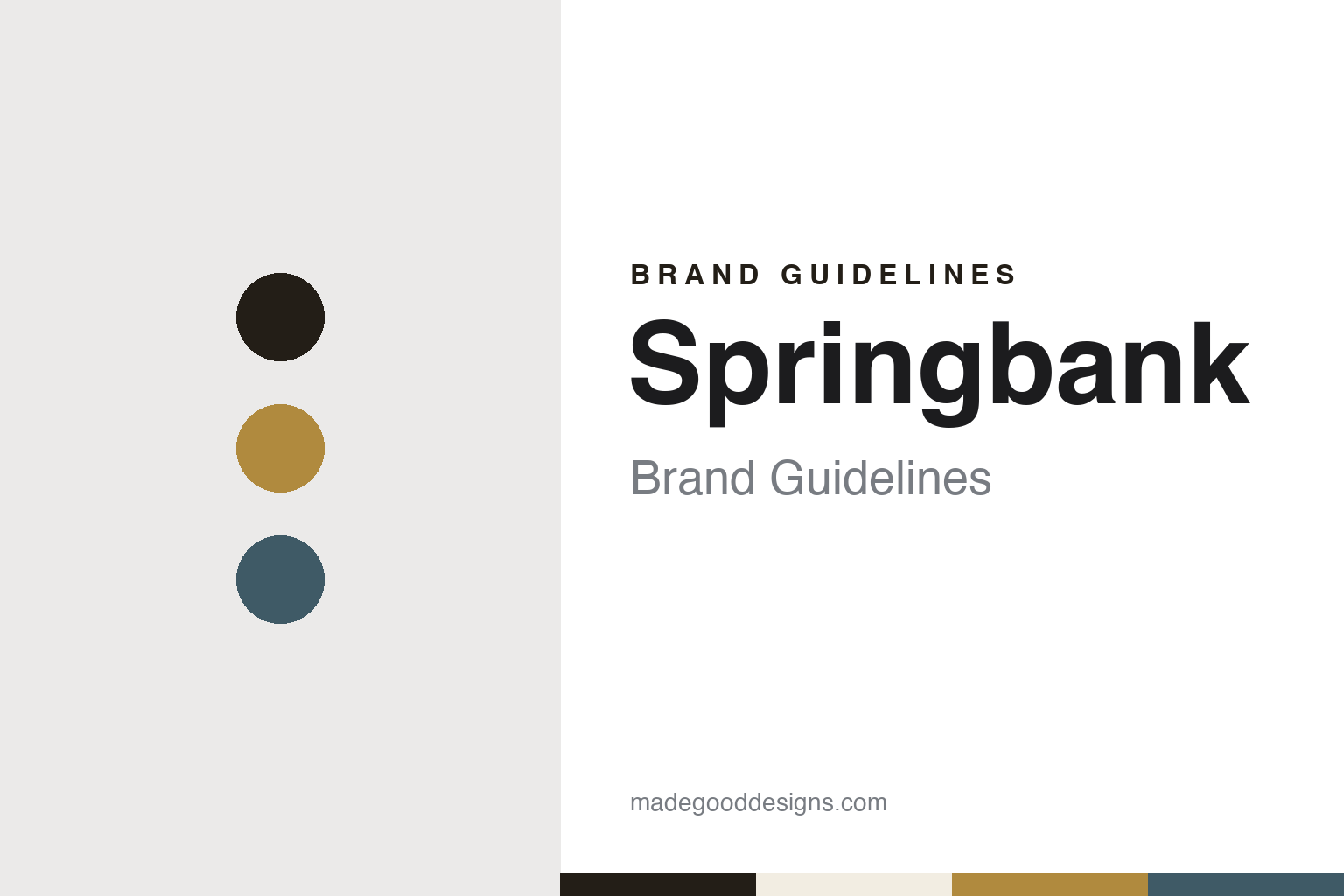
Springbank Brand Guidelines
The Campbeltown single malt of the Mitchell family, since 1828.
Aa
Two constants: a peat brown, malt gold and barley white palette and an old-style bookish serif register. Abstract homage — not a Springbank product or mark; no bottle, label or logo is reproduced.
Campbeltown
A whisky town, a licence and a family of maltsters.
Springbank stands in Campbeltown, the harbour town near the foot of the Kintyre peninsula in the west of Scotland. English Wikipedia describes the district as an area that once had more than thirty active distilleries; the company’s own timeline says 22 legal distilleries were working around the town by 1814. Springbank was licensed in 1828, and it is one of the few Campbeltown distilleries still producing.
Who founded it depends on the source. The company’s timeline says the Mitchell family came to Campbeltown from the Lowlands in the 1660s, that some of them were already maltsters, and that Springbank was built on the site of an illicit still used by Archibald Mitchell, becoming the fourteenth licensed distillery in the town. English Wikipedia and the Whiskypedia profile on Scotchwhisky.com instead name the Reid family as the first licence holders, with Whiskypedia naming William Reid and describing the Mitchells as his in-laws. Both accounts agree on the next step: in 1837 the distillery passed to the brothers John and William Mitchell, whom the company identifies as Archibald’s sons.
The family name on the business came a generation later. The company says John took his son into the business, forming J&A Mitchell; Whiskypedia names the son as Alexander and dates the founding of J&A Mitchell & Company to 1897. English Wikipedia, citing the London Gazette of November 1872, records that the partnership of John and William Mitchell was dissolved that year, with John keeping Springbank and William going on to build the Glengyle distillery nearby, which the company dates to 1872. The company also records that John Walker of Kilmarnock bought Springbank whisky in 1838.
Colour
Floor maltings, three stills and three names.
Springbank’s reputation rests heavily on how much of the work it keeps on one site. The Whiskypedia profile on Scotchwhisky.com calls it “the only distillery in Scotland to malt, distil, mature and bottle on the same site,” and English Wikipedia makes the same claim, adding that its traditional malting floor supplies all of its barley needs. Whiskypedia says the maltings closed in 1960 and reopened in 1992. English Wikipedia, citing the company and the Scotch Malt Whisky Society, says the barley is dried with peat from Islay for different lengths of time to give three levels of smoke.
Those three levels become three names. Springbank itself is medium-peated and, English Wikipedia says, distilled “two and a half times”, with part of the spirit going through the stills twice and part three times. Longrow, heavily peated and double-distilled, was first distilled in 1973; the company says it proved an Islay-style single malt could be made on the mainland. Hazelburn, unpeated and triple-distilled, was first distilled in 1997. Longrow and Hazelburn both take their names from former Campbeltown distilleries, English Wikipedia says, and Longrow was named Best Campbeltown Single Malt at the 2013 World Whiskies Awards. English Wikipedia, citing the company, says none of the malts is chill-filtered or coloured.
The distillery’s path through the twentieth century was uneven. English Wikipedia records storm damage in 1883 and 1904, and a shutdown in 1926 blamed on the effects of American Prohibition; it dates the restart to 1936, while Whiskypedia gives 1933. Springbank closed again in 1979. The company says production in the 1980s was sporadic at best and that regular production resumed in 1989; Whiskypedia records a limited run from 1987, after which the then owner, Hedley G. Wright, stopped selling to blenders and concentrated on single malt. English Wikipedia says most of the spirit is still bottled as single malt, with a small share going to blenders or to J&A Mitchell’s own blends such as Campbeltown Loch.
Typography
Design and documentation.
The seven brands in this group are all Scotch single malts: The Balvenie, Glenfarclas, Aberlour, Bowmore, Bruichladdich, Oban and Springbank. Single malt brands in general sit at many different points in the trade, from family companies that still own their distillery to names that now belong to much larger drinks groups, and a single brand can be sold everywhere from a corner shop to a specialist whisky bar.
A single malt’s identity is usually carried less by a single bottle than by a label, a name and the place it promises, because the company behind the name may have changed hands, changed how it makes its whisky or grown far beyond the place where it started. That makes the questions behind each name worth asking plainly: who started it, who owns it now, and where its whisky is actually distilled, matured and bottled.
Each guide separates what independent sources record from what the company says about itself — its founding story, its owners over time, where its whisky is made and how its labels have changed — and marks plainly what rests only on the company’s own word.
Springbank
An old-style, bookish serif for a family distillery that has kept its name since 1828. (Specimen set in Libre Caslon Text, a serif STAND-IN; NOT the Springbank logo or label lettering.)
J&A Mitchell
A family company, a second distillery and a trust.
Springbank is still owned by J&A Mitchell & Company, a private company based in Campbeltown. Whiskypedia says it bought the independent bottler Cadenhead’s in 1969; English Wikipedia describes William Cadenhead as the oldest independent bottler. In 2000, the company says, its chairman Hedley G. Wright, a great-great-grandson of Archibald Mitchell, bought the old Glengyle buildings, bringing them back into the Mitchell family line. The rebuilt distillery ran its first distillation in 2004, which the company describes as the first new distillery in Campbeltown in more than a century. Its whisky is sold as Kilkerran, because, English Wikipedia says, the Glengyle name belongs to Loch Lomond Distillers. The company also says it paused production for six months in 2008 to build new warehousing, resuming in 2009.
The company passed to a new arrangement in 2023. WhiskyCast reported in August 2023 that Hedley G. Wright, the long-serving chairman of J&A Mitchell, had died that month, and that years earlier he had placed most of the company’s shares into a trust intended to protect its independence and let its profits fund projects in Campbeltown; the company told WhiskyCast there would be no change to its structure or day-to-day running. The company’s timeline says ownership was placed into three trust funds and that a family member joined the board to keep the family link. WhiskyCast also credited Wright with leading the effort to keep Campbeltown recognised as a distinct Scotch whisky region. The company says Springbank is today one of three distilleries working in the Campbeltown area.
For a design guide, Springbank shows how a small family distillery can build one identity around a single place and carry it across three names. Compare Glenfiddich, the family-owned Dufftown single malt, The Macallan of Speyside, and the Islay distilleries Bowmore and Bruichladdich. For this guide we use a peat brown, a malt gold and a barley white with an old-style serif, an unofficial interpretation; no product or logo is reproduced.
Explore & save
Keep Springbank’s identity on hand — save it to a board in the Made Good inspiration library.
Springbank identity set
Pin the Springbank peat brown, malt gold and barley white palette and the old-style bookish serif register to your own board.