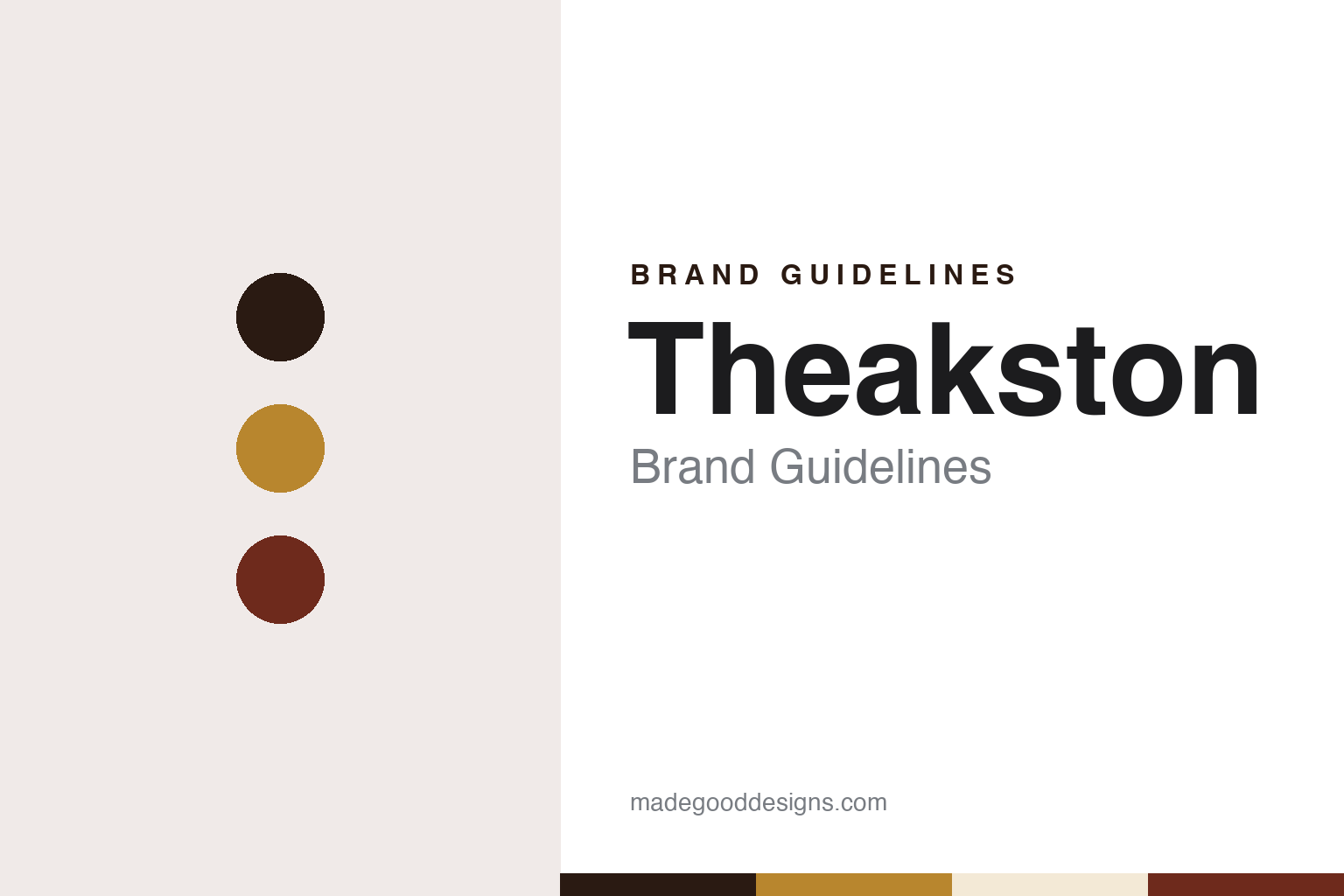
Theakston Brand Guidelines
The Masham brewery of Old Peculier, back in family hands since 2003.
Aa
Two constants: a Peculier black, brewhouse red and cask oak gold palette and an old-style serif register. Abstract homage — not a Theakston product or mark; no label, seal, logo or bottle is reproduced.
A Black Bull in Masham
From an inn cellar to a Victorian tower brewery on Paradise Fields.
Theakston is one of the oldest names in Yorkshire brewing. English Wikipedia says the business was founded in 1827 by Robert Theakston and a partner, John Wood, at the Black Bull pub and brewhouse in College Lane, Masham, a market town in North Yorkshire, and that by 1832 Theakston was the sole owner. The beer writer Roger Protz gave the same start, 1827 at the Black Bull inn, in a 2004 feature on the brewery.
The second generation gave the company its name. According to English Wikipedia, control passed in 1875 to Robert’s sons Thomas and Robert, who formed the T&R Theakston partnership and built a new brewery on Paradise Fields, near the original site. The company says that Victorian brewery is still in use today, and that it draws its brewing water from its own well beneath it. The company says T&R Theakston became a limited company in 1905.
The firm grew by buying its neighbour. English Wikipedia and Protz both record that in 1919 Theakston bought the Lightfoot brewery, its rival in the same town. The company says it bought its first pubs in 1935 and built an estate of 25 pubs in North Yorkshire. English Wikipedia links the next step to a revival of interest in cask ale from the 1960s; the company says it bought the government-owned Carlisle State Brewery in 1974 and moved some production there, and began exporting to the USA, the Netherlands and the Gulf states in 1976.
That expansion led to the brewery leaving the family. The company says Matthew Brown, a brewer based in Blackburn, acquired a controlling interest in 1984 after a family dispute, and Protz wrote in 2004 that Theakston agreed to merge with Matthew Brown that year. Scottish & Newcastle then bought Matthew Brown in 1987, and, Protz reported, closed the Blackburn site. English Wikipedia says some Theakston beers, including Best Bitter, were then brewed at Scottish & Newcastle’s Tyne Brewery in Newcastle.
Colour
A medieval church court, a knight’s seal and a deliberate spelling.
The brewery’s most famous beer carries its own piece of local history. Old Peculier, an old ale, is named after the Peculier of Masham, English Wikipedia says: a “peculier” was a parish outside the jurisdiction of a diocese, and Masham had its own church court. Protz explained in 2004 that the word comes from Norman French for “particular,” and that the brewery’s symbol is the seal of the Peculier Court, showing the medieval knight Sir Roger de Mowbray.
Old Peculier has collected its share of prizes. The company says it was named Champion Strong Ale of Britain at the Great British Beer Festival in 1990, and English Wikipedia records a silver medal in the Campaign for Real Ale’s Champion Winter Beer of Britain competition in 2000. The rest of the core range is plain and regional: English Wikipedia lists Best Bitter, XB, a dark mild, Lightfoot and Pale among the permanent beers, and the company says Barista Stout followed in 2015.
Casks are part of the identity too. English Wikipedia says Theakston is one of the few UK breweries that still has an in-house cooperage, making oak casks for Old Peculier. The company says its cooper, Euan Findlay, began a four-year apprenticeship in 2016 and was “trussed-in” as a qualified cooper in 2021, a ceremony English Wikipedia describes as the first of its kind in over 20 years.
The beer’s name has also travelled into books. In 2004, English Wikipedia and the company both say, Theakston became the title sponsor of the Theakston Old Peculier Crime Writing Festival in Harrogate, along with its Crime Novel of the Year award. When the family regained the brewery, Protz reported, it relaunched its beers on 7 October 2004 with new pump clips and labels for Mild, Best Bitter, XB, Old Peculier and Black Bull Bitter.
Typography
Design and documentation.
The seven brands in this group are all British beer names: Fuller’s, Greene King, Adnams, BrewDog, Theakston, Old Speckled Hen and Shepherd Neame. Beer brands in general sit at many different points in the trade, from family brewers that still carry a founder’s name to labels that now belong to much larger drinks groups, and a single brand can be sold everywhere from a corner shop to a pub bar.
A beer brand’s identity is usually carried less by a single bottle than by a pump clip, a label, a name and the place it promises, because the company behind the name may have changed hands, moved its brewing or grown far beyond the town where it started. That makes the questions behind each name worth asking plainly: who started it, who owns it now, and where its beer is actually brewed and packaged.
Each guide separates what independent sources record from what the company says about itself — its founding story, its owners over time, where its beer is brewed and how its labels have changed — and marks plainly what rests only on the company’s own word.
Aa
An old-style serif for a nineteenth-century brewery name. (Specimen set in Libre Caslon Text, a serif STAND-IN; NOT the Theakston logo.)
Theakston
A family brewery that bought itself back.
The return to family ownership came in autumn 2003. The Morning Advertiser reported on 22 October 2003 that heirs of the founder had regained control of T&R Theakston from Scottish Courage, the beer division of Scottish & Newcastle, after six weeks of talks. Simon Theakston and his brothers Nick, Tim and Edward joined the board, with Nick leading the negotiations, and Scottish Courage kept a minority shareholding and continued to distribute the beers. In a 2010 article, Protz reported that Best Bitter had returned to Masham from John Smith’s brewery in Tadcaster, that the family had restored it to its original strength after Scottish & Newcastle had lowered it in 1995, and that new fermenters had been installed.
The company says it added a fermenting room in 2005 that tripled capacity, and signed a long-term supply agreement with Heineken UK in 2013. In January 2024, it says, Simon Theakston became chairman of T&R Theakston Ltd and Richard Bradbury became managing director.
Masham has a second brewery with the same family name. Paul Theakston, who had been managing director of the family firm since 1968, left in 1988 and founded the separate Black Sheep Brewery in the town in 1991, English Wikipedia says; it is not part of T&R Theakston. The company’s own site is theakstons.co.uk.
For a design guide, Theakston shows how a brewery can draw its look from a single town: a medieval church court, a knight’s seal, a Victorian brewhouse and oak casks made on site. Compare Shepherd Neame, the family-owned brewery in Faversham, Kent, and Adnams, the Southwold brewer on the Suffolk coast. For this guide we use Peculier black, brewhouse red and cask oak gold with an old-style serif, an unofficial interpretation; no product or logo is reproduced.
Explore & save
Keep Theakston’s identity on hand — save it to a board in the Made Good inspiration library.
Theakston identity set
Pin the Theakston Peculier black, brewhouse red and cask oak gold palette and the old-style serif register to your own board.


