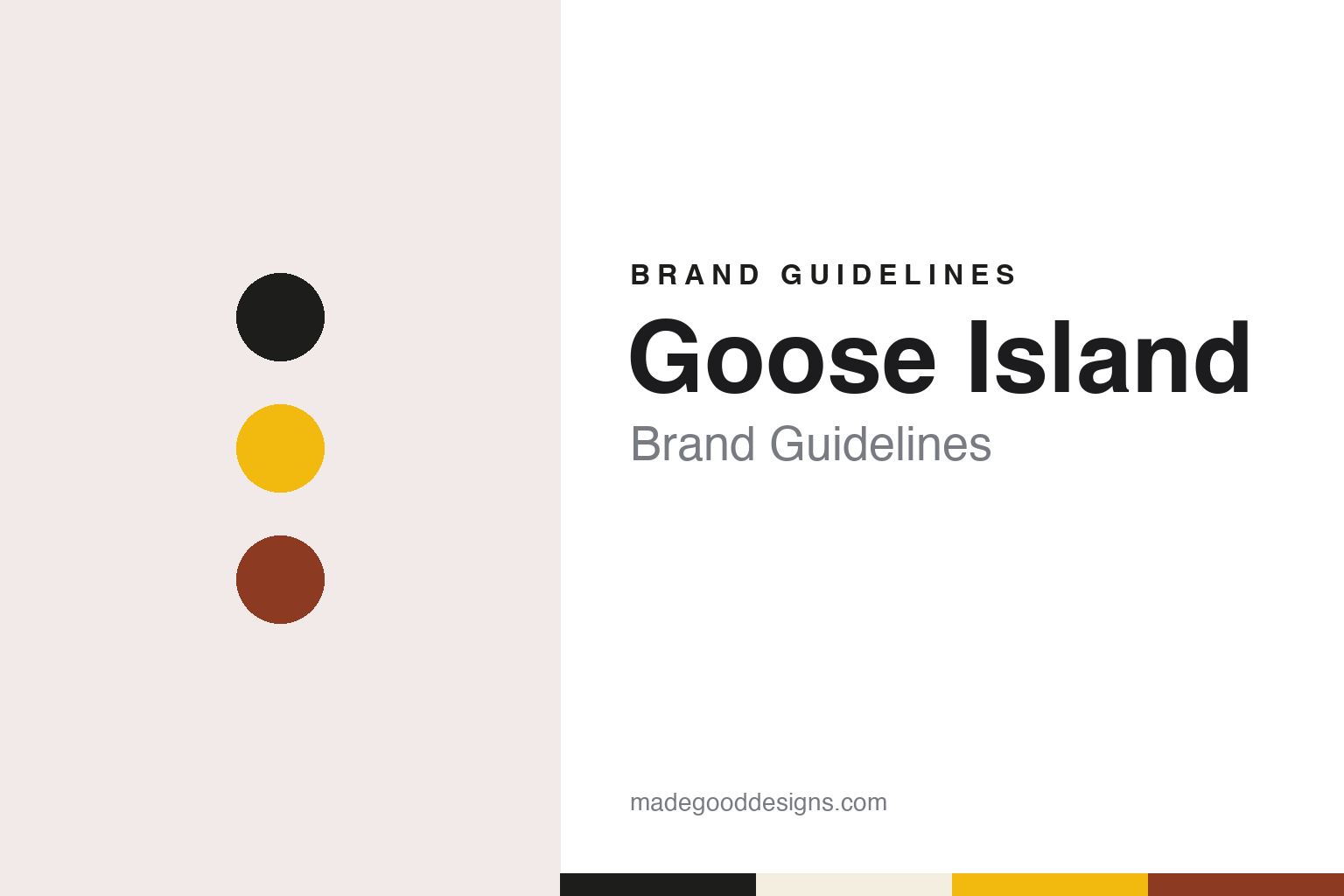
Goose Island Brand Guidelines
The Clybourn Avenue brewpub that became a Chicago beer brand.
Aa
Two constants: a goose black, wheat yellow and brick palette and a condensed urban sans register. Abstract homage — not a Goose Island product or mark; no label, logo or bottle is reproduced.
A brewpub on Clybourn Avenue
John Hall, an English pub idea and an island in the Chicago River.
Goose Island began in 1988 as a brewpub on Clybourn Avenue in Chicago’s Lincoln Park neighbourhood, opened by John Hall. Before brewing, Hall worked for the Chicago packaging company Container Corporation of America, the Iowa business publication Corridor Business reported, and English Wikipedia says his idea for the brewery was shaped by English brewing and pub culture. English Wikipedia says the brewery is named after a nearby island: Goose Island, in the north branch of the Chicago River.
The brewpub grew into a production brewery. English Wikipedia says a larger production brewery opened in 1995, and the company’s Fulton Street brewery, on the city’s West Side, has a taproom and offers tours. A second brewpub opened in Wrigleyville, near the Cubs’ ballpark, in 1999 and closed in 2015 to make way for development in the area, English Wikipedia says.
Hall’s son, Greg Hall, was the brewmaster until 2011. The core range came to include Honker’s Ale, an English-style bitter, Goose IPA and the wheat beer 312 Urban Wheat Ale. The 312 name is the city’s telephone area code, a point the Chicago Sun-Times returned to in 2013 under the headline “Is 312 still a Chicago beer?” Later came Belgian-style beers such as Sofie, a saison, and Matilda, a Belgian pale ale. In 2006 the founders sold a stake in the business to the Oregon brewer Widmer Brothers, English Wikipedia says, citing Crain’s Chicago Business.
Colour
A bourbon barrel, a thousandth batch and a stout released each November.
The brewery’s best-known beer is Bourbon County Stout, an imperial stout aged in used bourbon barrels. Goose Island dates it to 1992: the company’s account is that Greg Hall made it for the brewpub’s 1,000th batch, using barrels from the Jim Beam distillery after a beer, bourbon and cigar dinner at which he met Jim Beam’s master distiller Booker Noe. The date has been questioned in print. The beer writer Jeff Alworth examined the story in All About Beer in 2016, and Hall has called 1992 his best estimate, based on the brewpub’s average of about 200 brews a year from 1988; English Wikipedia notes that the stout may not have been produced until 1995. It is now released every year in late November, English Wikipedia says, and has grown into a family of barrel-aged variants.
The packaging has been reworked several times since the brand went national. The Chicago agency VSA Partners says it built a brand system for Goose Island after the Anheuser-Busch purchase that drew on the brewery’s urban roots and organised its beers around Chicago neighbourhoods. GDUSA credits VSA with a packaging redesign in 2014 that introduced the “urban textures” used across the range, and Packaging of the World credited VSA with the 2015 Bourbon County Stout bottle and label, for which the label maker Constantia Flexibles developed the flag-shaped neck label and back label, Packaging Digest reported. For the brewery’s 30th anniversary in 2018 VSA reinterpreted the textures on a limited dry-hopped 312 can, GDUSA reported.
The wheat beer has been redrawn again since. Craft Brew News reported in March 2026 that Goose Island had overhauled 312 Urban Wheat Ale with simpler packaging that keeps the beer’s yellow, a more prominent tagline, “It’s a Chicago Thing,” and a revised pack lineup. The typeface behind the Goose Island wordmark is the subject of a separate guide, What Font Does Goose Island Use?
Typography
Design and documentation.
The seven brands in this group are all beer names: Orval, Delirium Tremens, Kwak, Augustiner, Hofbräu, Schneider Weisse and Goose Island. Beer brands in general sit at many different points in the trade, from abbeys and family breweries that still carry an old name to labels that now belong to much larger brewing groups, and a single brand can be poured everywhere from a village café to a bar on another continent.
A beer brand’s identity is usually carried less by a single bottle than by a label, a name, a glass and the place it promises, because the company behind the name may have changed hands, moved its brewing or grown far beyond the town where it started. That makes the questions behind each name worth asking plainly: who started it, who owns it now, and where its beer is actually brewed and bottled.
Each guide separates what independent sources record from what the company says about itself — its founding story, its owners over time, where its beer is brewed and how its labels have changed — and marks plainly what rests only on the company’s own word.
Aa
A condensed urban sans for a brewery named after a river island. (Specimen set in Oswald, a condensed sans-serif STAND-IN; NOT the Goose Island logo.)
Goose Island
From a family brewpub to Anheuser-Busch.
On 28 March 2011 Anheuser-Busch announced that it would buy Goose Island, Chicago’s public radio station WBEZ and the trade site Brewbound reported. The deal combined a 58 per cent stake held by the founders and other investors with the 42 per cent held by Craft Brewers Alliance, the group that by then included Widmer Brothers. John Hall stayed on as chief executive, Brewbound reported; Greg Hall stepped down as brewmaster and Brett Porter took over, English Wikipedia says. The Clybourn brewpub was left out: Illinois law at the time did not allow Anheuser-Busch to own a brewpub, Brewbound later reported, so Hall and his partners kept it until its sale to Anheuser-Busch was announced in 2016, ending his involvement in the company he founded, the Chicago Tribune reported. The brewpub closed for renovation in January 2017 and reopened in October 2017 as the Goose Island Brewhouse, the Tribune reported.
Ownership brought scale. Chicagoist reported in July 2011 that production of 312 would move to Anheuser-Busch’s brewery in Baldwinsville, New York, freeing the Fulton Street brewery for other beers; in 2012 Brewbound reported that production would expand to the Anheuser-Busch brewery in Fort Collins, Colorado, and English Wikipedia says the beers have been sold in all 50 US states since 2012. English Wikipedia also lists Goose Island brewpubs abroad, in Shanghai, Toronto, São Paulo, Seoul and Dubai. Some of the 2015 Bourbon County Stout variants developed off-flavours, and Goose Island offered refunds in 2016, Chicagoist reported; a suit over that refund programme was dismissed by a federal court in Massachusetts in 2018, The Drinks Business reported.
The name has shared a shelf with other products: English Wikipedia says the WIT Beverage Company licensed it for a line of craft sodas until 2013, when they were renamed WBC Craft Sodas. Searches also meet Goose Island State Park on the Texas coast and the island itself, now an industrial district in Chicago; the brewery’s own site is gooseisland.com.
For a design guide, Goose Island shows how a brewpub can carry its city into packaging — an area code as a beer name, a river island as a brand name and textures taken from the streets — while production spreads far beyond Chicago. Compare Michelob, Anheuser-Busch’s own premium lager, and Hoegaarden, the Belgian wheat beer in the same AB InBev family. For this guide we use goose black, wheat yellow and brick with a condensed sans, an unofficial interpretation; no product or logo is reproduced.
Explore & save
Keep Goose Island’s identity on hand — save it to a board in the Made Good inspiration library.
Goose Island identity set
Pin the Goose Island goose black, wheat yellow and brick palette and the condensed urban sans register to your own board.


