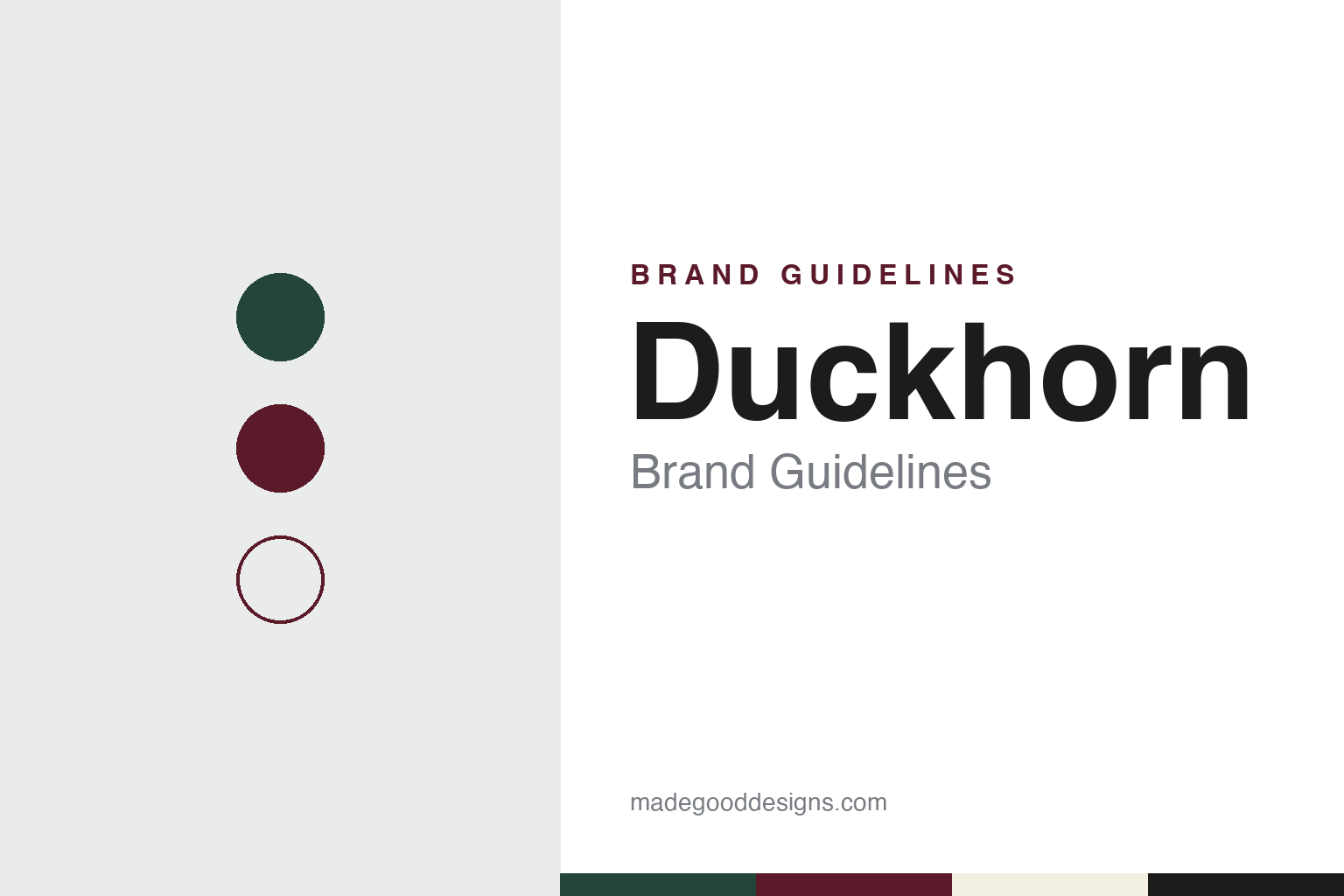
Duckhorn Brand Guidelines
A St. Helena winery that bet on Merlot in 1976.
Aa
Two constants: a mallard green, Merlot and label cream palette and a classic book serif register. Abstract homage — not a Duckhorn product or mark; no label, logo or bottle is reproduced.
A Merlot house in St. Helena
A couple, a group of investors and an unfashionable grape.
Duckhorn Vineyards was founded in 1976 by Dan and Margaret Duckhorn in St. Helena, in California’s Napa Valley. English Wikipedia says the business began as The St. Helena Wine Company, with eight co-investors alongside the couple, a group that later grew to about 80. The company says the original property was a 10-acre site in St. Helena that it named Marlee’s Vineyard after Margaret, and it describes Duckhorn as one of the first 40 wineries in the Napa Valley.
The first harvest came in 1978. The company says the Duckhorns and their founding winemaker, Tom Rinaldi, made Cabernet Sauvignon from the Stags Leap District and Howell Mountain and Merlot from the Three Palms Vineyard near Calistoga, 800 cases of each; English Wikipedia adds that the grapes were bought in and that the wines were released in 1980. Merlot was the bet. Trade obituaries of Margaret Duckhorn in November 2022, in The Tasting Panel and The Beverage Journal, said the couple believed Merlot was underappreciated in North America and championed it in California as a wine in its own right. The company today calls Duckhorn “the first American winery to pioneer luxury Merlot,” which is its own description.
The range widened slowly. The company dates its first Napa Valley Sauvignon Blanc to 1982 and its first wine labelled with the Howell Mountain appellation to 1989. For two decades tastings were by appointment only; the company says ground was broken on an Estate House and tasting room beside Marlee’s Vineyard in 1999, and that it opened in 2000. Later winemakers included Mark Beringer and Renée Ary, who joined in 2003 and was named winemaker in 2014, the fourth in the winery’s history, according to the company.
The grape that started the winery also gave it its best-known prize. Wine Spectator named the Duckhorn Three Palms Vineyard Merlot 2014 its Wine of the Year for 2017, a result recorded both by the company and by English Wikipedia. By then Duckhorn owned the vineyard: English Wikipedia says the winery had bought Merlot from Three Palms since 1976 and became its sole buyer in 2011, and the company says it acquired the vineyard in 2015.
Margaret Duckhorn spent much of her career on the industry’s behalf as well as the winery’s. Trade press reported that she was a past president of the Napa Valley Vintners, a past chair of the board of the Wine Institute and a founding member of Women for WineSense, and that she worked on marketing and public relations for the company. English Wikipedia says the Duckhorns remained active in management until 2016. Decanter and The Drinks Business reported in November 2022 that she had died in St. Helena.
Colour
A nineteenth-century lithograph, a mallard and a decoy.
The duck on the bottle grew out of the family name, but its drawing is older than the winery. English Wikipedia says the Duckhorn Vineyards label is based on a 19th-century French lithograph, and that the original label was created by Bill Cain, a graphic artist who was also a shareholder in the company.
The bird soon moved to a second brand. Atlas Obscura reported that Dan Duckhorn was a serious collector of wooden duck decoys and that the winery began making Decoy wines in 1985, with a mallard floating on a white background on the label. Decoy has since become a full range of red, white, rosé and sparkling wines, English Wikipedia says.
Other names followed as the company added wineries. English Wikipedia lists Paraduxx, a Napa Valley label for blends; Goldeneye, for Pinot Noir, Chardonnay and sparkling wine from the Anderson Valley in Mendocino County; and Migration, for wines from the Russian River Valley, Santa Maria Valley and elsewhere. Trade obituaries of Margaret Duckhorn also credited her with helping to establish Canvasback in Washington State. Goldeneye and canvasback are both names of North American ducks.
The company has guarded its bird in court. The Napa Valley Register reported in January 2013 that Duckhorn had filed a complaint against Duck Walk Vineyards, a winery on Long Island, alleging a breach of the 2003 settlement of an earlier trademark case between the two.
The anniversaries have been marked on the label too. The company says that every wine of the 2017 vintage carried a 40th Anniversary Harvest logo, and 2026 is the winery’s 50th year.
Typography
Design and documentation.
The seven brands in this group are all American wine names: Woodbridge, Josh Cellars, Meiomi, La Crema, Duckhorn, Caymus and Stag’s Leap Wine Cellars. American wine brands in general sit at many different points in the trade, from family houses that still carry a founder’s name to labels that now belong to much larger drinks groups, and a single brand can be sold everywhere from a corner shop to a restaurant list.
A wine brand’s identity is usually carried less by a single bottle than by a label, a name and the place it promises, because the company behind the name may have changed hands, moved its production or grown far beyond the place where it started. That makes the questions behind each name worth asking plainly: who started it, who owns it now, and where its wine is actually made and bottled.
Each guide separates what independent sources record from what the company says about itself — its founding story, its owners over time, where its wine is made and how its labels have changed — and marks plainly what rests only on the company’s own word.
Aa
A classic book serif for a label in the manner of an old print. (Specimen set in Libre Caslon Text, a serif STAND-IN; NOT the Duckhorn logo.)
The Duckhorn Portfolio
From a family winery to a group of Californian houses.
The winery became the core of a larger company in stages. English Wikipedia says a controlling interest was sold to the private equity firm GI Partners in July 2007, in a deal covering Duckhorn Vineyards, Goldeneye, Paraduxx, Migration, Decoy and Canvasback, and that GI Partners sold its interest to TSG Consumer Partners in 2016. Under that ownership the group bought the Central Coast Pinot Noir winery Calera, founded in 1975 by Josh Jensen, in 2017 and the Sonoma Pinot Noir house Kosta Browne in 2018, English Wikipedia says.
In March 2021 the company listed on the New York Stock Exchange as The Duckhorn Portfolio, under the ticker NAPA. It bought the Sonoma Chardonnay producer Sonoma-Cutrer from Brown-Forman in a deal that closed on 30 April 2024, both companies announced, leaving Brown-Forman with a minority stake. Later that year the company was taken private: Business Wire and Shanken News Daily reported on 24 December 2024 that Butterfly Equity had completed its acquisition and that the shares had stopped trading on the exchange. In January 2025 the company named Robert Hanson, a former Constellation Brands executive, as chief executive. Alex Ryan, who the company says first worked at the winery as a teenager in 1981, had led it as president from 2005.
The estate kept growing alongside the brands. The company says it added 40 acres of the El Veredicto vineyard in Los Carneros and the 10-acre Red Wing vineyard in St. Helena in 2022, and that the Duckhorn Vineyards estate in St. Helena closed for renovation in April 2026, with reopening planned for spring 2027. The winery’s own site is duckhorn.com; the group’s is duckhornportfolio.com.
For a design guide, Duckhorn shows how a family name, a duck drawn from an old lithograph and a single grape can anchor a Napa Valley winery for half a century and then lend their tone to a whole family of labels. Compare Caymus, the Wagner family’s Rutherford winery, and Stag’s Leap Wine Cellars, from the district that gave Duckhorn its first Cabernet. For this guide we use mallard green, Merlot and label cream with a serif, an unofficial interpretation; no product or logo is reproduced.
Explore & save
Keep Duckhorn’s identity on hand — save it to a board in the Made Good inspiration library.
Duckhorn identity set
Pin the Duckhorn mallard green, Merlot and label cream palette and the classic book serif register to your own board.