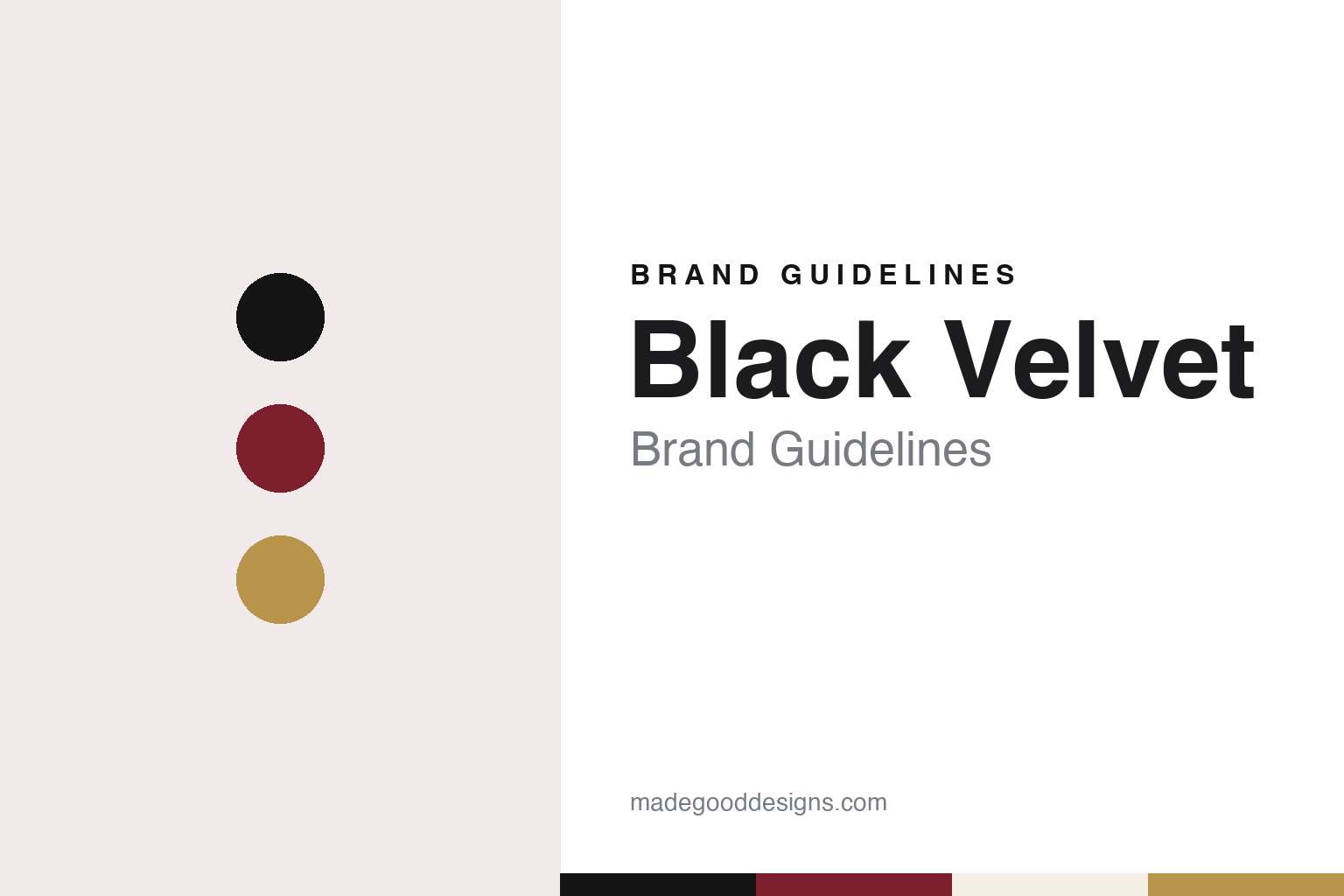
Black Velvet Brand Guidelines
Gilbey’s 1951 Canadian whisky, made in Lethbridge since 1973.
Aa
Two constants: a velvet black, rye red and barrel gold palette and a high-contrast serif register. Abstract homage — not a Black Velvet product or mark; no label, logo or bottle is reproduced.
A gin house tries whisky
From Gilbey’s gin stills to a blend of its own.
Black Velvet began with a gin company. English Wikipedia’s article on Canadian whisky says that W. & A. Gilbey, the London gin house, spent five years experimenting with whisky at its Toronto gin distillery before it created the Black Velvet blend in 1951. The brand’s owner at the time, writing on its own heritage page in 2019, said the whisky “first came out of the barrel in 1951.” Heaven Hill, the present owner, says on its brand page that the whisky was originally made in Quebec, so the early record is not entirely tidy.
The name is part of the brand’s own story. The company says the blend was first called Black Label, and that Jack Napier, the original distiller, renamed it Black Velvet after sampling the first batch, because he found the taste velvety and smooth. That account comes from the company, and it is the one the brand has repeated for decades.
The blend sold well enough to need a home of its own. English Wikipedia says the whisky was so successful that a new distillery was built in Lethbridge, in southern Alberta, in 1973 to produce it. The site, first known as the Palliser Distillery, is now called the Black Velvet Distillery; the Canadian whisky writer Davin de Kergommeaux, cited by English Wikipedia, describes most of its whisky being shipped in bulk to be bottled in the United States, with some bottled on site for Canadian drinkers.
The ownership chain followed the consolidation of the drinks industry. English Wikipedia says Grand Metropolitan bought Black Velvet in 1972. Grand Metropolitan merged with Guinness in 1997 to form Diageo, and in 1999 the distillery and the brand were sold to Canandaigua Brands, the company now called Constellation Brands.
Colour
A smooth name, a black label and a whisky blended young.
The brand has always sold itself on a single word. “Velvet” describes a texture rather than a place or a person, and the company has leaned on it consistently: its heritage page in 2019 said the name was chosen to reflect the whisky’s “uncommon velvety taste and smoothness.” The earlier working name, Black Label, survives only in that story.
The company also explains how the whisky is made. On the same page it said that Black Velvet is distilled from rye, barley and corn and “blended at birth”: aged high wines are mixed with fresh base whisky and then returned to bourbon barrels to mature for at least three more years. Heaven Hill’s brand page today describes Black Velvet as a blended Canadian whisky bottled at 40 per cent alcohol and aged for at least three years in ex-bourbon casks.
The range has grown outward from the original blend. The company said in 2019 that Black Velvet Reserve, an older expression, was introduced in 1991, and that the whisky was sold in more than 55 countries. Most of its volume, though, is in the United States: The Spirits Business reported in 2019 that Black Velvet sold almost two million cases there in 2018, in a Canadian whisky category of around 16.8 million cases.
Heaven Hill calls Black Velvet the second best-selling Canadian whisky in the world, a claim The Spirits Business reported in August and November 2019 as Heaven Hill’s own.
Typography
Design and documentation.
The seven brands in this group are all whisky, schnapps and rum names: Black Velvet, Seagram’s 7 Crown, Alberta Premium, Lot No. 40, Rumple Minze, Dr. McGillicuddy’s and Bumbu. Whisky, schnapps and rum brands in general sit at many different points in the trade, from names that still carry a founder’s or a distillery’s story to labels that now belong to much larger drinks groups, and a single brand can be sold everywhere from a corner shop to a bar rail.
A spirits brand’s identity is usually carried less by a single bottle than by a label, a name and the place it promises, because the company behind the name may have changed hands, moved its production or grown far beyond the place where it started. That makes the questions behind each name worth asking plainly: who started it, who owns it now, and where its spirit is actually distilled and bottled.
Each guide separates what independent sources record from what the company says about itself — its founding story, its owners over time, where its spirit is made and how its labels have changed — and marks plainly what rests only on the company’s own word.
Aa
A high-contrast serif for a smooth, dark whisky name. (Specimen set in Playfair Display, a serif STAND-IN; NOT the Black Velvet logo.)
Black Velvet
A Kentucky family buys a Canadian whisky.
The latest owner is a bourbon distiller. The Spirits Business reported on 13 August 2019 that Constellation Brands had agreed to sell Black Velvet and its production facility in Lethbridge to Heaven Hill Brands, the family-owned distiller based in Kentucky. The deal also took in other Canadian whiskies made at the site, among them MacNaughton and McMasters, and the international business of the Schenley brands Golden Wedding and OFC. The same magazine reported on 4 November 2019 that the purchase was complete and included the distilling, ageing and bottling operations.
Heaven Hill framed the purchase as filling a gap. The Spirits Business quoted the company as saying the brand “fills an important gap” in its portfolio, and quoted its president, Max L. Shapira, saying the Heaven Hill family was proud to continue “the culture of Black Velvet.” The whisky that began in a Toronto gin distillery, and moved west to Alberta, now belongs to a company best known for Kentucky bourbon.
The name needs care online. “Black Velvet” is also the title of a 1989 song by the Canadian singer Alannah Myles, written by Christopher Ward and David Tyson, and the name of a cocktail of stout and sparkling wine that English Wikipedia, citing Salvatore Calabrese’s Classic Cocktails (1997), says was first mixed at Brooks’s Club in London in 1861. Neither has anything to do with the whisky.
For a design guide, Black Velvet shows how one tactile word, repeated for seven decades, can carry a Canadian whisky across owners, provinces and borders. Compare Alberta Premium, the rye whisky from Calgary, and Lot No. 40, the Canadian rye from Ontario. For this guide we use velvet black, rye red and barrel gold with a serif, an unofficial interpretation; no product or logo is reproduced.
Explore & save
Keep Black Velvet’s identity on hand — save it to a board in the Made Good inspiration library.
Black Velvet identity set
Pin the Black Velvet velvet black, rye red and barrel gold palette and the high-contrast serif register to your own board.