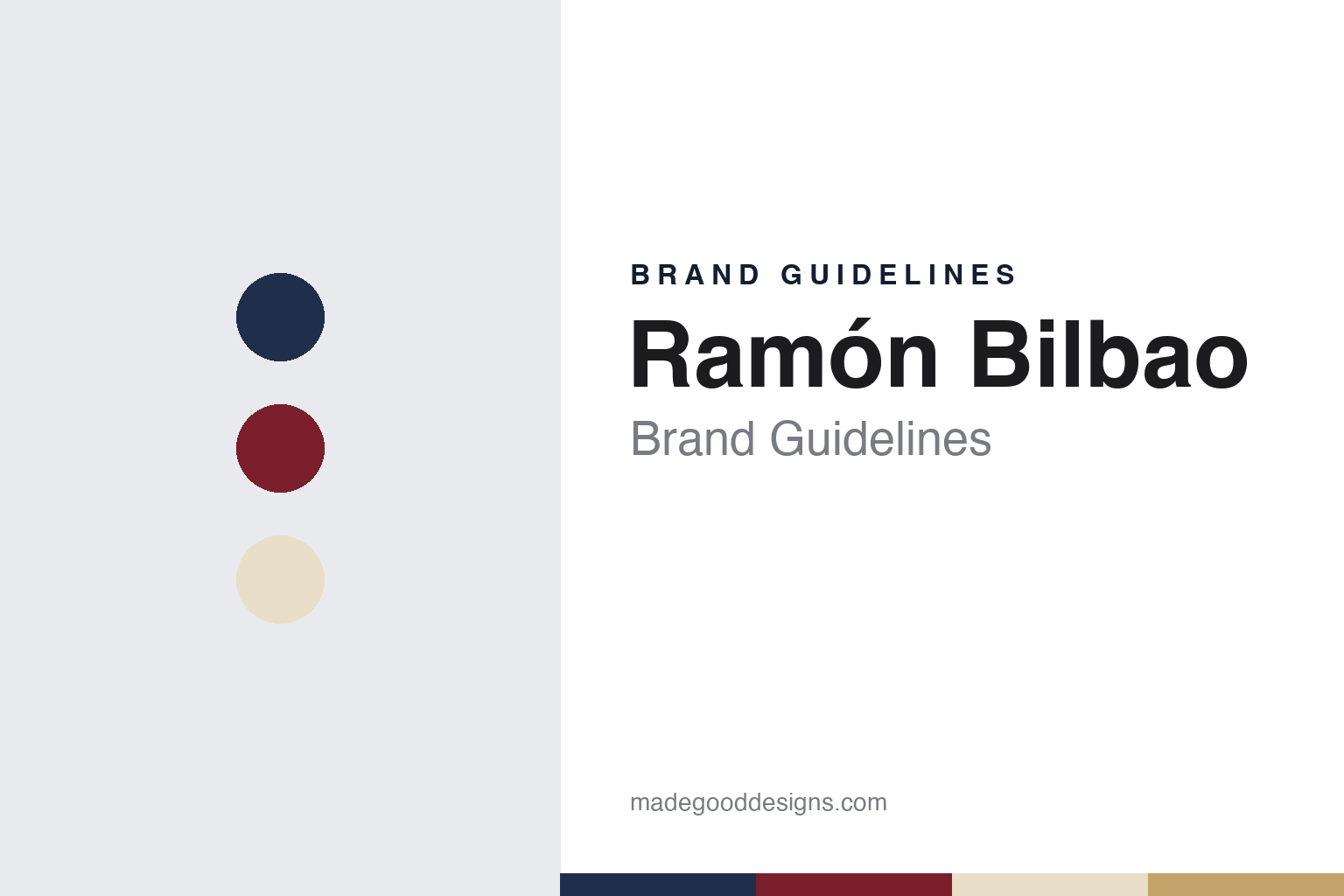
Ramón Bilbao Brand Guidelines
The Haro winery of 1924, with an explorer on the label.
Aa
Two constants: an engraving ink, Rioja red and map paper palette and an engraved transitional serif register. Abstract homage — not a Ramón Bilbao product or mark; no label, seal, illustration or bottle is reproduced.
A Haro winery and a liqueur family
Founded in 1924, bought by the makers of Licor 43 in 1999.
Bodegas Ramón Bilbao is a Rioja winery in Haro, the wine town of the Rioja Alta zone, and it carries the full name of its founder. Its owner, Zamora Company, dates the winery to 1924, and the German trade magazine Meininger’s gives the same year, describing a bodega founded in 1924 in the heart of Rioja Alta. Spanish wine retailers’ producer profiles give the founder’s full name as Ramón Bilbao Murga and place his first winery on the Calle Cuevas in Haro.
The modern chapter began in 1999. Zamora Company says that in that year, with Emilio Restoy as chairman, it diversified its range by acquiring the Ramón Bilbao winery, and later added Mar de Frades in Rías Baixas and Cruz de Alba in Ribera del Duero. The British wine writer Jamie Goode, writing on Wine Anorak in May 2020, likewise described Ramón Bilbao as part of the large drinks company Zamora since 1999.
Zamora itself grew from a liqueur. The company says that in 1946 the siblings Diego, Ángel and Josefina Zamora, with Josefina’s husband Emilio Restoy, began to produce and sell Licor 43, and that Diego Zamora was its first chairman. The group adopted a new name and corporate identity in 2017; Alimarket reported in September 2017 that Zamora Company was the new name of Grupo Zamora and described it as entirely family-owned, in its third generation. Its board today, the company says, is chaired by José María de Santiago Restoy, and members of the Zamora and Restoy families sit alongside an independent director.
Inside the winery, one name recurs across two decades of trade reporting: Rodolfo Bastida, quoted as managing director in the 2015 rebrand and described by The Drinks Business in January 2022 as the group’s chief winemaker.
Colour
An explorer, an RB seal and a double label.
The current look of Ramón Bilbao dates from a rebrand by Interbrand’s Madrid office, published by Packaging of the World on 25 May 2015. Interbrand said the winery had asked it for a brand strategy and a revival of its visual identity, and that the project began with a diagnosis of the market, the consumer and the old brand before a new positioning and brand architecture were drawn up. The credits list Borja Borrero as executive creative director, Carlos Magro as creative director, David Barrios and David de la Fuente as designers, and the freelance illustrator Alex Ferreiro.
The idea was a character. Interbrand chose the explorer as the archetype for the winery’s new phase and its international expansion, and wrote a piece of brand fiction in which Ramón Bilbao sets out in the spring of 1924 to see the world, paying his way with wine. The line “El viaje comienza aquí”, “The journey begins here”, became the winery’s corporate claim.
The mark was redrawn rather than replaced. Interbrand described the logo as an evolution of the brand’s traditional graphic icons towards something more timeless, modern and legible, with a monogram built from the letters RB and compacted inside a circle, so that the whole reads like a heraldic stamp. The illustrations were drawn in the manner of old engravings, set in the early twentieth century, showing stages of a fantastic journey by balloon and other improbable transport, with objects chosen to suit each wine. On the bottle they appear as a stamp within what the agency called the brand’s characteristic double label. A set of graphic rules governed how the character could be drawn, and the illustrations were carried into advertising, events and merchandising as well as packaging.
Carlos Magro said the challenge was to bring design into line with a brand with more than 90 years of tradition, and that recovering the founder’s audacity was the starting point. Zamora Company’s brand page now presents the wines under the line “Made For the Senses”.
Typography
Design and documentation.
The seven brands in this group are all Spanish and Portuguese wine names: Vega Sicilia, Muga, La Rioja Alta, Ramón Bilbao, Esporão, Casal Garcia and Aveleda. Wine brands in general sit at many different points in the trade, from family houses that still carry a founder’s name to labels that now belong to much larger drinks groups, and a single brand can be sold everywhere from a corner shop to a restaurant list.
A wine brand’s identity is usually carried less by a single bottle than by a label, a name and the place it promises, because the company behind the name may have changed hands, moved its production or grown far beyond the place where it started. That makes the questions behind each name worth asking plainly: who started it, who owns it now, and where its wine is actually made and bottled.
Each guide separates what independent sources record from what the company says about itself — its founding story, its owners over time, where its wine is made and how its labels have changed — and marks plainly what rests only on the company’s own word.
Aa
An engraved transitional serif for a brand drawn like an old print. (Specimen set in Libre Baskerville, a serif STAND-IN; NOT the Ramón Bilbao logo or monogram.)
Ramón Bilbao
From Haro to Rueda and a single-vineyard winery next door.
Under Zamora the winery has spread beyond its home appellation. Jamie Goode reported in 2020 that the Rueda venture was begun in 2015, after several years of making wine in the region with the local cooperative Diez Siglos de Verdejo. Alimarket reported on 12 September 2017 that Zamora Company had inaugurated Ramón Bilbao’s own Rueda winery at Finca Las Amedias, at 770 metres, with 60 hectares of Verdejo and Sauvignon Blanc vines. The Rueda whites now sit beside the Rioja reds in the range, which on Zamora Company’s brand page runs from the Crianza through Edición Limitada and Viñedos de Altura to Mirto.
The most ambitious project is Lalomba. The Drinks Business reported in January 2022 that Lalomba has its own team and its own winery next door to the main Ramón Bilbao facility in Haro, led by the project directors Alberto Saldón and Rosana Lisa, and that its first releases come from three sites: Finca Valhonta on the terraces of Villalba de Rioja in Rioja Alta, and Finca Ladero and Finca Lalinde on the slopes of the Sierra de Yerga in Rioja Oriental. The same report said Ramón Bilbao controls about 1,000 hectares of vineyard across Rioja and owns about 240 of them, and described the project’s ranks of tapering concrete vats.
The name needs a little care online. Bilbao is also the largest city of the Basque Country, but the winery is in Haro, in La Rioja, and the brand is spelled with an accent, Ramón.
For a design guide, Ramón Bilbao shows how an old family name can be given a fictional biography, an RB seal and an engraved world, and then carried by a drinks group from one Haro winery to Rueda and a single-vineyard range. Compare Licor 43, the liqueur on which Zamora Company was built, and Campo Viejo, the Rioja brand founded in 1959. For this guide we use engraving ink, Rioja red and map paper with a serif, an unofficial interpretation; no product or logo is reproduced.
Explore & save
Keep Ramón Bilbao’s identity on hand — save it to a board in the Made Good inspiration library.
Ramón Bilbao identity set
Pin the Ramón Bilbao engraving ink, Rioja red and map paper palette and the engraved transitional serif register to your own board.


