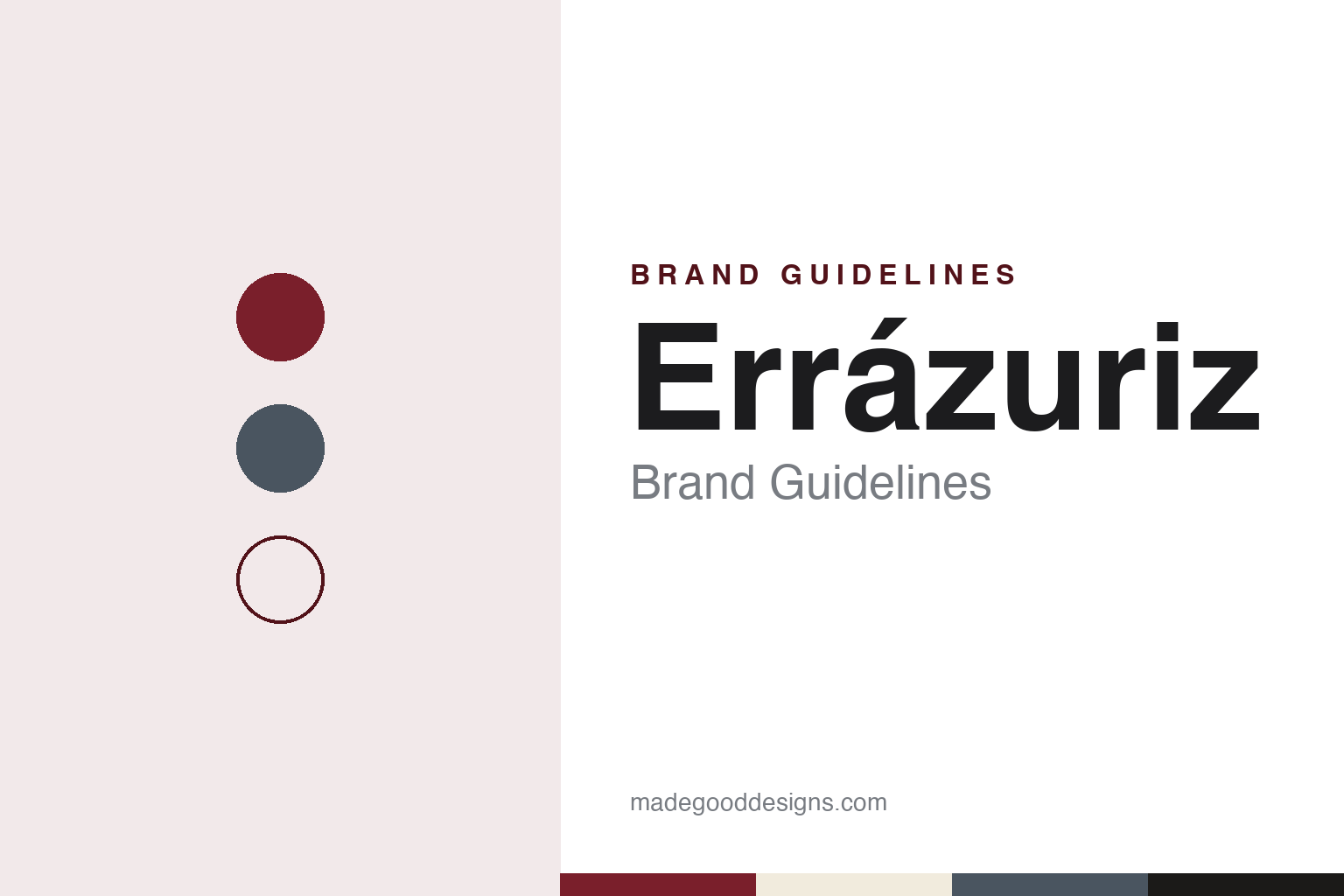
Errázuriz Brand Guidelines
The Panquehue wine house founded in 1870.
Aa
Two constants: an Aconcagua red, Andes slate and parchment palette and a classical book serif register. Abstract homage — not an Errázuriz product or mark; no label, logo or bottle is reproduced.
Don Maximiano
A politician, a vineyard and a cellar dug underground.
Viña Errázuriz dates from 1870, when Maximiano Errázuriz planted a vineyard on land he had bought at Panquehue, a small town north of Santiago in the Aconcagua Valley. English Wikipedia, drawing on the biography published by the Library of the National Congress of Chile, describes him as a politician, industrialist and surveyor who followed the example of his father-in-law, José Tomás Urmeneta, in planting vines. Spanish Wikipedia says he served as a senator between 1873 and 1882.
The vineyard was large from the start. English Wikipedia says Maximiano Errázuriz planted 300 hectares at Panquehue, and that his son Rafael later extended the plantings to 700 hectares — on the information of the time, the largest vineyard in the world in the hands of a single owner. In 1883, it says, Maximiano settled permanently at Panquehue, living in the estate’s administration house, building houses for his workers and founding a school and a church there.
The buildings of that era still matter to the brand. The historic Don Maximiano winery at Panquehue was first built in 1870, the British wine writer Jamie Goode wrote on his Wine Anorak site in December 2016, and its cellars were dug underground, a job that took about five years. The UK importer Hatch Mansfield places the estate about 100 kilometres north of the capital. The founder’s name lives on in the winery’s top wine, Don Maximiano Founder’s Reserve, and in the name of the estate itself.
Colour
The Chadwick family, Robert Mondavi and a tasting in Berlin.
The estate stayed in the founding family. Spanish Wikipedia, citing the Chilean outlet Interferencia in 2018, says Alfonso Chadwick Errázuriz recovered Viña Errázuriz, which came from his mother’s side of the family and had been fragmented by family divisions and by Chile’s agrarian reform. His son Eduardo Chadwick, of the fifth generation of the founding family, is president of Viña Errázuriz, English Wikipedia says, citing Wine Enthusiast in 2019; Spanish Wikipedia says the winery is controlled by the Chadwick family, and that its first premium wine, Don Maximiano Founder’s Reserve, was bottled in 1991.
Partnership with California followed. Seña — Spanish for a distinguishing mark or signature — began as a joint venture between Errázuriz and Robert Mondavi, with 1995 as its first vintage, English Wikipedia says, and a second joint venture, Arboleda, was set up in 1999, Decanter reported. When Constellation Brands bought the Robert Mondavi Corporation in 2004, the original agreement let either partner buy the other’s share, and in December 2004 Decanter reported that Eduardo Chadwick had bought Mondavi’s 50 per cent of both. Seña is made at Errázuriz’s Don Maximiano Estate winery in the Aconcagua Valley, English Wikipedia says. A further family wine, Viñedo Chadwick, comes from a former polo field in the Maipo Valley, turned into a vineyard in honour of Eduardo’s father, a polo player, Dine magazine wrote in 2019.
The family’s best-known moment came in Berlin on 23 January 2004. Eduardo Chadwick hosted a blind tasting with Steven Spurrier, inspired by the 1976 Judgment of Paris, Vino Joy News reported in 2024: 36 European wine experts tasted 16 wines — six from Chile, six from France and four from Italy. Viñedo Chadwick 2000 was placed first, Seña 2001 second and Château Lafite Rothschild 2000 third. Chadwick told Vino Joy News that the tasting grew out of frustration that critics were not recognising the quality of Chilean wine.
Typography
Design and documentation.
The seven brands in this group are all Argentine and Chilean wine names: Catena Zapata, Trapiche, Norton, Santa Rita, Montes, Errázuriz and Cono Sur. Wine brands in general sit at many different points in the trade, from family houses that still carry a founder’s name to labels that now belong to much larger drinks groups, and a single brand can be sold everywhere from a corner shop to a restaurant list.
A wine brand’s identity is usually carried less by a single bottle than by a label, a name and the place it promises, because the company behind the name may have changed hands, moved its production or grown far beyond the place where it started. That makes the questions behind each name worth asking plainly: who started it, who owns it now, and where its wine is actually made and bottled.
Each guide separates what independent sources record from what the company says about itself — its founding story, its owners over time, where its wine is made and how its labels have changed — and marks plainly what rests only on the company’s own word.
Aa
A classical book serif for a house founded in 1870. (Specimen set in Cormorant Garamond, a serif STAND-IN; NOT the Errázuriz logo.)
Errázuriz
Panquehue, a concrete icon winery and a family name.
Errázuriz grows grapes in the Aconcagua, Casablanca and Curicó valleys, English Wikipedia says, and its home is still Panquehue, where its Max vineyard lies beside the winery. In 2010 a new Don Maximiano “icon” winery opened there, designed by the architect Samuel Claro in bleached concrete and laid out so that juice and wine move by gravity, Jamie Goode wrote in 2016. Goode reported that the chief winemaker, Francisco Baettig, had moved the top wines toward a more classical, age-worthy style since 2010, using less new oak and picking earlier, and he tasted a Syrah from Aconcagua Costa, the zone nearer the Pacific, fermented in a concrete egg.
The wines travel far from the valley. English Wikipedia, citing Wine Enthusiast, says the company distributed its wines to 78 countries in 2019, and Spanish Wikipedia, citing Interferencia, names Europe, the United States and Asia as its main markets. Vino Joy News described Don Maximiano as the Errázuriz flagship in 2024, alongside KAI, a Carmenère.
The name needs care. Errázuriz is one of Chile’s best-known family names, carried by politicians including the founder’s half-brother Federico Errázuriz Zañartu, a candidate in the presidential election of 1871, English Wikipedia says. The winery spells its name with an accent on the first a — Errázuriz. Eduardo Chadwick’s paternal grandmother was an Errázuriz, Spanish Wikipedia says, which ties the family that leads the winery today to the founder’s name.
For a design guide, Errázuriz shows how a founder’s name, a historic cellar and a single blind tasting can anchor a family wine brand across more than 150 years. Compare Robert Mondavi, its former partner in Seña and Arboleda, and Château Lafite Rothschild, the Bordeaux estate placed third in Berlin in 2004. For this guide we use an Aconcagua red, an Andes slate and parchment with a serif, an unofficial interpretation; no product or logo is reproduced.
Explore & save
Keep Errázuriz’s identity on hand — save it to a board in the Made Good inspiration library.
Errázuriz identity set
Pin the Errázuriz Aconcagua red, Andes slate and parchment palette and the classical book serif register to your own board.