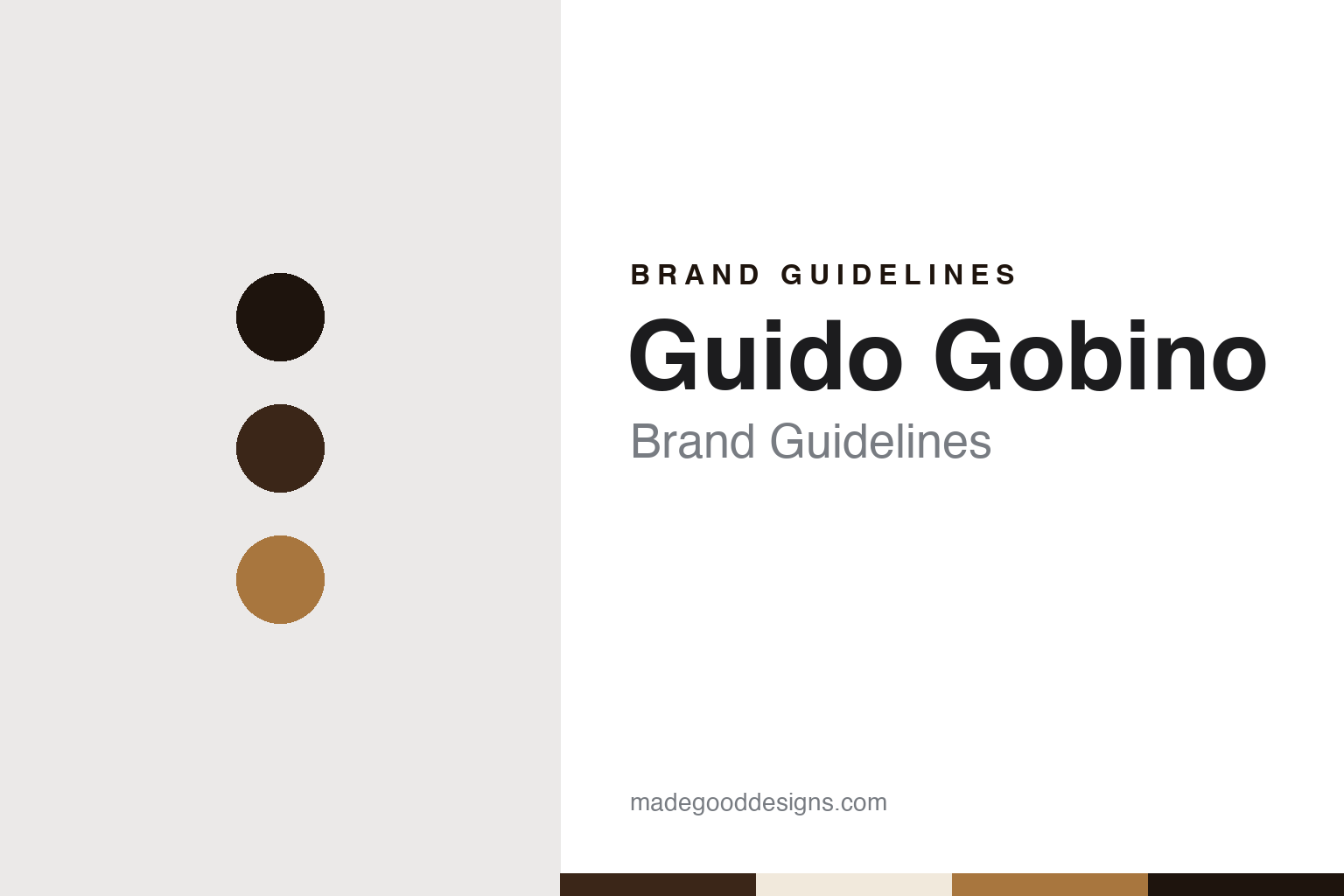
Guido Gobino Brand Guidelines
The Turin maker of the five-gram Tourinot.
Aa
Two constants: a Guido Gobino gianduja and hazelnut palette and a Clean sans register. Abstract homage — not a Guido Gobino product or mark; no wrapper, logo or packaging is reproduced.
Via Cagliari
A production director who became the owner.
Guido Gobino’s story begins in a Turin chocolate business the family did not found. The company says that in 1964 Giuseppe Gobino, who had worked in cocoa refining since 1950, joined Maras, a firm on Via Cagliari, as production director. He became its sole owner in 1980, and the business began to specialise in Turin’s own products, the giandujotto and gianduja cream. The company counts its history from 1964, and in 2024 marked the 60th anniversary of the Via Cagliari factory, which is still its production site and legal head office.
His son Guido Gobino joined in 1985. The company says he invested in the city’s signature chocolate, renamed the business Laboratorio Artigianale del Giandujotto — the artisan giandujotto workshop — modernised its machinery and brought attention to design into Turin chocolate for the first time; that last point is its own claim. The firm now trades as Guido Gobino S.r.l. A third generation, Pietro Gobino, joined in 2021, bringing, the company says, digitisation, internal training and an ESG team that published the firm’s first sustainability report. We found no outside shareholder in the sources we checked; the company presents itself as a family business of three generations.
The giandujotto is a Turin invention. Italian Wikipedia gives the usual account that Caffarel first made it and presented it at the Carnival of 1865, with hazelnuts standing in for scarce cocoa, and notes that the account is disputed. It also describes two ways of making it: extrusion, in which the paste is piped onto plates without moulds, and moulding, which it calls more industrial. Gobino extrudes.
Colour
Five grams of gianduja.
The brand’s signature is the Tourinot, a giandujotto shrunk to five grams, which the company likens to the miniature pastries of the Savoy tradition. Its current timeline dates it to 1995, and in 2020 it marked the 25th anniversary with a book by the Turin writer Giuseppe Culicchia, 5 grammi di felicità; its own website in 2002, preserved by the Internet Archive, said the Tourinot was “born in 1996.” It is made by extrusion, which Gobino says reproduces the shape once cut by hand with traditional knives.
Variations followed. The Tourinot Maximo, which the company dates to 1999 and which its 2002 website already called “the newborn of the family,” leaves out milk, following what Gobino describes as the original gianduja recipe of Piedmont hazelnuts, cocoa and sugar. The Tourinot Maximo +39 of 2010 contains more than 40 per cent Piedmont hazelnuts and is tempered by hand; the Tourinot N°10 of 2017 marked ten years of the shop on Via Lagrange; the Tourinot Bianco uses Sicilian almonds, orange peel and salt.
Ingredients are central to the brand’s claims. The company says it has worked directly with growers of the Tonda Gentile Trilobata hazelnut in the Langhe since 1997, and that Guido Gobino was named an ambassador for the Langhe hazelnut. In 2014 it began working with the Chontalpa cocoa growers of Mexico, a Slow Food Presidium, which it calls its first step toward a fully traceable cocoa supply. It says it makes its chocolate starting from the cocoa bean, giving it control of the whole chain, and in 2023 it made a single-origin giandujotto with Indonesian cocoa. It also says its salted cremino was named the world’s best praline by London’s Academy of Chocolate in 2008; we give that as its claim.
Typography
Design and documentation.
The seven brands in this group all make chocolate, and they come from three countries: Cacao Barry from France, Callebaut from Belgium, and Venchi, Caffarel, Majani, Guido Gobino and Slitti from Italy. They stand on either side of one of the oldest divides in the chocolate trade: between the chocolate that other people work with and the chocolate that is sold finished.
On one side is industrial couverture, chocolate made with enough cocoa butter to melt, temper and coat well, and sold in blocks, callets and pistoles to pastry chefs, chocolatiers, bakers and food manufacturers. A couverture brand often reaches the public second-hand, through a dessert, a bonbon or a filled biscuit, and its identity has to work on a sack in a professional kitchen as much as on a shelf. On the other side are confectionery houses, the Italian ones especially, whose names are on the box itself: pralines, gianduja, hazelnut spreads and filled bars, sold in their own shops and in fine-food stores, where the wrapper, the shop and the family name carry the brand.
Each guide separates what independent sources record from what the company says about itself — who founded it, who owns it now, where its beans come from and where its chocolate is made — and marks plainly what rests only on the company’s own word.
Aa
A clean sans — design as part of the recipe. (Specimen set in Jost, a sans STAND-IN; NOT the Guido Gobino logo.)
Guido Gobino
Design as an ingredient.
Design runs through the company’s own account. For Turin’s year as World Design Capital in 2008 it created N’UOVO, an Easter egg that it says is still made and admired for the lightness of its lines. In 2019, it says, it began working with Giorgio Armani; English Wikipedia’s article on Armani says the fashion house’s confectionery label, Armani/Dolci, works with Guido Gobino on its products. For the factory’s 60th anniversary in 2024 it opened its doors to young artists through a project called GugArt³ and another with the Artissima art fair.
Its retail is small and urban. The company lists the factory shop on Via Cagliari; a bottega on Via Lagrange in central Turin, opened in 2007 in the old-wood interior of a former stamp-and-sign maker; a second Turin shop in the historic premises of Platti on Corso Vittorio Emanuele II; and two shops in Milan, on Corso Garibaldi in Brera and on Corso Magenta. On packaging, it says its designs now favour alternatives to plastic, recycled and fully recyclable materials and fewer components; we found no named packaging designer in the sources we checked.
For a design guide, Guido Gobino shows how a small Turin maker can build a brand on one familiar shape made smaller: a five-gram giandujotto, its variations and a careful retail setting. Compare Caffarel, the Turin house credited with the first giandujotto, and Domori, a bean-to-bar maker based near Turin. For this guide we use a gianduja brown, a toasted hazelnut and a cream with a sans, an unofficial interpretation; no product or logo is reproduced.
Explore & save
Keep Guido Gobino’s identity on hand — save it to a board in the Made Good inspiration library.
Guido Gobino identity set
Pin the Guido Gobino gianduja and hazelnut palette and the Clean sans register to your own board.